

Though it has clear strengths that sometimes shine through, The Fix doesn't play into them often enough, and the viewing experience suffers for it.

Published Sep 10, 2026, 12:00 PM EDT
Alex is the Senior Editor of Reviews & Prestige Content, overseeing ScreenRant's film reviews as one of its Rotten Tomatoes-approved critics. After graduating from Brown University with a B.A. in English, he spent a locked-down year in Scotland completing a Master's in Film Studies from the University of Edinburgh, which he hears is a nice, lively city. He now lives in and works from Milan, Italy, conveniently a short train ride from the Venice Film Festival, which he first covered for SR in 2024.
When it comes to cinematic storytelling, the line between good and not good can be quite thin. Films like The Fix remind us of that by weaving back and forth over it. Co-writer and director Guy Moshe's genre cocktail mixes elements from war movies and espionage thrillers with some visual and tonal influences from Westerns, and when one of those rises to the top, things tend to click into place. When a firefight suddenly breaks out, or when the spy plot's endgame kicks off a flurry of activity, it feels as if the movie suddenly wakes up.
Unfortunately, that does imply it spends most of its time asleep. As a narrative, The Fix is misconceived and imbalanced, taking a premise with potential and devoting too much time to the wrong things about it. Star Zachary Levi is a poor fit for this material, and his performance, meant to channel the stoic, somber presence of many a Western hero, registers as inert. Combine those, and you're left with a thriller that fails to hold interest more often than it succeeds, and a film that is far less morally conflicted than it believes itself to be.
The Fix's Script Doesn't Live Up To Its Director's Ambitions
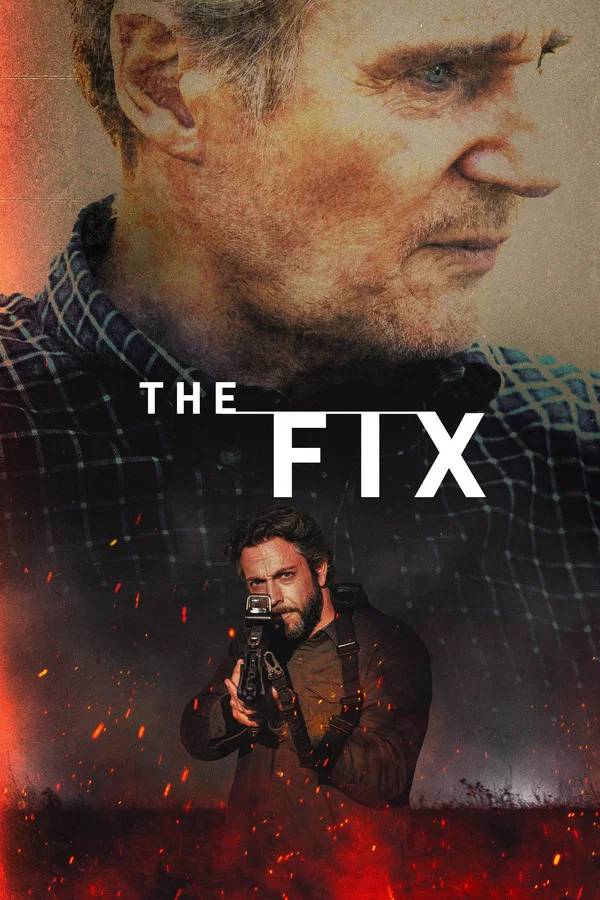
The story begins with an unfortunate episode during the US military's withdrawal from Afghanistan. CIA operative Tucker (Zachary Levi) and his team have been brought in by their handler, Larry (Liam Neeson), to extract a local informant and his family. With the exception of Clay (Quincy Isaiah), a hotshot young sniper brought in last minute to replace a fallen teammate, they all knew him; this mission is personal to them. But by the time they arrive, the Taliban have already made his location, and the ensuing shootout goes very, very wrong.
To make a bad situation worse, they weren't even supposed to be there – Larry, offended by his superiors' willingness to leave a dedicated source to the wolves, ignored direct orders to do nothing. Everyone but Clay suddenly finds themselves out of a job, with no severance or pension. And Larry, who had complained of worsening migraines during his last days in Afghanistan, finds that his memory is suddenly going. Whatever it is that's wrong, it's progressing fast.
Most problematically, the script just isn't good enough.
One day, some time later, Tucker is called to Larry's home, hopefully to bring him some comfort as a familiar face. But he mistakes him for an old, long-dead partner, and drops a big secret: They had hidden $25 million in the wall of a Tehran hotel room when the American embassy fell in '89. Tucker sees this as his chance to set things right for him and his team, and he gets the gang back together for one last mission. The catch? The only one who can tell them where the money is buried is an Iranian dissident in exile in Paris, and her one condition is that they extract her activist daughter before the Revolutionary Guard catches up to her.
It's a good set-up, but The Fix spends far too much time on it – the team doesn't arrive in Iran until nearly an hour into the film. Clearly, Moshe wanted to prioritize the grounded conversations between these people, rather than dive into the more sensational parts of the story right away, which is all well and good in principle. But that doesn't play into the movie's strengths.
Most problematically, the script just isn't good enough. When the team are chatting among themselves, and the dialogue is more about showing character and creating atmosphere than what they're actually saying, the film can feel natural and grounded. Whenever a scene has a clear, plot-driven goal that the dialogue must accomplish – which is most of the time – it's usually clunky. Whether that comes down to the lines themselves or their delivery is up for debate, but in either case, it ensures there's little chance for the quieter moments to generate much intrigue.
The Fix Miscast Its Lead Role, And The Whole Film Suffers For It

Zachary Levi's casting here also proves a liability. As a screen presence, he's far more successful when leaning into personality, which this role virtually drains him of entirely. For the strong, silent type to resonate, an actor must draw us inward, hinting at hidden depths that we yearn to see. Tucker never gets there. Levi does better with the moments when his character's bottled-up feelings burst free, but those are few by design, and he is far less interesting than he needs to be the rest of the time.
Philosophically, The Fix is muddled, not ambiguous...
This has implications beyond just the drama. Though it takes too long to get going, The Fix's spy story does have an extra gear saved for its third act, and the action sequences always manage to be urgent and engaging. Thematically, however, the film is quite confused. Tucker is a man who has done violent, traumatizing things for his country, only to have that country toss him aside. He is positioned as grappling with the complicated feelings the Afghanistan incident created in him, and whether he can still justify his actions. Through him, the movie itself aims to ask these same questions, and ultimately to live in a morally ambiguous space.
These ideas never manifest fully, however, almost as if the filmmakers are afraid to push them any further than flirtation. Philosophically, The Fix is muddled, not ambiguous – willing to suggest that Tucker's life has been devoted to a false cause without ever wanting to grapple with the implications of that. It's possible that another actor in this role could have performed the inner conflict in a way that lent some credibility to this idea. The movie we get simply doesn't do it justice.
The Fix releases in theaters on Friday, September 11.
Release Date September 11, 2026
Director Guy Moshe
Writers Mark Bacci, Guy Moshe, Ron Hutchinson
Producers David Lipper, Marina Grasic, Clay Pecorin, Guy Moshe, Matthew G. Zamias, Russell Geyser, Justin Oberman, Ryan Winterstern, Ryan Donnell Smith, Ryan D. Adams, Shalom Eisenbach, Wendy Sweetmore, Kevin Weisberg







 English (US) ·