
 3 hours ago
8
3 hours ago
8
For every reason except one, Once Upon a Time in Shaolin, the seventh album by the Wu-Tang Clan, should’ve been a commercial hit. The 31-track double album, recorded in secret between 2007 and 2013, reunited all of the remaining members of the hallowed Staten Island rap crew and featured eye-catching collaborators from the standard (Redman, offshoot group Wu-Tang Killa Bees) to the unexpected (Cher, Game of Thrones actor Carice van Houten). The sound, at least according to those involved, harkened back to the glory days of the group’s beginnings in the 90s.
But for years, almost no one heard it. The group only issued a single copy of Once Upon a Time in Shaolin – on CD, ensconced within layers of filigreed silver – with the stipulation, in legalese, that it could not be used for any commercial purposes for 88 years. The decree, either a stunt or a bold artistic statement on streaming’s devaluation of music, depending on your generosity and perhaps your net worth, succeeded in drumming up plenty of hype. And if you were anywhere around the blogosphere or cable news in 2015, you may recall that the beneficiary of that hype – the purchaser and thus single intended listener of this $2m musical treasure – was one Martin Shkreli, the “pharma bro” widely despised for gleefully hiking the costs of prescription drugs for profit.
A baseline level of fluency in these occasionally arcane events is assumed, if not required, for The Disciple: A Wu-Tang Fable, a new documentary which retraces the long saga of the buzzy single album, which still holds the record for the most valuable album ever sold, and its controversial producer. The film, directed by Joanna Natasegara (who won the best documentary short Oscar in 2016 for The White Helmets) and executive produced by de facto Wu-Tang leader RZA, in fact goes much farther back than those covert recording sessions in the late 2000s; The Disciple, casual fans and Shkreli rubberneckers may be surprised to learn, is less a rehashing of the album’s infamy than a subjective, meandering examination of its controversial producer, Tarik Azzougarh, the Dutch Moroccan rapper and Wu-Tang associate also known as Cilvaringz.
Azzougarh, who narrates much of the film built around his personal archive (the Disciple doubles as an evolution of digital self-recording, from camcorders to selfies), can be a compelling lead: an unnervingly even-keeled presence, at once well-connected and under-the-radar, who came to the Clan via unrelenting ambition, having connected to their music with fellow immigrant friends, as outsiders in largely white Holland. But centering the bulk of a 105-minute film around one somewhat reticent lead can also prove repetitive and dead-ending, extraneous digressions on the Clan’s Hong Kong film references or tours around Staten Island notwithstanding.
Natasegara banks on, and draws out, Azzougarh’s fervent yet vaguely described obsession with Wu-Tang, particularly RZA, his eventual infiltration of their scene by phone and by simply showing up, his later entrenchment in RZA’s inner circle. There’s certainly something fascinating, at once hopeful and maybe sinister, in the ascendance of the self-described “fanboy” to the right-hand man. (See: last year’s underrated film Lurker.) But with minimal input from other Wu-Tang members beyond vague recollections and niceties, there’s little grist in what amounts to a slightly complicated and one-sided love letter to a genuinely formative, culture-shifting group. Though blessed by RZA, the leader only appears in archival footage or in ponderous grayscale interludes before a chess board, as if the relationship between mentor and subject were tricky and adversarial, not largely symbiotic.
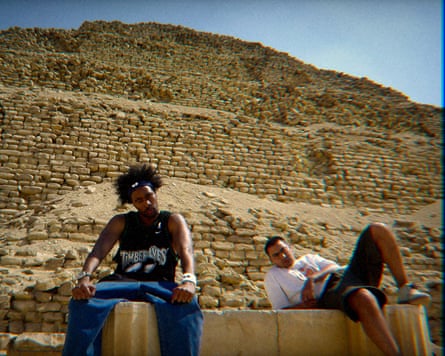
Things pick up, at least, once the secret project gets going, bringing up artistic questions – why is a Warhol painting valued in the millions but not music? Why do people feel entitled to music for free? – and the practical matter of making one’s money back. Azzougarh’s idea to release but one CD, as the Mona Lisa of albums, was radical, but a multidimensional chess game this was not. As Cyrus Bozorgmehr, a seemingly bon vivant adviser to the album, recalls in the film, “buyers wanted to know what was hype, what was just a headline, what happened when you got to the nitty-gritty. And the answer was, we had no idea.”
Shkreli, for those wondering, doesn’t enter the story until the final third – the “poorest” of the potential buyers, one subject recalls, with a reported net worth of just $200m. There’s probably some intriguing nugget here for those locked into the story – that Shkreli planned to film a video threatening Wu-Tang members with mock guns, for one – but The Disciple is not trying to generate clickbait or conflict.
It does not, however, generate much interest, either. The film gestures at many potentially fruitful deep dives – on the passage of time and the curdling of one’s ambition, on the relationship between artist and fan, or just more simply the disputes over how to handle a true rogue like Shkreli – but largely does not wander, keeping viewers instead on the glossy surface or stranded in long-winded stories about parties. It’s unclear, for instance, where Azzougarh and RZA stand now, though one can probably assume that both endorse the exhibitions now being held by PleasrDao, an NFT collective, who bought the album for $4.75m in 2021. For true fans – the ones who’d, say, fly to Tasmania to hear the album or be thrilled by a 30-second snippet in a documentary – there’s plenty here to keep one’s attention. For everyone else, it remains a crazy headline.
-
The Disciple is out now in select US and UK cinemas and is streaming on Netflix








 English (US) ·