
 5 hours ago
36
5 hours ago
36
To paraphrase a favorite pair of authors of mine: once is never, twice is always. Not sure where the third and fourth times something goes wrong rates.
Because that's how many times my Leica MP pulled my bulk-loaded film out of the canister. Not the camera's fault; instead, the cheap tape I've been using didn't seem to be holding up to the stress of those final few tugs of the film advance. The first time it was something important: two dozen arrests during a protest downtown. Thankfully the rest were less important, mostly technical shots for this lens review.
Still, not an auspicious start.
Anyway, a few weeks ago, 7Artisans announced the release of their 35mm f/2.8 LTM lens. Technically it's been around for a bit, but it's only now being released outside the Chinese market. I've been fascinated by not just this bit of glass, but the sheer persistence of the Leica Thread Mount (LTM, also known by the M39 mount). This design dates back 94 years to the introduction of the Leica I Model C, and the fact that production continues today for this mount with modern optical formulas is absolutely fascinating.
In their marketing literature, 7Artisans describes it as a perfect walking-around lens, a pancake lens with a natural perspective "closely resembling the way we see the world." In its simplest form, the lens is roughly 20 mm long; without the hood or UV filter it certainly fits the concept of a pancake lens, allowing the photographer to easily slip their cameras in and out of their coat pockets without worrying about bulk or snagging on something. The f/2.8-f/22 aperture has seven blades, and the optical construction features even elements in five groups. Out of the box, it comes with two different lens hoods (one narrower with a 34mm screw-on hood, the other deeper and tightening similar to the Leica FISON hood). The UV filter that comes with it is pleasantly thin and unobtrusive. I found the focusing smooth, with a push-button focusing lock and a pull from 0.7 meters (2.29 feet) to infinity. At 88 grams, it's sturdy but not particularly heavy.
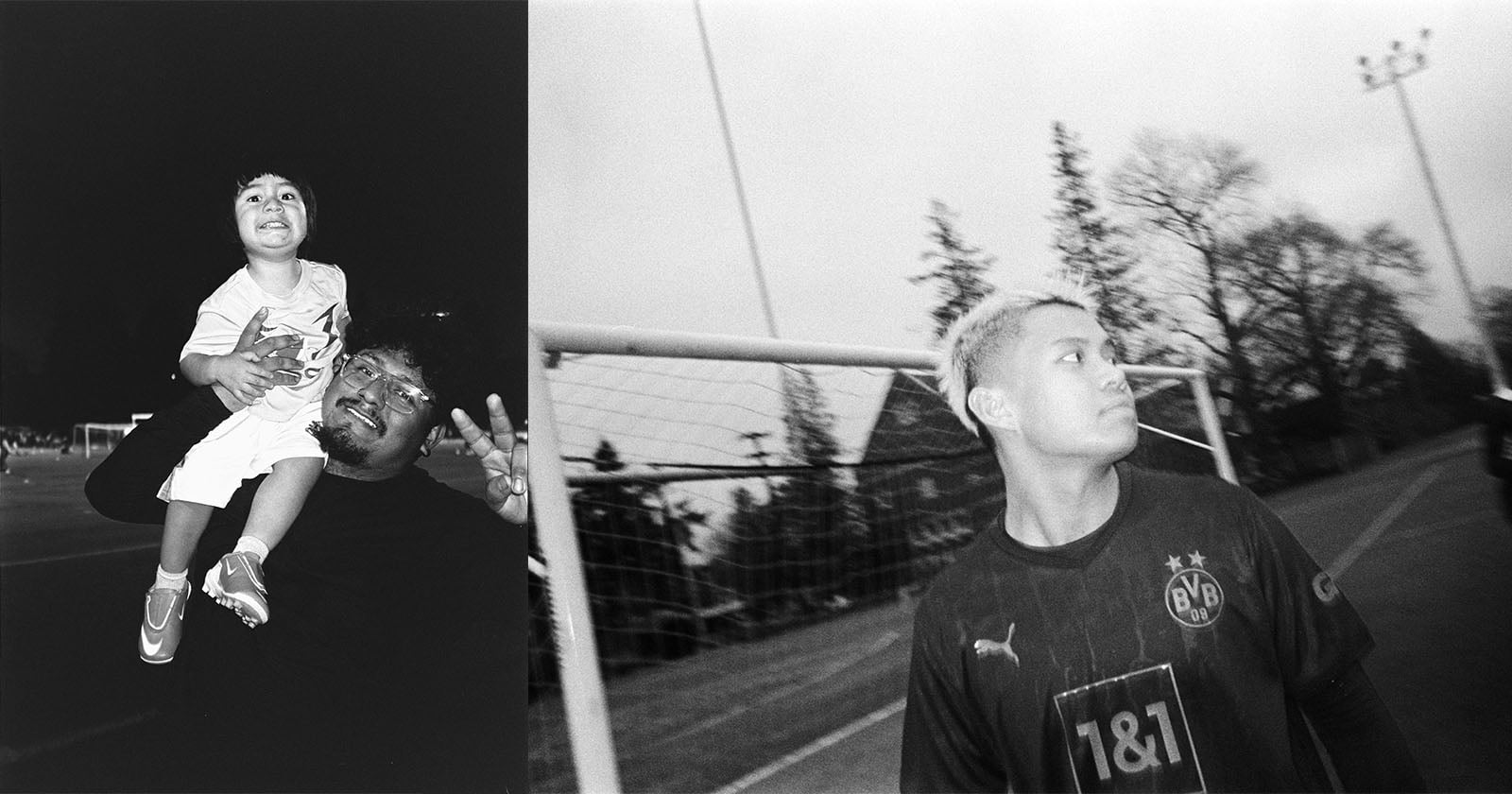
During my testing, I brought this lens out with me for several events, including a surprise May Day protest at Wall Street resulting in about two dozen arrests. And I wish I could provide those shots; they were interesting and exciting moments in a high-impact scene, the sort of thing a 35mm compact lens is ideal for. But again, my bulk film loading failed inside the camera and I wasn't able to extract it safely in my changing bag. Lesson learned, I suppose. I did, however, spend some time with an old buddy of mine photographing one of his projects. The lighting conditions were middling to okay, but the final shots were sharp and the exposure spot on. At f/2.8 I found the bokeh pleasant but not distracting; the sharpness was higher than I expected, save some light falloff at the edges and corners. Higher apertures up to f/5.6 or f/8 also result in excellent shots. Following that, I photographed an Armored League fighter near their training center in Harlem. Again, solid sharpness in the center with a slight falloff at the corners and edges. Vignetting was present but not overpowering at f/2.8, becoming much more manageable after f/4.
One issue that popped up, and has been discussed in other media, is that the lens has a tendency toward flaring in certain lighting conditions. I didn't encounter that in my shooting, but it's still worth noting.
One thing that I really appreciated was that the lens came calibrated. When I shot on the 75mm 1.25 II, I found an excellent bit of glass that arrived without calibration, resulting in a couple of rolls wasted during the Lunar New Year Parade. Calibration isn't particularly difficult, but it requires meticulous attention to detail, patience, and a fair amount of time. Thankfully, this lens didn't have any of those issues, and shot perfectly out of the box.
There are quite a few modern competitors to this lens, including the new Mandler 35mm f/2 (which I bought and am currently reviewing) and the Voigtländer 35mm f/2.5 Skopar. Over my career, I've accumulated quite a few Leica-mount 35mm lenses, honestly far more than I'll ever need. It's a great focal length: wide enough to give a sense of location but narrow enough for more intimate work. Each has its own unique flavor, and there are good arguments for any of them, but as a budget 35mm pancake lens this one stood out. It features modern, sharp optics. It's affordable and small, and it fits on both Barnack LTM and M-mount bodies, meaning you can use it on almost any camera from 1932 to today.
What makes this lens particularly interesting isn't just its optical performance, but the fact that it exists at all. The Leica Thread Mount ecosystem is nearly a century old, yet manufacturers continue to develop new lenses for it. For owners of Barnack Leicas, that means access to modern coatings, modern manufacturing tolerances, and readily available replacement parts without sacrificing compatibility with cameras that predate the Second World War. In an era when most camera equipment is obsolete within a decade, there is something refreshing about mounting a newly manufactured lens onto a camera designed nearly one hundred years ago and heading out to make photographs.
After several weeks of use, I found myself appreciating the lens less for its specifications and more for how little it demanded attention. The compact size keeps the camera balanced and unobtrusive, making it easy to carry for hours at a time. Unlike larger, faster lenses that can dominate a rangefinder body, the 35mm f/2.8 feels like it belongs there. It encourages a style of photography where the camera disappears into the background and the photographer can focus on the scene unfolding in front of them, a quality that has always made the 35mm focal length so popular among street and documentary photographers.
Ultimately, who is this lens designed for? Who is the end user? It's an affordable 35mm with a reasonably wide aperture, a lens formula resulting in tack-sharp photos with a pleasant separation of the subject from the background. It fits with almost any Leica rangefinder ever made, and can easily be adapted to modern mirrorless bodies. The classic look is functional but still fits with the classic Leica lineup of cameras. In many ways, this lens is designed for the photographer who simply wants to carry their camera more often. It's small enough to disappear into a coat pocket, affordable enough to justify as a daily-use lens, and versatile enough to work on everything from a 1930s Barnack Leica to a modern mirrorless body. For street photographers, travelers, and rangefinder enthusiasts who prioritize portability and practicality over maximum aperture, the 7Artisans 35mm f/2.8 LTM makes a strong case for itself.

 English (US) ·