
 2 hours ago
2
2 hours ago
2
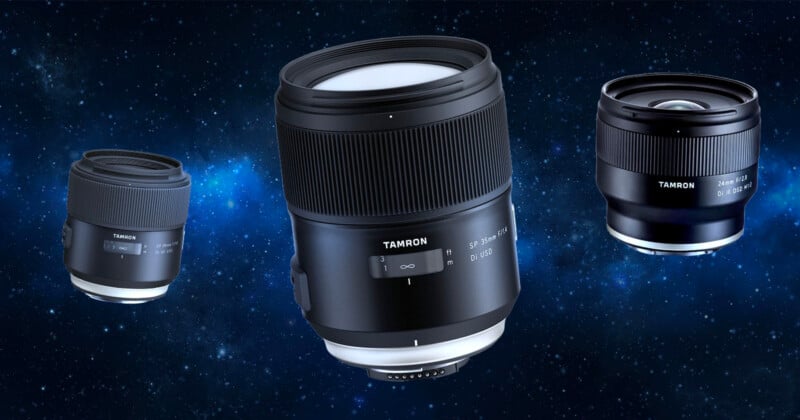
Tamron is focused on making lenses that no other manufacturer does. A consequence of this is that Tamron makes a lot of zoom lenses, although the company reiterated to PetaPixel at CP+ 2026 that it is not opposed to making new prime lenses, but it needs to be the right prime, a unique offering.
“Our goal at Tamron is to make lenses that no one else offers,” Nobuo Koganeya, Senior Executive Officer, General Manager, Tamron Imaging Products Business Unit, told PetaPixel at CP+ 2026 in Yokohama, Japan. “We believe the most important thing is to accurately identify and respond to increasingly diverse needs of our users.”
However, as Koganeya continued, it is not that Tamron exclusively cares about making distinct lenses, that is only part of the broader objective. The company’s priority during product planning and development is to deliver a high-quality product for users.
“However, more often than not, our pursuit of the ideal user experience naturally results in unique specifications, such as unconventional focal length ranges that differ from existing products on the market.”
Tamron solicits feedback from photographers across the market when planning future products, and the company says it frequently hears requests for new, different zoom lenses.
“It’s the feedback we get,” Koganeya said. “When we plan any product, our first step is always to define the target. That target is always user demands. We clarify exactly who the user is, the situations they will shoot, how they will use the lens, and what kind of images or videos they seek to create.”
As for prime lenses and Tamron’s relative lack of new ones over the past five-plus years, the company says delivering unique experiences is a significant challenge. Tamron released its excellent 90mm f/2.8 Di III Macro VXD lens in 2024, but before that, its last prime lenses were the 20mm f/2.8 Di III OSD M1:2, 24mm f/2.8 Di III OSD M1:2, and 35mm f/2.8 Di III OSD M1:2 full-frame half-macro primes released in October 2019. For those keeping score at home, that’s one prime lens in over six years. During that same period, Tamron released nearly 20 unique zoom lenses, plus brought existing lenses to new mounts.
 Tamron’s only prime lens released since late 2019 is 2024’s excellent 90mm f/2.8 Di III Macro VXD.
Last year, Tamron told PetaPixel that if its users demand more prime lenses, the company will certainly consider making them. The company said again this year that it has “absolutely not given up on developing prime lenses.” However, it is complicated.
“The needs for prime lenses are even more diverse than those for zooms,” Koganeya explained. “And the market is already filled with numerous options to meet those demands. So within this landscape, we must carefully consider what kind of a unique experience Tamron can provide to the users. To be honest, finding the perfect answer is an incredibly challenging path.”
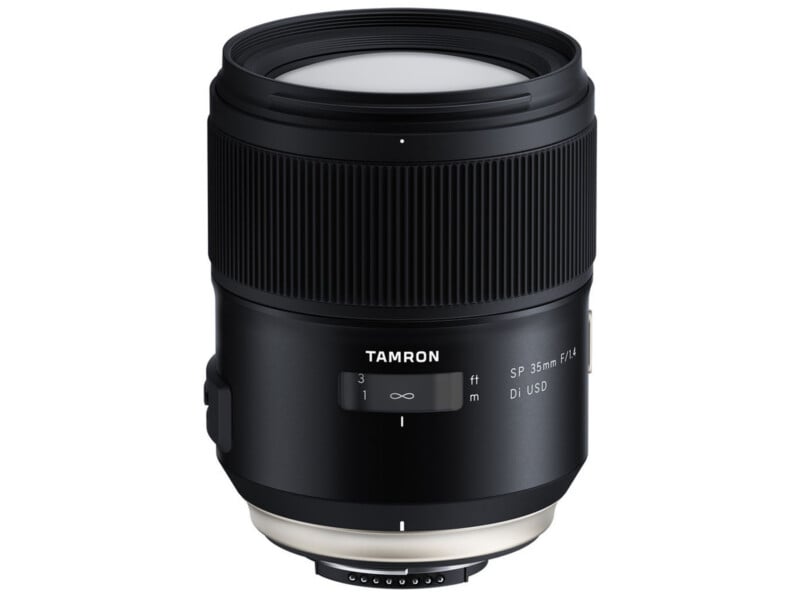 Tamron’s now-discontinued SP 35mm f/1.4 Di USD for Canon EF and Nikon F DSLR cameras may be a good example of the kind of lens Tamron isn’t interested in making, given how many 35mm f/1.4 primes are out there, but the lens also shows Tamron’s optical excellence. As Lensrentals’ Roger Cicala showed in 2019, Tamron can make phenomenal prime lenses. The company’s most recent prime, the SP 90mm f/2.8 Macro, tells a very similar story.
“We are committed to continuing our trials and explorations to ensure that when we do bring a prime lens to the market, it is a product that truly delights our users and meets our own high standard of innovation,” Koganeya concluded.
PetaPixel floated some ideas by Tamron at CP+, including mid-telephoto and telephoto prime lenses that prioritize compact, lightweight designs, rather than ultra-fast apertures. Tamron, ever the face of compact, lightweight lenses, often with 67mm filter threads, may be uniquely positioned to bring distinct lenses like a 135mm f/2, 105mm f/2.5, or 150mm f/2.5. “Slower” primes were common in the film era but have all but disappeared in the modern mirrorless age.
“We’ve been asking [companies], why would you not just make a slightly slower prime lens that is smaller, easier to handle, and more affordable?” PetaPixel told Tamron.
‘To be honest, finding the perfect answer is an incredibly challenging path.’
“That’s exactly what happened with our zoom lenses like that 28-75mm,” Koganeya responded. “Everybody else has 24-70mm, but we wanted to make it small, compact, lightweight, so that people can just carry it around all day.”
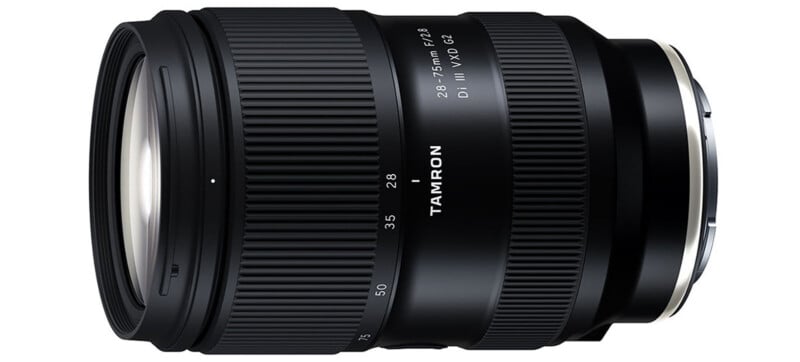 Tamron 28-75mm f/2.8 Di III VXD G2 | Credit: Tamron
“We are committed to expanding our lineup to meet the diverse needs of photographers all around the world,” Koganeya said. Perhaps one day that will mean more prime lenses. In any case, more distinct, high-quality zoom lenses in the spirit of the recent 35-100mm f/2.8 Di III VXD are a safe bet. No matter what Tamron does next, it will be at least a little different from the competition.
Image credits: Tamron. Header photo created using an asset licensed via Depositphotos.com.







 English (US) ·