Synopsys debuts Autopilot platform for developing chips autonomously using AI
3 weeks ago
47
(Image credit: Synopsys)
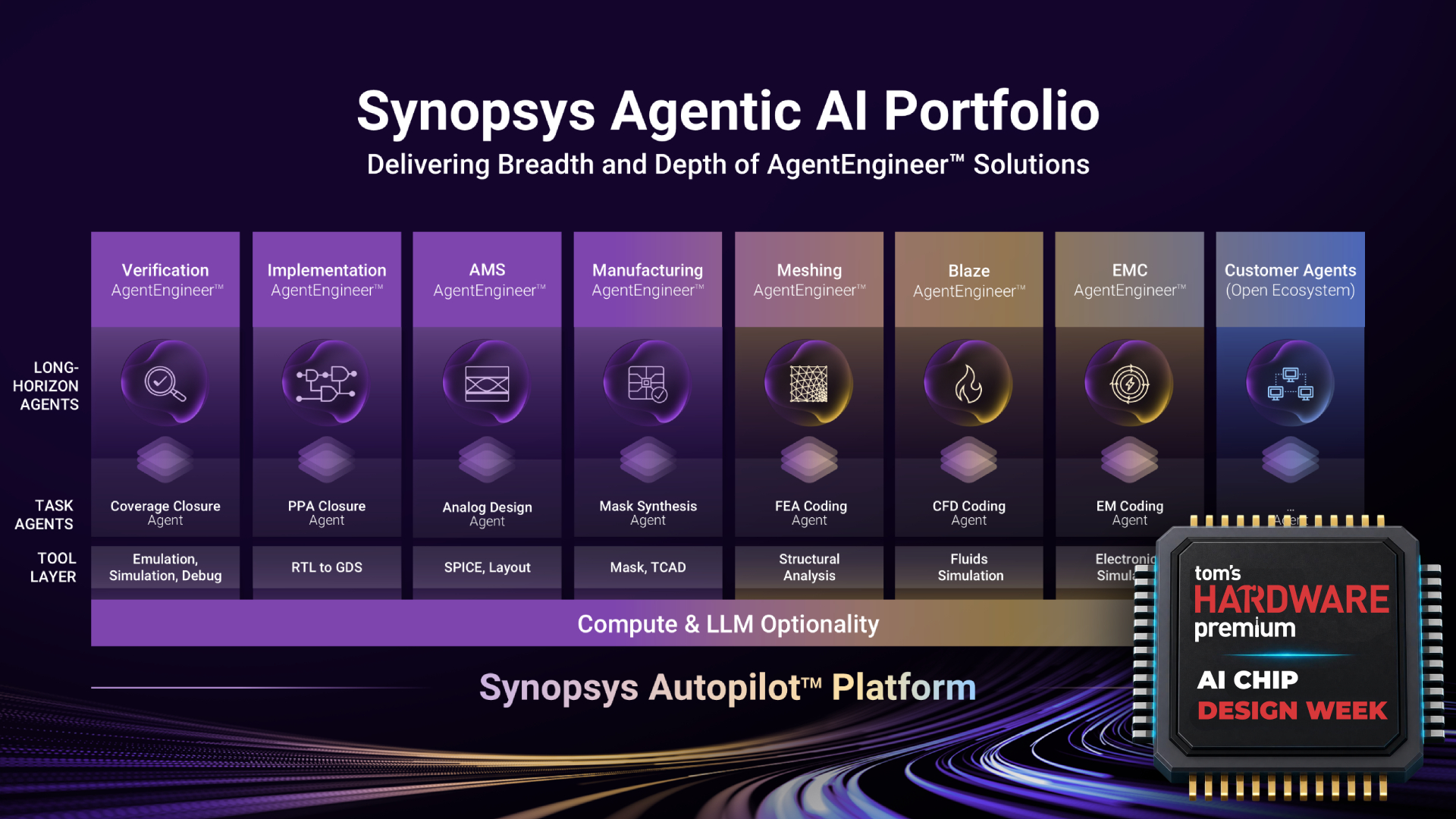
Synopsys announced its AgentEngineer solutions, a portfolio of “domain-specific long-horizon agents” built on its new Autopilot Platform. As the company details in a blog post, the portfolio covers six named domains: verification, system validation, implementation, analog and mixed-signal (AMS) design, manufacturing, and simulation and analysis. More than 50 customer engagements are underway, according to the company, and Synopsys confirmed to Tom’s Hardware Premium that general availability is planned for the end of 2026. This follows July, when the company showed agentic AI workflows developed with Nvidia and with Microsoft at DAC, the Design Automation Conference.
The launch brings Synopsys’ plans into focus with a named product line and a target date. The platform’s agents are clearly named and delineated, the engagement count points to customer interest, and a goal for general availability anchors a roadmap for autonomous agents in production. Two of the headline performance figures are restated from July, and the only named customer figure is one company’s range. While Synopsys describes the agents as autonomous, the approval checkpoints remain with humans, the company said.
For companies designing and producing chips who want to leverage the potential efficiency gains of AI, this technology allows them to “accelerate their shift from AI-assisted design to autonomous engineering,” said Ravi Subramanian, chief product management officer at Synopsys.
Swipe to scroll horizontally
Synopsys AgentEngineer portfolio
AgentEngineer
What it covers
Task agent
Tool layer
Verification
Spec interpretation through coverage closure
Coverage closure
Emulation, simulation, debug
Implementation
Floorplanning, placement, routing, congestion, DFT, and timing, power, and design-rule closure through signoff
PPA closure
RTL to GDS
AMS
Analog and mixed-signal design, layout synthesis, IP node migration, physical verification, and transistor-level timing and characterization
Analog design
SPICE, layout
Manufacturing
Process and device simulation, mask synthesis, and mask data preparation
Mask synthesis
Mask, TCAD
Meshing
Generating, validating, repairing, and optimizing simulation meshes
FEA coding
Structural analysis
Blaze
Gas turbine combustion studies and their simulation workflows
CFD coding
Fluids simulation
EMC
PCB EMI/EMC analysis, radiated-emissions checks against EMC limits, and design iteration
EM coding
Electronics simulation
Customer agents
Agents customers build or bring, running alongside Synopsys' own
—
Synopsys tools
In a blog post published alongside the release, Anand Thiruvengadam, executive director of product management at Synopsys, detailed three layers: long-horizon AgentEngineers are “domain-specific super agents that orchestrate task agents,” task agents “complete specific, bounded engineering tasks” and can be orchestrated by an AgentEngineer or invoked directly by an engineer, and the tool layer’s engines “execute the requested work” but do not set goals or make decisions. Unlike long-running agents, which may perform one activity for hours or days, long-horizon agents address “goal complexity,” pursuing objectives that can take hundreds or thousands of reasoning steps.
The platform covers everything from orchestration to telemetry, with a “cognitive model” powering what Synopsys calls context intelligence. Access controls, encryption, and runtime guardrails protect customer, partner, and Synopsys IP, which is particularly important when third-party agents share the workflow. Customers can choose commercial, open-source, or fine-tuned language models and deploy on Synopsys Cloud, their own cloud, or on-premises infrastructure. In other words, customers can “bring their own LLMs and data and infrastructure,” Thiruvengadam told Tom’s Hardware Premium.
The blog outlines the verification loop — the agent plans, orchestrates task agents, checks what they return, and adjusts whenever an intermediate result falls short. When a test finds a bug, a root-cause analysis (RCA) agent reads logs, clusters errors, forms a hypothesis, and inspects waveforms to confirm it. The agent then makes “local rewrites of the RTL to prove that the bugs have indeed been fixed” and produces a bug fix manifest. When intermediate results drift from the objective, the agent will “course correct, adapt, react,” he said.
The performance numbers in Synopsys’ release are heady: up to 50x faster verification closure, 20% higher coverage, a 30% productivity boost, 2x better token efficiency, and lower latency. The 50x and 20% figures are not new. Synopsys told Tom’s Hardware Premium that they come from its July work with Nvidia, measured against its own verification workflows without AgentEngineer. The 30% number is at the top of the 10% to 30% range Fujitsu reported for its RTL code generation.
Those productivity gains are measured “compared to what the human experts would have done otherwise or are doing today,” Thiruvengadam said. The 2x token efficiency, meaning fewer tokens for a given task, is customer-reported: an unnamed customer compared Synopsys’ agents with its own, built on commercial agentic harnesses. No figure exists for the latency claim; the release and blog credit it in part to context intelligence, which suggests less time spent waiting on model calls.
Another engagement with results is AheadComputing, whose Vice President of Verification, Alon Mahl, said the Implementation AgentEngineer helped reduce manual engineering effort from RTL handoff through signoff, without giving a number. Intel, MediaTek, and Samsung also endorsed the technology. None gave hard results, but all supported the technology as promising. Today's launch is the portfolio and platform, without production details. Synopsys’ earlier AI tool from 2020, DSO.ai, has passed 100 production tape-outs, while the new agents are still in engagements.
How autonomous are these agents? Each vendor defines autonomy on its own scale, and Synopsys introduced its L1-to-L5 framework last year. “The original vision of L5 was fully autonomous execution. But not just fully autonomous execution, but also complexity,” Thiruvengadam told us, describing L5 as executing a complex workflow autonomously within human guardrails. “That was the idea, and that’s exactly where we are.” Synopsys confirmed that it characterizes the agents as L5. Cadence also claimed Level 5 on its own scale at Computex in June.
Earlier this year, Nvidia chief scientist Bill Dally said AI cut a 10-month, eight-engineer task, porting a standard cell library for GPU design, to one night, but that Nvidia is still “a long way” from having AI design a new GPU end to end.
Human engineers remain in the loop, but the amount of oversight varies. “The guardrails are still going to be defined by the humans, the crucial approval checkpoints are still going to be human-driven,” Thiruvengadam said. “Our customers will have to learn to trust these autonomous systems.” The blog adds that teams can set checkpoints where people inspect results, validate decisions, and redirect the workflow, then “reduce intervention” as confidence grows. No vendor has yet described when its agents stop retrying or escalate to an engineer.
Synopsys says the capabilities are already there; its next goal is general availability. Eyes will be on whether Synopsys reaches general availability by the end of 2026, and names a customer in production when it does. Cadence expects Level 5 early access in the second half of 2026, and Siemens has promised self-verifying capabilities in forthcoming releases. The product exists and works in customers’ hands, and the speedup claims, if they can be realized beyond internal evaluations, and especially if backed by independent testing, appear to be extremely promising.
Shane Downing is a Contributing Writer for Tom’s Hardware, covering consumer storage, PC hardware, and AI.

 3 weeks ago
47
3 weeks ago
47








 English (US) ·