
With a decade of proxy service catering to individuals and small businesses, Storm Proxies has established itself as a budget-friendly proxy provider for those who want straightforward performance without paying per gigabyte. Its product catalog covers three primary proxy types: residential rotating proxies backed by a pool of 20M+ IPs, dedicated rotating proxies drawing from 700,000+ shared IPs, and private dedicated proxies offering 1 Gbps speeds across US locations.
Storm Proxies sets itself apart with 100% unlimited bandwidth across every single plan, pricing its plans differently than the majority of its peers. As expected, a focus on low-cost simplicity comes with a few trade-offs (which we’ll get to), but it doesn’t change the fact that Storm Proxies is a no-nonsense and cost-effective entry point for heavy scraping and other data needs.
Plans and pricing
Storm Proxies provides access to three IP categories: residential rotating proxies, dedicated rotating proxies, and private dedicated proxies. Each comes with its own distinct thread- or port-based pricing options, and most notably, unlimited bandwidth across every tier.
Latest Videos FromTechRadar
The company charges a monthly fee for private dedicated IPs according to the number of proxies, hosted on a 1 Gbps network across three US locations.
For $10/month, you can get 5 private IPs ($2 per proxy) with unlimited bandwidth and 100 concurrent threads. At $20/month, you can get 10 IPs; $40/month gets you 20 IPs, $60/month provides access to 30 IPs, $90/month is guaranteed 50 IPs , $160/month means 100 IPs, $320/month is 200 IPs, and for $640/month, you can get 400 data center proxies ($1.40 per proxy).
In other words, the higher the number of IPs, the lower the cost per IP.
Where residential rotating proxies are concerned, you pay according to the number of ports ('proxy gateway' IPs) that change every five minutes, drawing from a pool of over 20 million IPs. Access to one residential IP port costs $19/month, 5 ports are charged $50/month, 10 ports are $90/month, 20 ports are $160/month, 50 ports are $300/month, and 100 ports are available for $550/month (with each port capped at a limit of 50 simultaneous threads).
For reverse rotating backconnect proxies, which draw from a pool of 700,000+ shared IPs, you pay according to the number of 'threads' or simultaneous connections from one device.
Pricing starts at a low $14/month for a 10-thread test package, while standard plans start at $39/month for up to 40 simultaneous connections. To get 80 connections, you'll pay $59/month; $97/month will get you 150 connections, $147/month delivers 200 threads, and $294/month gets you 400 threads. Depending on the backconnect gateway you choose, IPs rotate on every HTTP request or every three or 15 minutes.
All packages include optional discounts for bi-annual billing (such as 1 month free on 6-month plans) and a 24-hour money-back guarantee on entry-level plans.
Features
Storm Proxies focuses on proxy IPs and lacks complementary features you’ll find on other proxy providers, such as web scraping APIs. However, it performs its core function well.
Residential rotating proxies
Residential proxies are real IP addresses sourced from physical devices. The device owners agree to add their IP address to Storm Proxies’ network in exchange for a benefit, e.g., VPN usage. The vendor then pools these IPs and offers them to its users with automated rotation every five minutes per gateway port.
Rotating means your IP address changes frequently to a new one randomly selected from the pool without needing manual IP replacements or complex API scripting. Constant rotation makes it harder for target servers to detect and block your automation tools. Storm Proxies’ residential rotating proxy pool boasts over 20 million IPs.
So what are residential proxies used for? Web scraping is a major use case, like tracking retail prices or monitoring competitor listings across sites that deploy strict anti-bot checks.
When you use a residential proxy to visit a website, the website thinks the traffic comes from a typical device. With IP rotation, the website thinks the traffic comes from different devices visiting the site as usual. Some ticket websites block traffic from entire countries, usually those they aren’t serving. But you can simply bypass this geo-restriction by choosing a US or EU proxy.
Storm Proxies' residential proxies have unlimited bandwidth, so you don't need to worry about the volume of data being scraped. It uses encryption to hide your actual IP address from websites. During our test, Storm Proxies’ IPs offered fast speeds and performance, with little slowdown compared to accessing sites normally. The drawback is this platform’s limited proxy pool, with servers concentrated in the US and EU and negligible in other regions.
Dedicated rotating proxies
Somewhat confusing since Storm Proxies' official terminology also includes the term ‘backconnect rotating proxies’, these are a type of proxy server that dynamically routes traffic through a pool of rotating IPs. Storm Proxies lets you choose proxies that change every three minutes or 15 minutes. A three-minute proxy is suitable for regular browsing or account creation, while 15-minute proxies are suitable for longer browsing sessions. You can also get a fresh IP address with every new HTTP request, which further improves your anonymity and maximizes data extraction speeds.
The provider gives you one or several "proxy gateway" IPs that you'll enter into your proxy management software. With this connection set up, you'll receive a new proxy IP on every HTTP request or at the previously mentioned intervals. The good news is that there’s no need to manually change IPs in your proxy management software, since everything works out of the box on Storm Proxies' side. Additionally, you can route your traffic through four general geographic pools: USA, EU, combined USA+EU, or worldwide.
The maximum number of backconnect proxy connections you can open depends on your proxy plan. Storm Proxies offers different plans ranging from 10 simultaneous threads (a $14/month entry package) up to 400 simultaneous threads for high-volume tasks. Depending on your plan tier, you can register between 1 and 5 authorized access IPs (allowing you to run connections simultaneously across multiple machines). Users get unlimited bandwidth, so there’s no need to worry about your data scraping volumes or unexpected overage fees.
Storm Proxies’ backconnect proxies were reliable during our test. We liked that the pools rotated automatically while we surfed the web seamlessly. We chose the option for a new IP address with every request, enabling us to bypass geo-restrictions more effectively, although we encountered a few request failures. The main drawback remains Storm Proxies’ limited 700,000-IP pool (though IPs are replaced every 7 days), unlike many competitors whose access is measured in tens of millions of global IPs.
Private dedicated proxies
Unlike residential and backconnect proxies, which rotate on set intervals or on every request, private dedicated datacenter IPs are static IP addresses tied to physical servers. You'll get fixed IPs to keep for your entire billing cycle, but you can request up to two IP replacements per month in case you haven't gotten more than 20% of your assigned proxy pool banned.
Datacenter IPs deliver rapid speed and performance. In this case, a physical server with a stable 1 Gbps connection sits as an intermediary between you and the good ole internet. Such a setup provides far higher stability and faster throughput than relying on an end user’s PC or mobile phone (residential IP), which might have an unstable connection.
Among the more noteworthy things about private dedicated datacenter IPs here is that Storm Proxies owns 100% of its dedicated server infrastructure, providing users with exclusive and non-shared access. All dedicated plans include unlimited bandwidth and support up to 100 concurrent threads, and offer both IP allowlist and username/password authentication options in the member dashboard.
If you’re scraping massive data volumes, datacenter IPs are the best choice because of their better reliability and speed. The drawback is their limited reach, with Storm Proxies supplying datacenter IPs only in the US (Cheyenne, Los Angeles, and New York City). If you need a datacenter IP in Asia, Europe, the Middle East, and other continents, Storm Proxies can’t fulfill this need.
Storm Proxies also provides purpose-built dedicated proxy packages tailored for strict target platforms, such as specialized Ticket Sites proxies and Social Sites proxies.
This would be a good place to mention what Storm Proxies lacks compared to its more robust and enterprise-oriented competitors. For starters, there is no web scraping or SERP API. Web scraping is the most common use case for proxy servers, and web scraping APIs let you automate massive data scraping tasks. You’ll choose the website you want to scrape from and select your data type, and the API fetches the data.
We don’t like that Storm Proxies doesn’t offer bandwidth-based or pay-as-you-go pricing plans, which can be more economical for small or low-volume users. If you need just a few GB of proxy bandwidth for light tasks, it’ll be more cost-effective to pay per gigabyte rather than subscribe to a monthly plan with set port or thread limits. Furthermore, rotating pools support HTTP and HTTPS protocols exclusively, with no SOCKS5 support. We also don’t like this platform’s limited geographical reach, as it lacks city- or state-level targeting entirely.
That said, if you’re looking for unlimited bandwidth proxies and already run custom scripts, Storm Proxies is an affordable and good choice.
Ease of use
Storm Proxies offers a simple dashboard that we found easy to use. Setting up your proxies is as simple as it gets, helped by its limited features and straightforward design. Account activation is completely automated, giving you instant access to your proxies immediately after payment.
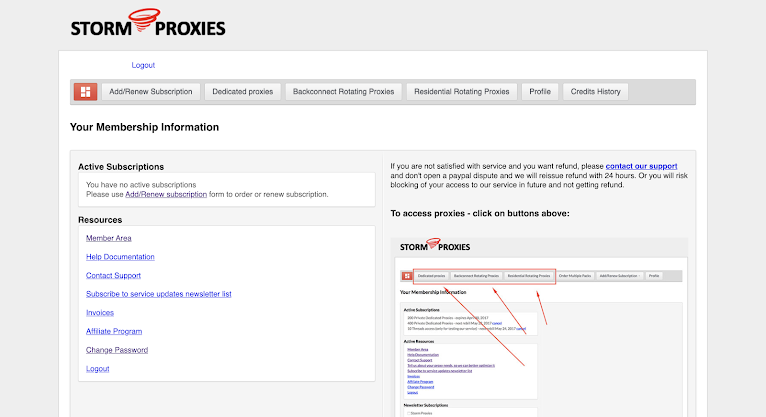
The user interface in the member area neatly organizes options by active subscription package. From this menu, you can renew your plan, deploy new proxies, change credentials, and whitelist IPs (supporting 1 to 5 authorized access IPs depending on your plan tier, or dynamic DNS tracking via No-IP for non-static home connections). Just keep in mind that private dedicated proxies support both IP allowlisting and username/password credentials, whereas the other two types operate exclusively on IP authorization.
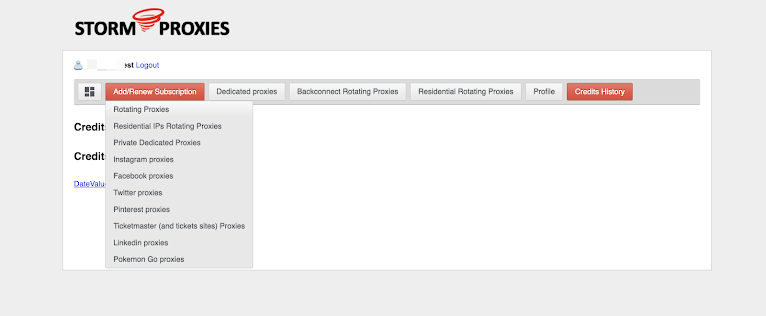
However, we noticed a user interface-related drawback: the lack of usage reports and traffic analytics. Most proxies we've tested provide extensive usage reports, which let users know how much bandwidth they've consumed over time or track request success rates. But Storm Proxies doesn't have this feature; a disadvantage for developers who want deeper connection diagnostics. On the bright side, Storm Proxies provides 100% unlimited bandwidth on all subscriptions, so you don't need to monitor your data consumption rigorously.
Customer support
You can contact the Storm Proxies customer support team 24/7 via email or through the web contact form in the member area. It doesn’t offer telephone support or real-time live chat, a noticeable drawback compared to competitors offering instant chat widgets. Nonetheless, the company aims to respond to emails promptly, typically within a few hours.
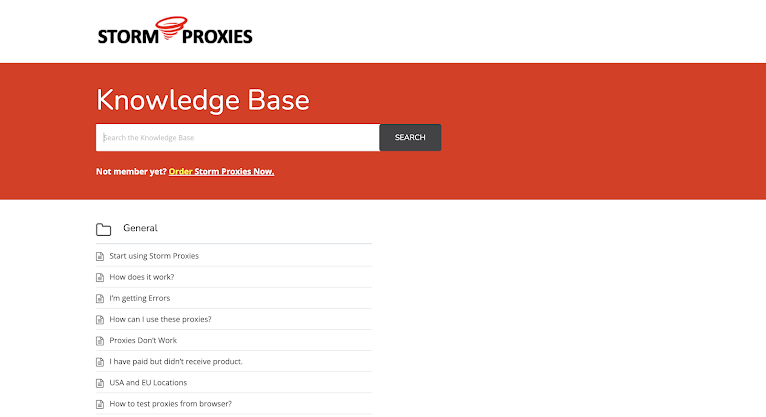
Storm Proxies also maintains a dedicated Help Scout Knowledge Base with answers to common questions about using its service.
A word about Storm Proxies' strict refund policy. The company offers a 24-hour money-back guarantee, but it applies exclusively to the single smallest package within each proxy category for first-time buyers. Higher-tier plans and repeat purchases carry zero refund eligibility, which makes it smart to test the smallest entry plan before committing to a larger order.
The competition
Storm Proxies sits firmly in the basic, budget-friendly niche compared to the likes of Bright Data, Oxylabs, and IPRoyal.
Bright Data is a stellar proxy provider that offers residential, datacenter, ISP, and mobile proxies from its gargantuan network of 400 million+ global IPs. It also offers sophisticated web scraping APIs, so it lets users kill two birds with one stone. Overall, we consider Bright Data a better proxy service than Storm Proxies, albeit a more expensive one.
Oxylabs has a massive pool of 177 million proxies and provides residential, datacenter, ISP, and mobile proxies, plus web scraping APIs and pre-built datasets. Oxylabs is a more sophisticated proxy provider, but unlike Storm Proxies and its unlimited bandwidth, residential IPs are bandwidth-limited.
IPRoyal is a strong alternative for users who need geographical flexibility and modern features. The provider offers a flexible pay-as-you-go pricing model with bandwidth that never expires, and access to over 68 million residential IPs spanning 195+ locations. It also fully supports the SOCKS5 protocol, which makes it a better choice for users needing city-level targeting or non-HTTP traffic.
Final verdict
Presenting itself as a budget-conscious option for individuals and small businesses who need straightforward proxy access without paying steep per-gigabyte bandwidth fees, Storm Proxies is not designed for complex, enterprise-level scraping. It lacks granular state- or city-level targeting, offers no SOCKS5 support for rotating pools, provides no web scraping APIs, and restricts its server footprint primarily to broad US and EU regions.
Still, if you need simple setup and unlimited traffic for US/EU targets as opposed to a solution for massive data scraping tasks, Storm Proxies delivers excellent value for money.
We've also highlighted the best proxy and best VPN







 English (US) ·