

Brooke Palmer/Paramount+
Spoilers for "Star Trek: Starfleet Academy" episode 4, "Vox in Excelso," to follow.
"Star Trek: Starfleet Academy" is utterly unafraid to embrace being a school show. Its third episode, "Vitus Reflux," focused on campus athletics (including some fitting mascots) and a prank war. Now, its fourth episode, "Vox in Excelso," has shifted its attention to something even more exciting: a debate team, coached by the Doctor (Robert Picardo).
The Doctor introduces the power of rhetoric to his students by citing a quote from Judge Aaron Satie, apparently one of the great legal minds of the 24th century. As the honorable judge wrote:
"With the first link, the chain is forged. The first speech censured, the first thought forbidden, the first freedom denied, chains us all irrevocably."
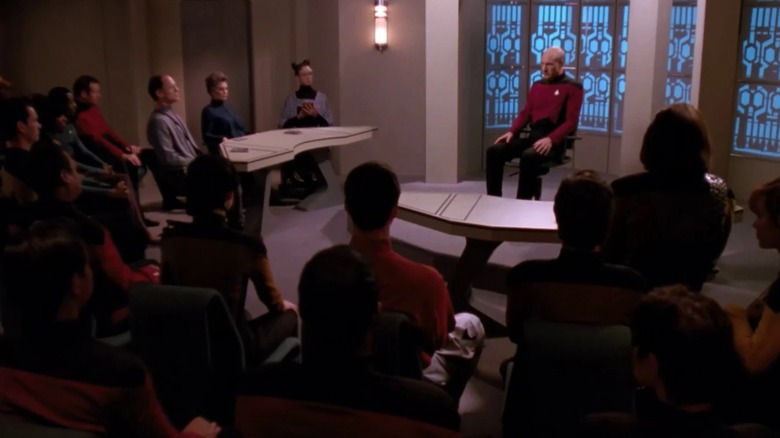
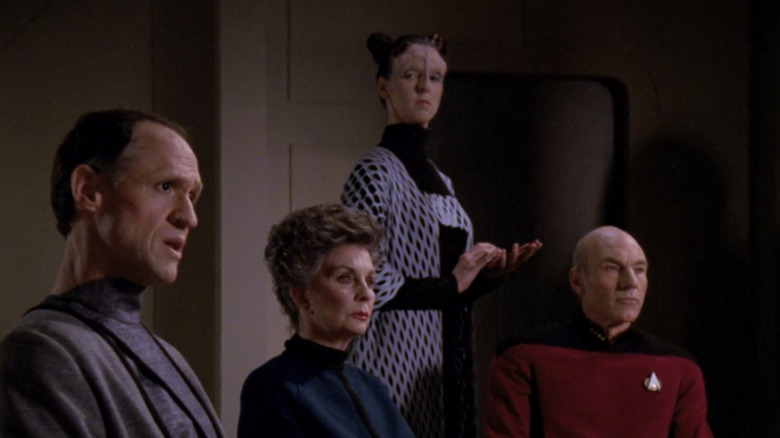
Trekkies might recognize those words, because they were actually written for an episode of "Star Trek: The Next Generation" — specifically, "The Drumhead," written by Jeri Taylor. During that episode, an explosion on the Enterprise reveals that the Klingon scientist J'Dan (Henry Woronicz) is working for the Romulans as a spy. Criminal investigator Admiral Norah Satie (Jean Simmons), the daughter of the late Judge Satie, is sent to the Enterprise to investigate, but she gradually starts abusing her power, looking for evidence of a larger conspiracy that doesn't exist.
Satie's paranoia grows so great that she eventually suspects (or deludes herself into thinking) that Captain Picard (Sir Patrick Stewart) himself is working with the Romulans and puts him on the stand. To shut her down, Picard recites some words he first learned as a schoolboy. Those words? Judge Satie's very own, which initially enrages Admiral Satie before making her realize just how far she's strayed from her revered father's example.
Star Trek: TNG's The Drumhead follows a witch hunt on the Enterprise
Paramount
"The Drumhead" is one of the most suspenseful and (true to its title) tightly-wound episodes of "Star Trek: The Next Generation." If you were to rank the best courtroom or trial episodes of "Star Trek," it would absolutely be near the top. Satie may not be a physically imposing villain like a Klingon warrior or Borg drone, but it's unsettling how she slowly takes over the Enterprise, turning the starship into a kangaroo court.
It's all the scarier because she's just a woman of the law doing her job when she starts. It's easy to see why Worf (Michael Dorn), one of the more authoritarian Enterprise crew members, supports Satie's crusade until almost the end. As Picard and Worf discuss at the episode's conclusion, safeguarding freedom takes continual vigilance, which means watching out for more than just the obvious dangers.
In combining a courtroom drama and an exploration of a community being torn apart by paranoid authorities, "The Drumhead" often flows like a riff on Arthur Miller's 1953 play "The Crucible." That play, a fictionalization of the Salem Witch Trials (and, later, a 1996 movie starring Daniel Day-Lewis and Winona Ryder), explored the anticommunist paranoia sweeping the then contemporary U.S. by allegory.
This "Red Scare" was infamously egged on by Wisconsin Senator Joseph McCarthy, whose name endures as "McCarthyism" — that is, oppressive trampling on freedom to find imagined dangers (just like Satie does in "The Drumhead"). Miller himself had skin in the game; in 1952, filmmaker Eliza Kazan named him as a communist to the House Un-American Activities Committee (HUAC).
The Drumhead continues to influence the Star Trek franchise
Paramount
Being a suspected communist, and blacklisted (in Hollywood or otherwise) because of it, could ruin people's lives in Joe McCarthy's America. McCarthyism would've been a living memory for Jeri Taylor (she was born in 1938), and "The Drumhead" explores blacklisting. Enterprise crewman Simon Tarses (Spencer Garret), who had claimed to have a Vulcan grandparent on his Starfleet Academy application, is exposed by Satie as actually having a Romulan grandparent. Of course, Tarses had nothing to do with the espionage, but his heritage condemns him. (Another example of "Star Trek" using fictional alien races to explore real prejudice.)
In "The Drumhead," Picard describes Satie's "first link" speech as "wisdom and warning." It's a truly timeless message, because freedom of expression is a principle that you can't carve out exceptions for. If those with power decide that something, or someone, isn't free, then no-one truly is.
It's also true that civil liberties are often eroded gradually. Severe repression all at once can inspire backlash, but a slow slide away from freedom can go unnoticed by the apathetic. Then, when you accept one right being taken away, that creates room for more to be stolen. Hence, the first link's forging being tantamount to a whole chain.
"Starfleet Academy" dropping the words of wisdom from "The Drumhead" is fan service, yes, but it's never a bad time to hear those words. As Picard noted, we must be vigilant, lest we not notice a chain being forged around us until it's bound too tight to escape.
"Star Trek: Starfleet Academy" is streaming on Paramount+, with new episodes premiering on Thursdays.








 English (US) ·