
 4 weeks ago
26
4 weeks ago
26
“Jackal’s crew produced a validated mission plan in under 30 minutes from tasking,” True Anomaly said in a statement. “Jackal executed ingress and a burn sequence over 23 minutes to close on Puma. When Puma maneuvered away during the approach, Jackal downlinked what it saw, and our team replanned, revalidated, and implemented a new mission plan in rapid succession.”
As Rocket Lab’s Puma backed away, True Anomaly’s Jackal executed more burns to reengage and image its prey. Military and company officials haven’t released any photos from the most recent Victus Haze demo, and they declined to disclose exactly how close the satellites came to one another.
“Due to operational security, further details involving sensor suites for characterization, phenomenology, payloads, distances, or docking will not be shared,” a spokesperson for Space Systems Command said in response to questions from Ars.
True Anomaly’s ground controllers, working out of an operations center in Colorado, managed the maneuvers with the help of an algorithm generating “hyper-accurate” targeting estimates from measurements onboard the Jackal satellite. All of this was done without coordination between True Anomaly and Rocket Lab. “No scripted target behavior,” True Anomaly said.
“Puma wasn’t playing a role,” the company continued. “It was maneuvering to lose us, and we didn’t know how in advance. That’s the entire reason to do this on orbit instead of in a lab: the human decisions, the unexpected conditions, and the adversary’s freedom to act are all real, and integration that hasn’t held up against them hasn’t been tested at all.”
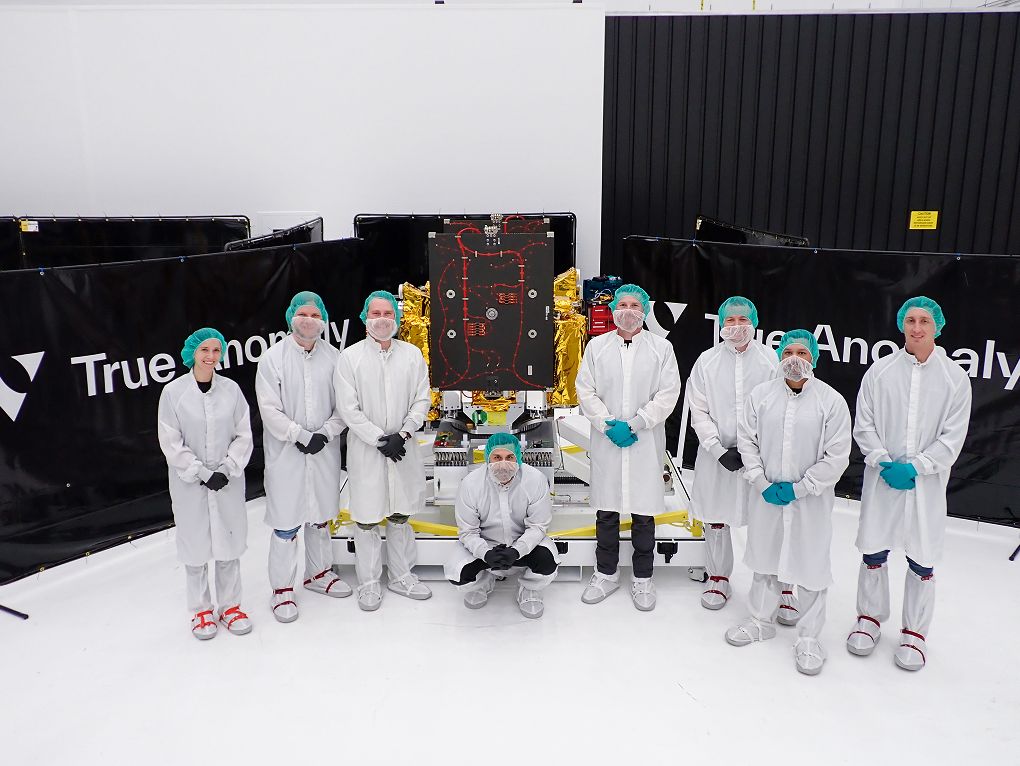
True Anomaly’s Jackal satellite, seen here, plays one part in the Space Force’s Victus Haze mission.
Credit: True Anomaly
True Anomaly’s Jackal satellite, seen here, plays one part in the Space Force’s Victus Haze mission. Credit: True Anomaly
This cat-and-mouse game sounds a lot like dogfighting in space, something Rogers, who started True Anomaly in 2022, has discussed with Ars in the past. Rogers previously served in a space aggressors unit in the US Air Force, taking up against US space operators in war game and military exercises.
But orbital dogfighting is a lot different from what you may have seen in Top Gun.
“Dogfighting in space doesn’t quite have the drama of an aerial dogfight,” Rogers told Ars earlier this year. “The tempo is slower, and the relative velocities are slower.”
Relative is the key term. It’s important to remember this all played out as the satellites soared approximately 300 miles (500 kilometers) above Earth, speeding around the planet at some 17,000 mph (7.6 kilometers per second). But in the same orbit, the satellites’ motion relative to one another is more like a carefully choreographed dance than a game of chicken.







 English (US) ·