
 4 hours ago
7
4 hours ago
7
Everything you need to know about Sony's alphanumeric naming schemes.
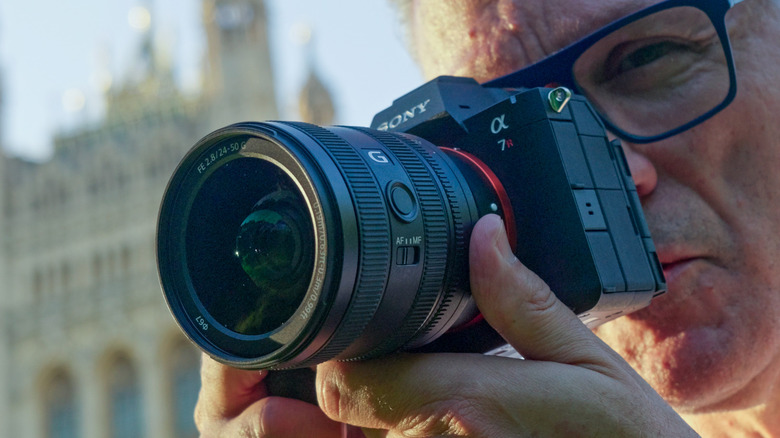
Steve Dent for Engadget
If you've decided to buy a Sony camera for the outstanding technology, ease of use and other good reasons, which one should you get? The company has a number of lineups on offer, including the A1, A7 and A9... but wait, is that an "A" or the Greek symbol for "alpha?" Some of those A7 models also have letter suffixes, like A7C, A7R and A7S, along with roman numerals afterwards (III, IV, V, etc.). Then, there are models with much bigger numbers like the A6400 and A6600, some that start with "RX" and others with "ZV" in the name. It's confusing, but there is some logic to it.
'A' for 'Alpha' means mirrorless
Sony's camera lineup can be divided into two categories, mirrorless and compact. Both have features like electronic viewfinders and rear displays, but mirrorless cameras use interchangeable lenses, while compact models have fixed lenses.
The company's mirrorless models all have the same prefix: α. In case you didn't quite notice, that's not an "a," but the symbol for "alpha," the first letter of the Greek alphabet. Nobody except Sony uses that, though; most of us just say "alpha" or use the uppercase letter "A." Sometimes, confusingly, the cameras are referred to as "Alpha A7 V," for instance.
Within the "A" lineup, Sony has two categories, namely full-frame and cropped-frame (also called APS-C) cameras. Full-frame cameras have larger sensors (the same size as 35mm film) that allow you to blur the background behind subjects more and shoot clearer photos at night. As a rule of thumb, they're generally more expensive than Sony's APS-C models. APS-C models offer most of the benefits of full-frame models (removable lenses, manual controls and good video capabilities), but are cheaper and easier-to-use for beginners.
Sony full-frame cameras
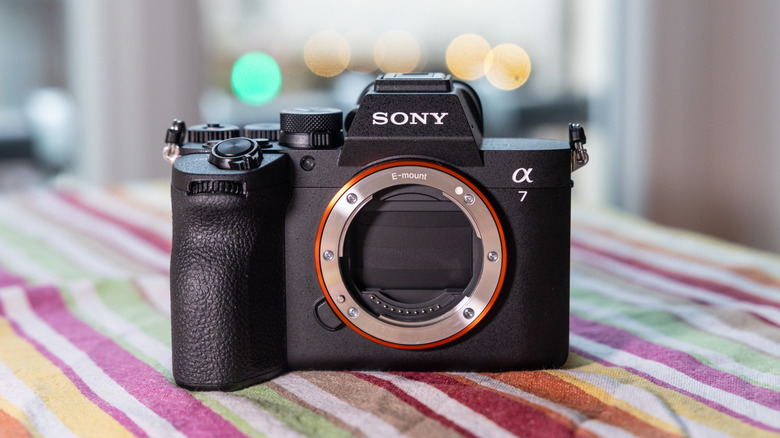
Steve Dent for Engadget
Full-frame mirrorless models are divided into sub-categories, all with a single number. The A1 series is the, er, alpha of the bunch with the highest price, aimed at pros. It uses a fast "stacked" sensor that lets you shoot high-resolution 50-megapixel photos at high speeds up to 30 fps, with incredibly accurate autofocus. It also has advanced video capabilities with up to 8K 30 fps shooting, along with Sony's best electronic viewfinder (EVF). The latest model in the lineup is the A1 II, with the roman numerals referring to the camera's version number.
The A9 is also designed for professionals, particularly sports shooters and journalists. Those models have lower resolution (24MP typically), but stacked sensors designed for speed. The newest version, the A9 III, comes with a "global" sensor that's the first ever in a mirrorless camera. It reads the entire image at once rather than line-by-line as regular "rolling shutter" sensors do, eliminating distortion caused by fast-moving subjects. It's Sony's fastest camera by far with 120 fps RAW shooting speeds.
Finally, A7 designates Sony's mainstream mirrorless lineup with moderate prices, divided into no less than four categories. The first A7 is the mainstream series that can handle both photos and video, shoot at relatively high speeds and is the least expensive. The the A7 V from early 2026 has a 33MP partially-stacked sensor, 30 fps burst speeds and 4K 60 fps full-frame video.
The pricier A7R lineup (the "R" is for resolution), has a high-res sensor good for detailed portraits or landscape photos. It can handle video at up to 8K, but creating video is more of a side quest on this camera. The current camera is the A7R VI with a 67MP stacked sensor that supports 30 fps shooting speeds and up to 8K 30 fps video.
Then there's the A7S series designed for video. These have low-resolution sensors with huge pixels designed to capture low light with minimal noise. The latest A7 III model came out in 2020, with a 12MP sensor and up to 4K 120 fps capture. Sony now has many dedicated video models in its FX lineup (I won't get into that here), which may be why it's neglecting the A7S series.
Finally, there are the A7C models (the "C" is for "compact"), including the A7C and A7CR. As the naming suggests, those are compact, stylish versions of Sony's A7 and A7R models with exactly the same functionality. They have the viewfinder on the left side of the camera rather than in the middle and fewer manual controls to preserve space. The latest models are the A7C II (2023) with the same specs as Sony's 33MP A7 IV, and the A7CR that corresponds to the A7R V.
Sony mainstream APS-C cameras
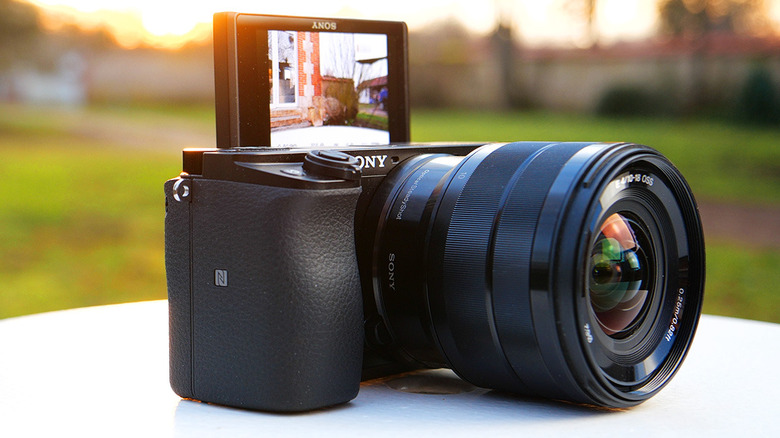
Steve Dent for Engadget
Sony used to have a hodgepodge of names and numbers for its APS-C mirrorless cameras, including NEX, A3000 and A5000. Over the last decade, though, it has stuck to the A6x00 branding for its latest models like the A6100 and A6700.
As a general rule here, the higher the number, the more capable and expensive the camera. For instance, the APS-C cameras currently in Sony's lineup are the $900 A6100 camera, $1,100 A6400 and the $1,498 A6700. The latter has a slightly higher-resolution 27MP sensor and also comes with a 5-axis in-body stabilization system. The other two cameras have 25MP sensors and no stabilization. The A6700 also supports 10-bit video recording, while the other two only support 8-bit.
Other features, like a higher-speed card slot, headphone outputs and USB-C input are also only found on the A6700. That camera is now more than three years old, however, so Sony is overdue to refresh its APS-C camera lineup.
ZV series: V is for vlogging, Z is for ???
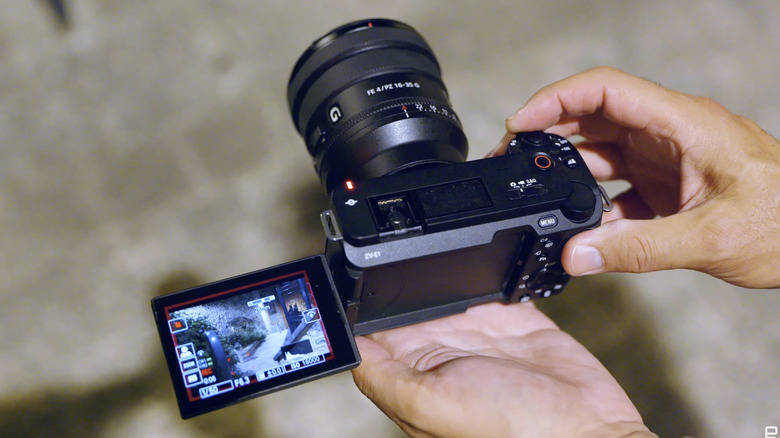
Steve Dent for Engadget
Sony was the first "traditional" camera company to truly embrace vlogging with its ZV series launched in 2020. It consists of both compact and mirrorless models, but all share certain common features specifically designed for content creators, like "Product Showcase" that quickly focuses on a product, along with film-style settings for social media.
Since they're designed mainly for video, all cameras in this series lack an electronic viewfinder, because Sony likely figures that videographers don't need one, and eliminating them can reduce a camera's weight and price. All have video-centric features like flip-out displays, high-quality built-in microphones and 4K 60p recording.
The first ZV model was the ZV-1, a compact vlogging camera. All the ZV models with this ZV-1 prefix with no letter "E" in front (like the current ZV-1, ZV-1F and ZV-1 II), and they are all compact models with fixed lenses. Models that do have the "E" designation, followed by a "10," like the ZV-E10 II, are APS-C mirrorless cameras that allow lenses to be changed. Finally, models with the E designation followed by a "1" (the ZV-E1, above) are full-frame mirrorless interchangeable lens cameras.
Sony's RX for compact cameras
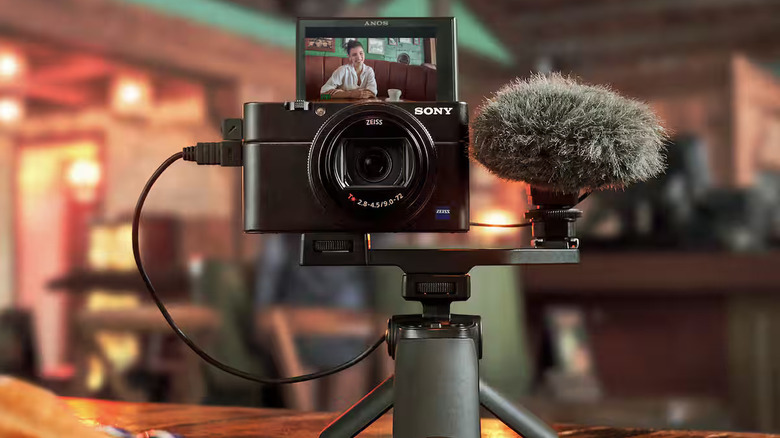
Sony
The last consumer category for Sony is compact cameras with fixed (not interchangeable) lenses, designated with the "RX" suffix. Sony has three categories of those: zoom, super-zoom and large sensor models, with a wide price variation across the lineup.
First is the RX100 zoom category, with the latest model being the $1,500 RX100 VII (above). It comes with a 1-inch sensor and a high quality Zeiss 24-200mm f/2.8-4.5 zoom lens. This camera delivers high image quality in a compact, pocketable size.
Next is the RX10 category with this year's RX10 V being the flagship model. It also offers a 1-inch sensor, but features a Zeiss 24-600mm f/2.4-4 superzoom lens that's well suited for wildlife, sports and other types of capture where a long reach can come in handy. It's also very fast, with up to 24 fps continuous shooting with continuous autofocus. Unlike the RX10 VII, it's pretty big and definitely not pocketable. This camera is $2,298, making it one of the more expensive superzooms on the market.
Then there's the RX1 series, represented by Sony's wild RX1R III full-frame compact. It has a 61MP full-frame CMOS sensor, along with a fixed 35mm Zeiss f/2.0 lens. It's not as compact as the other models but can still be slipped into a bag, so it's ideal as a street photo camera for serious photographers. It carries a serious price to match: $5,098.
Finally, don't forget about the RX0 series and its latest model, the RX0 II. It's designed as a "life-vlogging" camera, or for VR and multi-camera work. It has a 1-inch, 15.3MP sensor and wide-angle Zeiss 24mm f/4 lens. You can think of it as Sony's answer to action cams, but with higher quality but more limited features. This model retails for $1,000.





 English (US) ·