
 4 weeks ago
43
4 weeks ago
43
TLDR
- Solana is trading near $78, just below the $81 level flagged as a breakout point by crypto researcher gum.
- The next major resistance sits at $104.38, matching the weekly 50-EMA on the chart.
- SIMD-0550 would raise SOL’s disinflation rate from 15% to 30%, speeding up the path to 1.5% terminal inflation.
- SIMD-0553 would add resource-based fees that get fully burned, aiming to raise long-term SOL burns.
- Solana’s RWA sector passed $2.8 billion in May, with SOL holding 97% of tokenized-equity trading volume.
Solana is trading near the $81 level that traders are watching for a possible breakout. Crypto researcher gum flagged this level in a recent post shared on X.
Gum said a move above $81 could open the way toward $104. That level lines up with the weekly 50-EMA on the chart he shared.
On that chart, Solana sat near $78.42, below its 20-week EMA at $81.64. The 50-week EMA sits higher at $104.38, marking the next resistance zone.
The weekly RSI on gum’s chart read 43.14. That is below the neutral 50 mark, showing momentum has improved without turning fully bullish.
Two Tokenomics Proposals Under Review
Solana’s inflation schedule may change under proposal SIMD-0550. It would raise the annual disinflation rate from 15% to 30%.
That change would cut the time needed to reach the 1.5% terminal inflation rate. The timeline would drop from about 5.7 years to 2.8 years.
A second proposal, SIMD-0553, would add resource-based fees to the network. The resource portion of those fees would be burned rather than kept by validators.
Supporters of SIMD-0553 say it could raise SOL burns as network usage grows. Solana’s own documents list SIMD-0550 as under review and SIMD-0553 as a draft.
Real-World Asset Activity Keeps Growing
Solana’s real-world asset sector passed $2.8 billion in value in May. That figure came from a Solana Foundation report.
SOL accounted for 97% of all tokenized-equity spot trading volume across blockchains during that period. This shows the network’s growing role beyond memecoins.
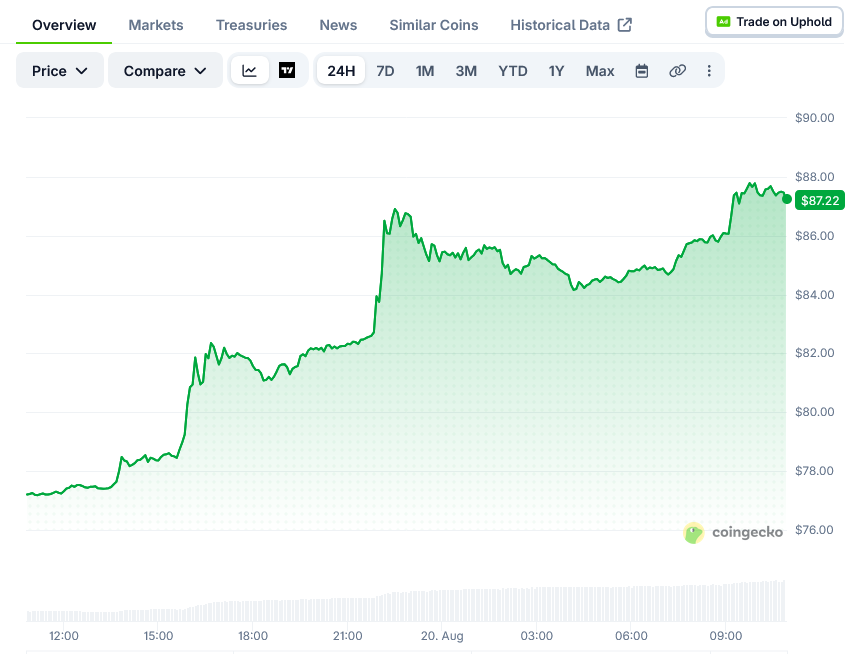 Solana Price on CoinGecko
Gum pointed to rising onchain volume and steady app retention as added support. He said broader usage could raise demand for blockspace over time.
More blockspace demand could strengthen the case for higher fee burns under SIMD-0553. Still, usage growth does not guarantee a higher SOL price on its own.
The next step for both proposals is governance voting. Gum said the two measures were moving toward a final vote when he posted his analysis on August 19.
Approval alone will not change SOL’s supply schedule right away. Implementation and actual burn levels will decide whether the changes affect price.
For now, traders are watching whether SOL can close above $81 on the weekly chart. A break above that level would shift the near-term structure, with $104 as the next test.
The post Solana (SOL) Price: Weekly Chart Shows $81 Support and $104 Resistance Levels appeared first on Blockonomi.








 English (US) ·