
 3 weeks ago
22
3 weeks ago
22

Sigma has been developing a full-frame Foveon sensor since 2018 but there have not been major advancements in that process since 2022. However, CEO Kazuto Yamaki says that Sigma engineers have made progress and it should be ready to proceed to the final stage of development this year.
Foveon sensor technology uses a proprietary three-layer structure in which red, green, and blue pixels each have their own full layer. In traditional sensors, the three pixels share a single layer in a mosaic arrangement and the camera “fills in” missing colors by examining neighboring pixels.
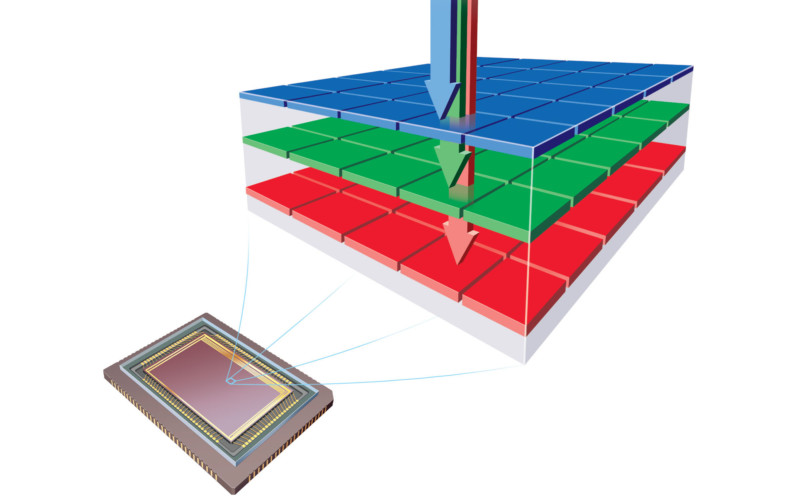
Since each pixel of a photo is recorded in three colors, the resulting photo should be sharper with better color accuracy and fewer artifacts. Foveon sensors have made it into production cameras in the past, but always smaller than full-frame. Sigma has been trying to realize the dream of the larger, full-frame Foveon sensor for nearly a decade.
Back in 2022, Yamaki explained that the development process of the full-frame sensor could be broken into three stages:
- Stage 1: Repeated design simulations of the new three-layer structure to confirm that it will function as intended.
- Stage 2: Prototype evaluation using a small image sensor with the same pixel size as the product specifications but with a reduced total pixel count to verify the performance characteristics of the image sensor in practice.
- Stage 3: Final prototype evaluation using a full-frame image sensor with the same specifications as the mass products including the AD converter etc.
At the time, Yamaki said that the senor’s development had entered Stage 2 and by the summer of 2022, he believed that the sensor would be ready by the end of that year. This, after Sigma was forced to pull the sensor “back to the drawing board” a year previously due to what he described as the discovery of a critical flaw.
Unfortunately, that timeline slipped. Two years later, Yamaki admitted that the sensor’s development had not progressed beyond Stage 2. Last spring, Yamaki said that the sensor had been continuously delayed due to the discovery of technical issues with each new prototype.
“Unfortunately, it’s been taking more time, much more time than we expected, and it’s delayed, delayed, delayed. Because every time we make a prototype, we find some technical issues, but we are making progress little by little because we already promised to deliver the products with the Foveon sensor,” Yamaki said in an interview with Chris Niccolls on The PetaPixel Podcast.
Earlier this month at the CP+ Show in Yokohama, Japan, Yamaki provided another update that, for the first time since 2022, sounds promising: progress has been made.
“We made some progress since last year and we have been narrowing down the cause of the problems — the technical problems. And probably this spring to summer timeframe, we will be able to go to the next stage, but still it’s in the middle of the sensor development,” Yamaki tells PetaPixel, indicating that the sensor development remains in Stage 2.
That said, his team has been making progress on the biggest technical problem: noise.
“The main problem — there are actually several problems — is mainly noise. And we needed to find the cause of the noise. There were several causes of problems and we’ve been solving them.”
Hearing that noise is the biggest technical issue Sigma is facing does make sense. On paper, Foveon sensors should collect about three times more light, which should translate in a 1.7 times improvement in signal to noise ratio, Timothee Cognard explained in a story back in 2022. However, it turns out that in practical comparisons, the low-light performance of Foveon sensors falls short.
“One of the limitations of Foveon’s approach is that image noise is higher than in conventional sensors,” Foveon General Manager Shri Ramaswami admitted in a 2014 interview.
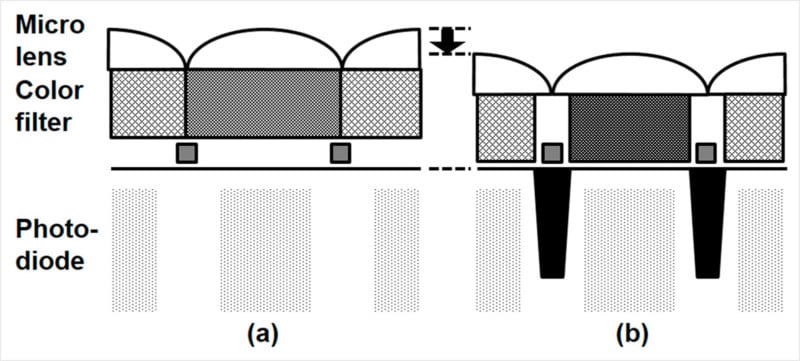 Schematic cross-sectional views of a pixel. (a) is a control pixel and (b) is a crosstalk-improved pixel. Illustrations from “A 45 nm Stacked CMOS Image Sensor Process Technology for Submicron Pixel.”
“This is probably due in part to inefficiencies within the sensor architecture itself — perhaps some light is lost to internal structures that separate the layers — and also in part to the processing that has to be done to produce pure colors from the rather mixed signals that the chip actually captures.”
In short, it is really complicated to get light to move well through the various layers of the sensor at each photodiode site. But there are also software challenges, compounding possible problems. It is speculation, but noise issues could have been exacerbated when Sigma changed the pixel size of this full-frame sensor, leading to issues that have taken four years to address.
But there has been progress, and Yamaki sounded hopeful that development could finally leave Stage 2 this year. Regardless, to take on this challenge for what will ultimately be niche, low-volume production is admirable.




 English (US) ·