
 21 hours ago
6
21 hours ago
6
Whenever a new autofocus-equipped cinema lens is announced, I always have mixed feelings. While I often find autofocus extremely useful, the manual focus experience inevitably suffers compared to a mechanically coupled manual focus lens. When they were first teased, I was told that this would not be a problem with the new Sigma Cine Zoom with AF lens series. Now I have reviewable copies of the 28-45mm T2 and 28-105mm T3 and get to answer the very important question: Has Sigma really managed to make a breakthrough?

Creators on the go will find these lenses to be supremely convenient to use. They look and feel like true cinema lenses, with a manual focus that feels mechanically coupled.
Pros
- Autofocus is convenient and excellent
- Manual focusing feels as if it is mechanically engaged
- Proven optical formulas double as photography lenses
- Amazing build quality
Cons
- Some breathing Issues
- Not parfocal
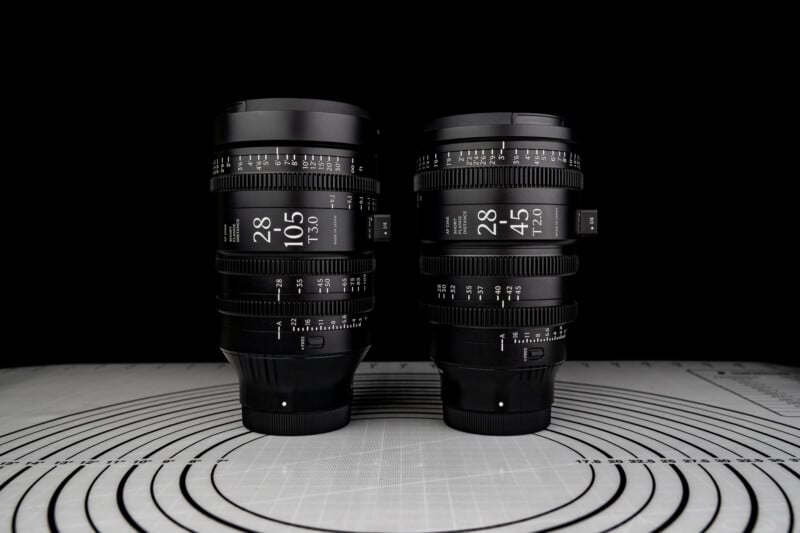 The new Cine AF zooms are overbuilt and made for cinema work.
Sigma Cine AF Series Review: Disclosure
You may have noticed that I had access to Aizu Primes and Sigma Cinema lenses and have been using them regularly for the last several months, so before we get into this review, it’s important for me to disclose that Sigma has partnered with PetaPixel to provide the optics we use for a majority of our episodes in 2026, which we’ve previously disclosed.
Despite this, just as was the case in my Aizu Primes review, we’re speaking from an editorial perspective here, and that is detached from that support. Sigma had no input into the content of this review and, frankly, didn’t even know that we were making it. You all know we’re always honest about our reviews, which is evident in that Aizu Primes review where I point out that while the lenses are great, they aren’t without flaws. That’s a theme that will carry over to this review as well.
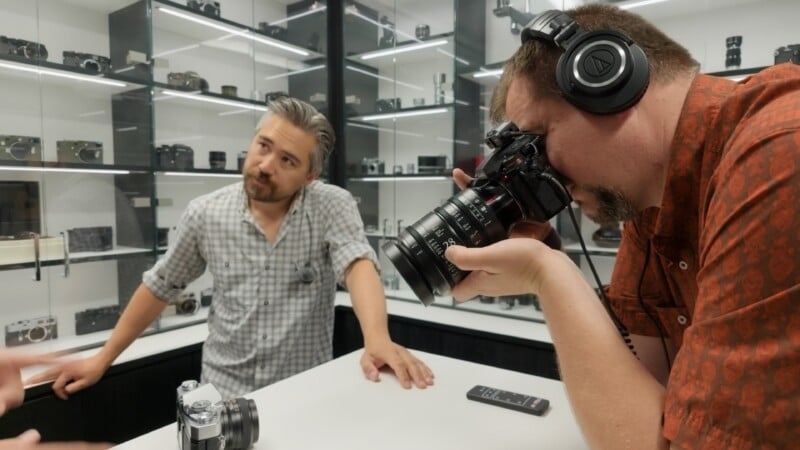 Jordan Drake seen here using the Sigma Cine AF lenses on a recent shoot.
Sigma Cine AF Series Review: What Is So Special About Them?
So Sigma has been making Cinema lenses for quite a while — even zooms. So, what makes these new AF Cine lenses so unique? The most obvious thing is right in the name: these lenses support autofocus powered by Sigma’s very fast and quiet linear motors. Despite that, they are still geared and indexed for proper manual focus. As well, all of Sigma’s prior cinema lenses have been designed for the long flange back of the PL mount, which adds size but makes them extremely adaptable. The AF Cine lenses are designed specifically for mirrorless mounts, currently E-Mount and L-Mount. This means they can use Sigma’s outstanding mirrorless lens optical formulas, but they cannot be adapted to other mounts.
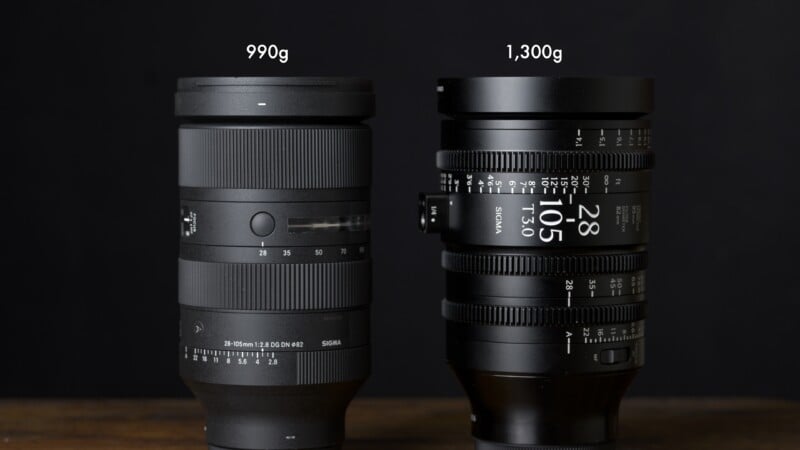 The lenses share very similar optical performance to the Art series zooms, but they are built for video.
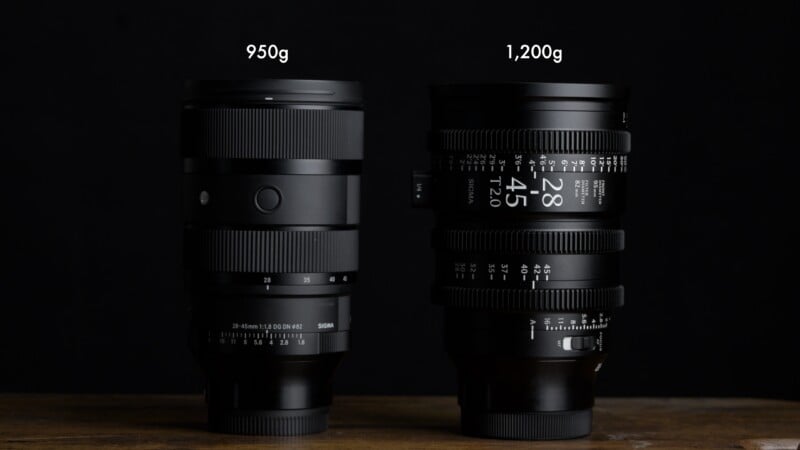 The Cine AF lenses have geared rings, and are definitely heavier than the photo-specific designs.
For the first lenses in this series, Sigma chose two full-frame lenses that make a lot of sense for video shooters. The 28-45mm T2 is a pretty limited range, but based on the 28-45mm f/1.8 Art, one of the fastest full-frame zooms ever made. The 28-105mm T3 is based on the 28-105mm f/2.8 Art, which is quite a bit slower but has an incredibly useful range for documentary and event work. Unlike the Aizu Primes, which were designed from scratch for video and film work, you can purchase either the photographic or Cine AF versions of these lenses in the L- and E-Mounts. So what makes the Cine AF lenses different from those previous, much less expensive photographic versions?
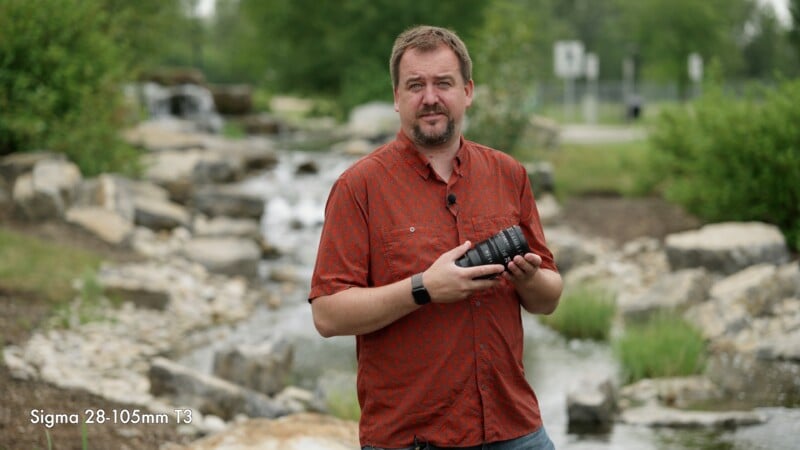 Here you can see the soft depth of field and natural rendering of the image.
Sigma Cine AF Series Review: How They Feel
The design is exactly what you’d expect from a Cinema lens. We have geared iris, zoom, and focus rings, and an industry-standard 95mm front diameter that makes it a breeze to add a matte box. There are also 82mm screw-in filter threads for those who want to use filters but keep the overall size down. I also like that the iris ring can be locked and controlled from the body, as I often found myself twisting that ring when attempting to zoom. On the top and bottom are a couple of small screw holes for attaching the included 1/4-inch thread, which is useful for mounting the lens directly to a tripod or cage.
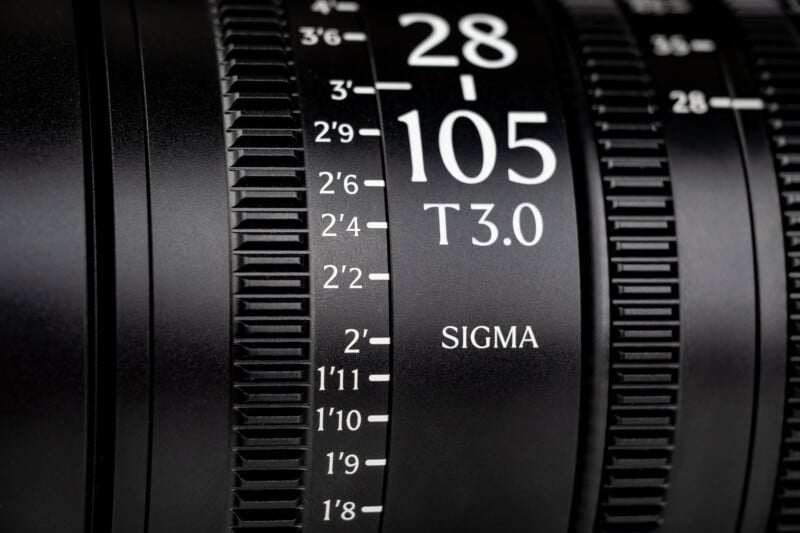 These lenses will give you geared rings and proper T stops.
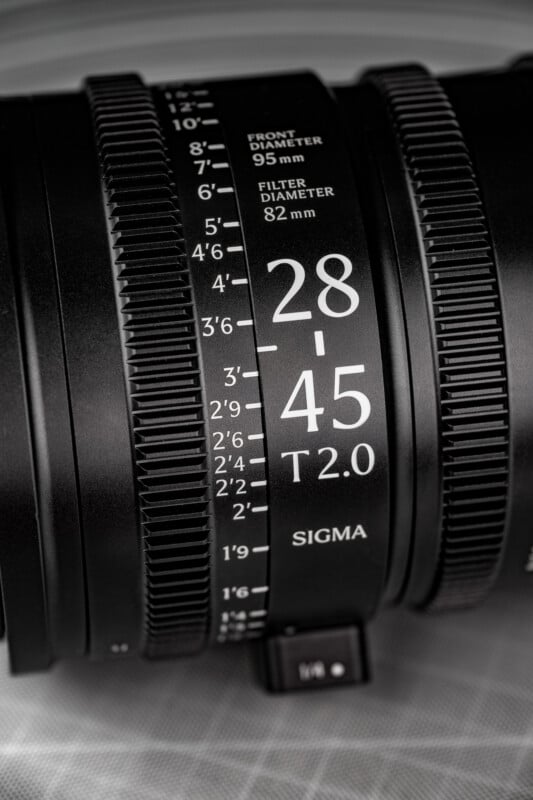 Long focus throws are the norm, and the manual focusing is smooth.
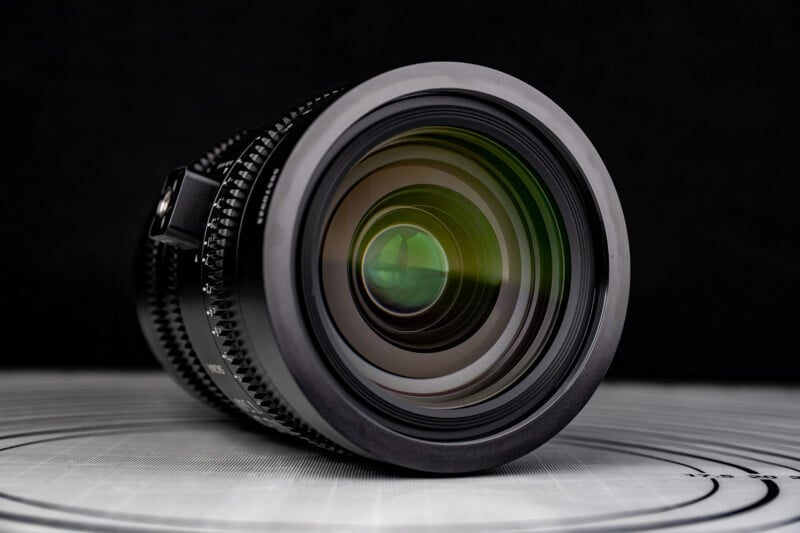 These lenses feature a different chassis, but the optical formulas are similar.
The most unusual control for a lens like this is the AF/MF switch. Often, hybrid lenses will utilize a focus clutch, which allows you to keep your hand on the focus ring while switching between focus modes. I did initially find this switch frustrating as I needed to reach back to cycle between focus modes, but found that the AF-S/AF-C/MF switch on Lumix bodies can override this switch, which I far prefer.
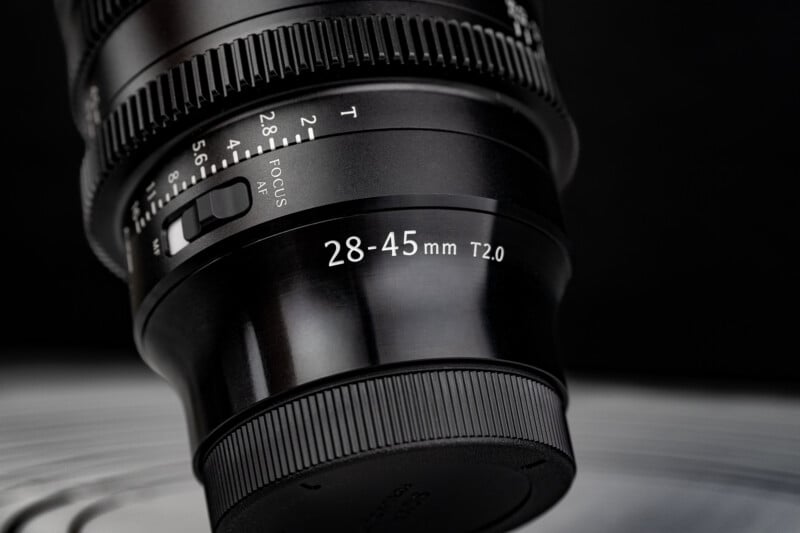 The AF/MF switch is very normal on photo lenses but is unique on cinema ones.
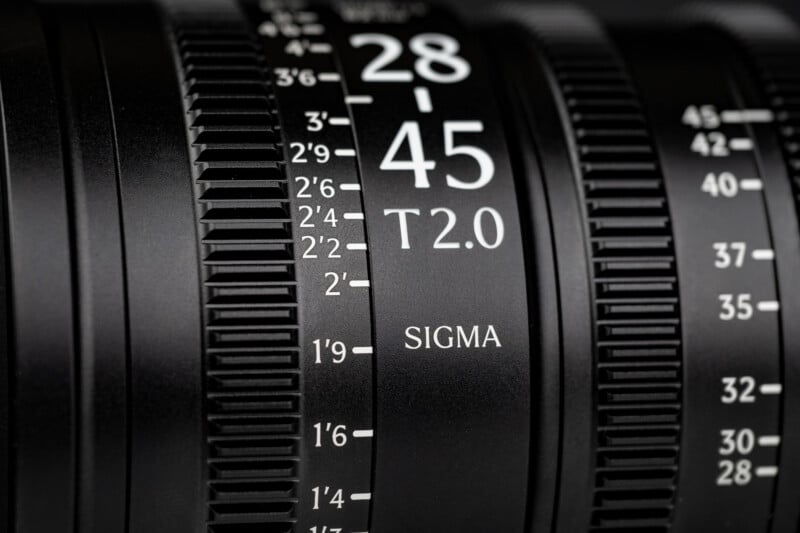 The 28-45mm features a brighter T2 aperture.
Sigma Cine AF Series Review: How They Shoot
In terms of autofocus, I found the speed and responsiveness to be indistinguishable from other Sigma and Panasonic lenses I regularly use on the Panasonic S1 II I used to test the lenses. The real meat of this review is in a discussion of how the manual focus experience feels when it’s not mechanically coupled to the focusing groups. To this point, I have never used a focus-by-wire lens that felt particularly good to manually focus.
Like previous autofocusing cinema lenses, you are not actually moving the focus elements when you twist the focus ring, but rather telling the lens’ motor which direction to move. Historically, this has led to a laggy and disconnected experience, where it is very easy to overshoot focus due to the lack of precision of these motors. The Sigma Cine AF lenses are a different story. While manually focusing either by hand or with a mechanical follow focus unit, I found responsiveness and a feeling of connection to be in line with the mechanical Sigma Aizu Primes I have been using recently.
This is a huge deal, as it means shooters now have access to a lens with all the benefits of cinema glass, with an autofocus and manual focus experience with no compromises. Kudos to Sigma for this accomplishment.
 These lenses will deliver all the resolution that you need.
In terms of optical performance, I found the Sigma Cine AF lenses to be largely indistinguishable from their earlier photographic versions, which we have full reviews of. Long story short, these are both outstanding optics that will easily resolve 8K resolution and provide a very nice out-of-focus rendition. There’s a reason these lenses were already popular with videographers and cinematographers.
The only area I noticed a major difference compared to the earlier versions was in terms of flare, where I did see a bit more of a loss of contrast and an increase of ghosting with the Cine AF when shooting directly into the sun. Many cinematographers may actually prefer this, as a bit of flare can look really good in motion.
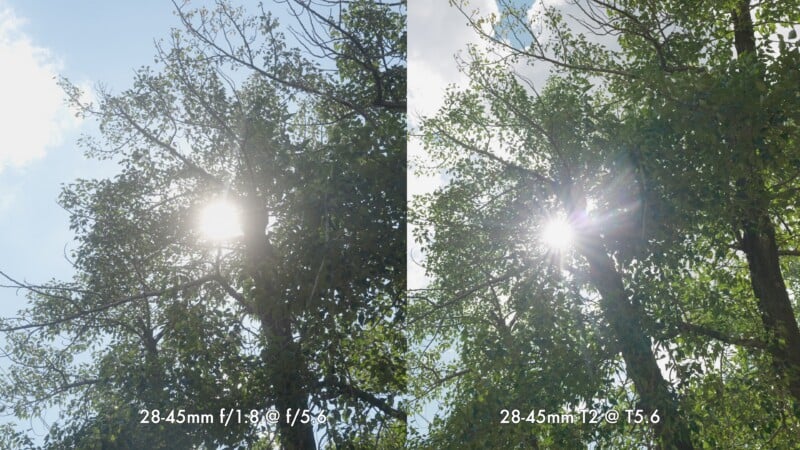 The Cine AF lenses tend to have more pronounced flare characteristics.
Unfortunately, one thing that also remains the same from the Art series lenses is the lack of parfocal design and breathing performance. “Parfocal” means that a lens will maintain its focus distance perfectly while zooming, and is quite important if you want to zoom mid-shot while maintaining focus manually. The 28-105mm T3 drifted dramatically while zooming, meaning re-focusing was required when zooming either direction. The 28-45mm T2 maintains focus better through its very limited zoom range, but there was still enough of a focus shift to move the focus plane from my subject’s eyes to their nose.
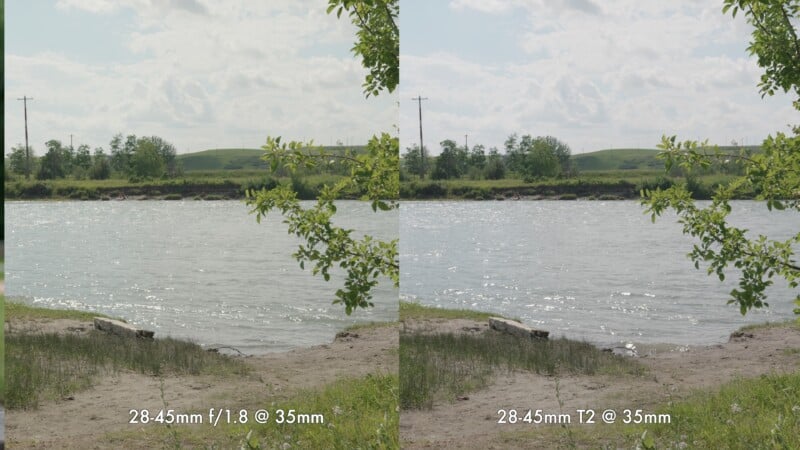 Other than flare, the optical performance looks identical to the photo versions.
Breathing is also the same as in previous versions, but with reversed results in terms of severity. The 28-45mm T2 exhibits fairly noticeable breathing at both ends of its zoom range. The 28-105mm fared quite a bit better, with some slight breathing at the wide angle and very minimal breathing at the telephoto. These results were a bit disappointing, as I was hoping for perfectly optimized lenses for cinema, but it’s worth keeping in mind that both these optics are dramatically less expensive than manual-focus cinema zooms that do correct for these phenomena.
 The 28-105mm proves to be a very convenient lens for run-and-gun work.
Sigma Cine AF Series: A New Era?
The focus performance Sigma has created here cannot be understated: it is a massive achievement. That said, I hesitate to call it a truly unique achievement as Fujifilm has recently released two autofocusing GF Mount cinema zooms, the 19-35mm T3.5 and 32-90mm T3, which promise similar levels of performance in autofocus and manual focus. I will be looking at those lenses shortly to see if Sigma’s engineering is more effective or if two manufacturers somehow cracked the code at the same time. For the time being, though, the new Sigma Cine AF zooms are my two favorite lenses to use, and stand well above the competition in either E- or L-Mount.
 If you want the cinematic look with the added convenience of autofocus, look no further.
Are There Alternatives?
In E-Mount, the Sony 16-35mm T3 and 28-135mm T4 have proven popular in the past and boast servo zooms, but they are a far inferior manual focus experience, and even their AF performance is quite dated. The Sigma Cine AF Zooms are a better way to go if the focal ranges appeal to you.
In L-Mount, I haven’t yet encountered an autofocusing cinema zooms that compete with what Sigma offers here. These should prove wildly popular for L-Mount users.
Should You Buy Them?
Yes. If you are primarily working in video or cinema, these lenses offer a truly compelling package. While the prices are substantially higher than the photo-focused versions, these are still quite affordable for cinema zooms and have no downsides if they are used for photo work.







 English (US) ·