
 3 weeks ago
38
3 weeks ago
38
The novelist Michael Cunningham has described Provincetown, on the tip of Cape Cod, as “the only small town I know of where those who live unconventionally seem to outnumber those who live within the prescribed bounds of home and licensed marriage, respectable job, and biological children. It is one of the places in the world you can disappear into.”
This idiosyncratic bohemia has attracted the likes of Edward Hopper, Eugene O’Neill, Mark Rothko and Tennessee Williams along with poets, dropouts, drag queens and drifters. In the summer of 1975 came a lanky, restless 19-year-old from New Jersey with no job and no money, sleeping on the floor of a shared cottage while his roommates worked to pay the rent. His name was Anthony Bourdain, who would later become a celebrity chef, author and television globetrotter.
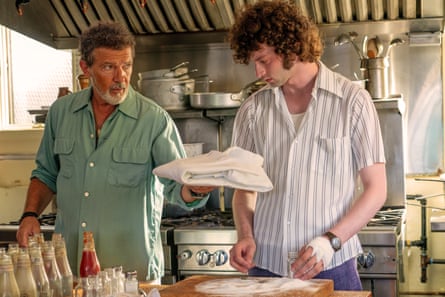
Half a century later, that coming-of-age has been mythologised by Hollywood. Matt Johnson’s new film, Tony, starring Dominic Sessa as the adolescent dishwasher, imagines the origin story of the man before he rewrote the rules of food writing with his 2000 memoir, Kitchen Confidential.
For those who knew Bourdain best, the film’s release – eight years after his death by suicide – has been a difficult one to sit with. “I have a very strong emotional relationship to Tony and yeah, it’s hard,” says Joel Rose, 78, a novelist and editor who was arguably Bourdain’s closest literary confidant for 35 years.
“This has been a difficult period for me. There’s a lot going on with Tony’s memory and the memories that I have, and how in so many ways I feel cheated and confused. I had a very different relationship with Tony than his TV persona and all that. I wasn’t in that world with him, and I’m not sure that it was a favorite place for Tony to be.”
Bourdain described his time in Provincetown in Kitchen Confidential: “We all went to the beaches and ponds each morning, smoked pot, sniffed a little coke, dropped acid and sunbathed nude, as well as indulging in other healthy teenage activities.”
After getting a job as a dishwasher in the kitchen of local restaurant Flagship – later fictionalised as the Dreadnaught in Kitchen Confidential – he discovered a structure he’d never known before: something with real stakes, real hierarchy and an odd, brutal kind of belonging. He worked his way up from the dish pit to the salad station, then to the fryer, and eventually earned a shift or two at the broiler.
He put it this way to the Observer in 2017: “I only became happy – in fact, intensely satisfied – as a dishwasher at a restaurant in Provincetown in Cape Cod, my first job. I was a shy, goofy, awkward teenager. But in this blue-collar, factory-like environment, there was no blurred line, no grey area, no philosophical question to fret over.
“Dishes had to go in the washer and come out taintless, and doing this swiftly and competently meant I was acknowledged as a human being by colleagues I wanted to be like. The day they promoted me to dunking fries I was overjoyed.”
It was also that first summer at the Flagship that Bourdain saw the moment he would later credit with making him want to become a chef. He and the rest of the kitchen crew crowded around a window overlooking the restaurant’s trash-bin corral to watch their chef in the middle of a sexual encounter with a customer who, still in her wedding dress, was minutes from sitting down to dinner with her own wedding party.
Whether the marriage survived is not recorded anywhere. What is clear is the effect the scene had on a teenage Bourdain: the kitchen staff, he decided, were like pirates, answerable to nobody, living entirely by their own rules.
Michael Ruhlman, 63, a food writer who became one of Bourdain’s closest friends in later years, said he once asked Bourdain directly whether the bridal-gown story was true. “He said: yeah, it happened, the guy was a total fucking pig,” Ruhlman recalls. “He said he was the kind of chef who would make servers give him blowjobs while he was prepping his station. He was always hanging out with an interesting crowd.”
That romantic image of the kitchen pirate cut both ways. As the restaurant industry later reckoned with its long history of physical and sexual abuse, Bourdain said he regretted having glamorised a culture that was, underneath the swagger, often exploitative.
He also grew more clear-eyed about the drug use that hollowed out so many of the Provincetown kitchens he had worked in. In a 2014 episode of Anthony Bourdain: Parts Unknown he said simply: “Many of our friends from those days didn’t make it.”
None of that was visible to him yet in 1975. Riding the confidence of his first Flagship summer, Bourdain came back to Provincetown the next spring hoping to land the broiler position outright. But the Flagship had new ownership, and he ended up trying out instead at Ciro’s, an Italian restaurant run by Ciriaco Cozzi that turned out hundreds of dinners a night on a kitchen that ran with near-military precision.
The cooks at Ciro’s unsettled him – they moved as a unit and talked in what he later called a “lush, intimidating, sardonic secret language”, part 18th-century literary allusion, part marine drill sergeant. They were not impressed with him in return. During a tryout at the broiler, an overconfident Bourdain badly burned himself on a hot pan and was immediately bumped back down to salads.
The humiliation stung Bourdain, prompting him to enroll at the Culinary Institute of America in February 1977 in an effort to prove himself. If Provincetown was where Bourdain discovered the kitchen, it was the grimy streets of New York’s East Village in the early 1980s that forged him as a writer.
In 1983 Rose and his then wife, the French novelist Catherine Texier, were running a radical, highly influential literary magazine called Between C & D. Produced on a dot matrix printer using fanfold paper, the magazine was sold in big, plastic Ziploc bags – a cheeky nod to the heavy heroin trade that dominated their neighborhood.
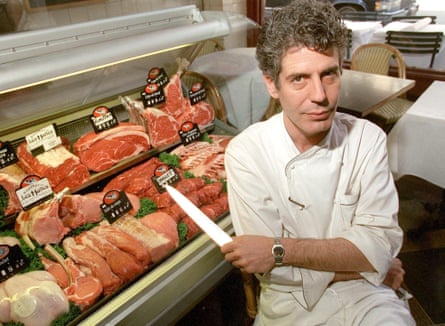
One afternoon, Rose’s fourth-floor apartment buzzer rang. “I went downstairs and there was a very tall guy, never seen him before, in chef whites, and he introduced himself,” Rose recalls by phone from the mountains in Kerhonkson, New York. “He said he had submitted a comic that he had drawn to the magazine and that I had rejected it, but I’d written something very nice. And he wondered, could he talk to me?
“So I invited him up to my apartment on the fourth floor. I’d written back that his drawing sort of sucked, but that his writing was good. He said he didn’t know any writers, that he wanted to be a writer and he just wanted to talk.”
The two men sat in the apartment for hours, talking about their lives. They discovered a shared suburban background, a love of literature and a mutual history with the restaurant business. Rose’s father had been a career waiter at New York spots like the Stage Deli and Carnegie Deli.
“I didn’t influence his writing one iota,” Rose says. “He was a good writer right from the start. He was a natural writer. If you’re young and unsure and don’t even have a voice yet, wow, it’s terrifying. And he was terrified because he was already looking ahead. He was barely established and, as much as he loved what he was doing, he could see the wear and tear that it took on a person in the long term.”
Bourdain was still living on the margins, balancing intense double-shifts in Manhattan kitchens with a heavy drug habit.
Rose continues: “When Tony came up to the apartment that day, he was pinned. He had just gotten high and I called him on it right away because I knew. I’ve been there myself. I wasn’t doing drugs then. I had a hard time and almost gotten killed, and I didn’t need to go back there. I know he was doing more coke than heroin but he was coming around my house quite a bit. I lived on 7th Street and he was getting drugs on 2nd and 3rd. I saw him quite a bit in those days.”
In the late 1990s, Bourdain was in a Tokyo hotel room, looking out over the city after a visit to the fish market, when he sent a long, incredibly vivid email to Rose, who was living with Karen Rinaldi, an editor at Bloomsbury who had recently given birth to their son, Rocco.
“She was in the living room breastfeeding the baby, and I came in with this email and I said to Karen, ‘I’ve got to read you this.’ She said, ‘Joel, get the fuck away from me, do you see what I’m doing?’ I said, ‘No, no, no, no, let me read it to you.’ I read it to her and she knew Tony through me a little bit, and she said, ‘Does Tony have any other stories?’ I said, ‘Are you kidding me? He has so many!’”
Rinaldi contacted Bourdain’s agent, made an offer and bought the book. When it was published in 2000, Kitchen Confidential shattered the genteel, recipe-driven world of food publishing, ushering in an era that would lead to TV dramas such as The Bear.
Dianne Jacob, 71, a food writer and editor, comments: “First of all, the writing is incredible. He has a very strong voice. He’s an excellent storyteller. He understands pacing and candour, and he was almost like an investigative reporter. It made food writing sexy … More than anything else, it was real bad-boy persona and he was such a beautiful writer.”
Yet when Jacob met Bourdain in person during a book promotional tour in San Francisco, she encountered a man who seemed profoundly uncomfortable with the sudden glare of global fame.
She recalls: “There was an older woman in the bathroom applying blush to her cleavage. There were all these men who were chefs who were full of tattoos and in love with him. When I got in line to have him sign my book, there were women passing him notes, maybe with their phone numbers. It was an incredible scene.
“He was charismatic, but he was also a little awkward and shy. I saw him afterwards, outside, smoking a cigarette, and I just thought I’m not going to bother him, you know? He wasn’t all in on the glamorous part of being a celebrity. He was kind of like a deer in the headlights with all these people admiring him. They all wanted to sleep with him, I think, everyone in the audience. Even straight men who are chefs.”
José Andrés, a Spanish American chef and restaurateur, and founder of the food aid charity World Central Kitchen, first met Bourdain 20 years ago and became a close friend.
Andrés and Bourdain watched each other’s children grow up and for years would holiday together for a week in the Cayman Islands. They also travelled – and ate – far and wide in countries ranging from Spain to Haiti.
“He gave joints a lot of value in ways other shows never did,” Andrés recalls. “As much as he loved high-end cooking and great wines and three-star Michelin, he loved the people doing the impossible hole-in-the-walls, and that was beautiful.
“I remember we ate in the streets of Port-au-Prince [in Haiti] in places nobody would eat. That was Tony. He could be eating in the best restaurants in the world but he would go to the hole-in-the-walls, and many of them, because he made them famous, sometimes moved to better places.”
Yet as the travel shows grew more successful, the TV crews bigger and the global adoration more intense, Bourdain’s private world was fracturing. His 20-year marriage dissolved in 2005, unable to withstand the constant strain of his travel schedule.
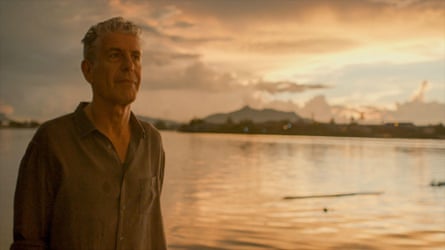
The final, tragic chapter of his life began when he met the Italian actor Asia Argento. To those who had known him for decades, the change in his personality was abrupt and alarming.
Ruhlman says: “He was a completely different person after Asia. After he met her, I got an email. I had invited him to my wedding reception in New York City and he says, ‘Can’t do it. I’m in Italy shooting. I’m in love too. Love abounds. Nothing but happiness.’ And a year later he’d killed himself.”
For Rose, who was in text and email contact with Bourdain just a day before his death, finishing work on their graphic novel Hungry Ghosts, the suicide in a French hotel room in June 2018 remains an open wound.
He says: “He was not one who shied away from talking about suicide and killing himself and throwing himself in a meat grinder or a wood chipper or whatever he said. But from the day that I learned of his passing, I always felt that Tony probably put that noose around his neck and then at the last moment said, ‘What the fuck am I doing now?’”
Up in the quiet mountains of New York, Rose watches the hummingbird at his bird feeder and looks out at the vast, green vista of the Catskills. He has just watched the first footage of Get Jiro!, an upcoming TV adaptation of the graphic novel he wrote with Bourdain.
“Tony would be in heaven,” he says, with a bittersweet note in his voice. “I know it’s just what he envisioned, blood spatter and all the stuff that he loved. I have warm feelings about this as a long project and to see it through and then I also feel like, fuck, man, why aren’t you here? This would be so much better if you were here.”
-
Tony is out now in US cinemas and in the UK on 14 August and Australia on 20 August



![[Virtual Event] Building a Secure AI Strategy for the Enterprise](https://eu-images.contentstack.com/v3/assets/blt6d90778a997de1cd/blt11afeac15e7adbb9/6a921187f8aef68330d6ae57/DRIW-AI-Strategy-VE-Oct26.jpg?width=720&quality=80&disable=upscale)

 English (US) ·