
 1 week ago
109
1 week ago
109
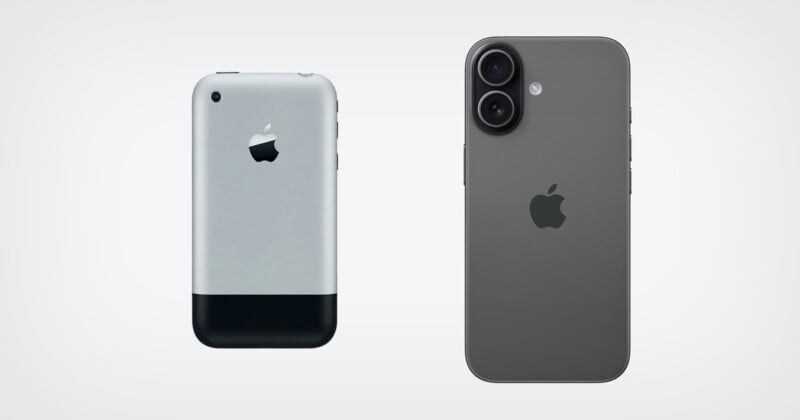 The original iPhone (left) and the iPhone 17 (right)
While PetaPixel readers are particularly passionate about serious, dedicated cameras with the latest and greatest features, one of the most popular cameras in the world is the iPhone. Nearly every year, Apple touts improved photo quality on its latest handhelds, often due to a combination of better hardware and more sophisticated software.
A pair of new videos from popular technology YouTuber Marques Brownlee (MKBHD) shows how far the base iPhone model has come in terms of photo quality.
2007 to 2025: Important iPhone Camera Milestones
Although phones had cameras long before Apple released its first-generation iPhone in June 2007, there is no question that the iPhone’s arrival and subsequent improvements forever changed the photography industry, just as it changed smartphones themselves. People having a small, compact, easy-to-use, and eventually highly capable camera with them at all times transformed how many approached photography. No longer did the average person need a dedicated camera, instigating a seismic shift readily visible in charts showing annual digital camera shipments.
The early iPhone models were pioneering and influential, of course, but not yet photographic powerhouses. The first iPhone had a measly two-megapixel rear camera with pretty poor image quality. The next iPhone, the 3G, made no changes. However, in subsequent years, as technology improved, Apple began investing more heavily in iPhone camera technology. The iPhone 4 in 2010 upped the megapixel count to five, and 2011’s iPhone 4S went to eight.
Even still, photo quality was middling, at best. Imaging Resource reviewed the iPhone 4, and had little good to say about its performance as a photographic tool:
“If you stack them head-to-head, the iPhone 4 is not going to give a good, entry-level point-and-shoot digital camera a run for its money. The 5MP 1/3.2-inch backside-illuminated (BSI) sensor in Apple’s iPhone 4 may be one of the best on the smart phone market right now but it’s simply too small in size to compete with what’s in a dedicated digital camera. Furthermore, while the iPhone’s miniscule 3.85mm lens produced far sharper results than we expected, it’s rudimentary, at best, when compared to most cameras.”
However, technology and performance continued to improve. The iPhone 7 Plus in 2016 was the first to include dual rear cameras, sporting a 12-megapixel Sony Exmor main camera and a 2x telephoto.
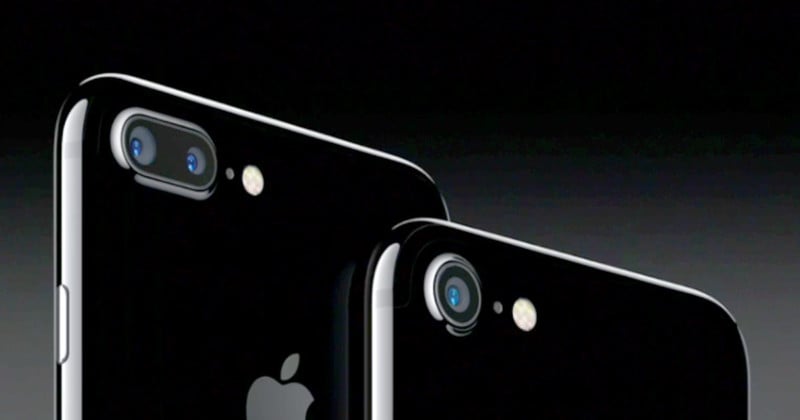 iPhone 7 Plus | Credit: Apple
2019’s iPhone 11 Pro introduced triple cameras to iPhone and debuted its now ubiquitous “Deep Fusion” image processing technology, although Apple has since dropped “Deep” from its Fusion branding.
Newer iPhone models, especially Pro variants, have made significant imaging leaps for both photography and video, with the latest iPhone 17 Pro and Pro Max being among the very best smartphones for photographers.
However, Brownlee did not test every single iPhone but instead stuck to the base models from each generation. While Apple’s newest Pro phones are certainly the very best the company has to offer, many people stick with the more affordable standard iPhone models. It also provides a fair way to evaluate nearly 20 years of imaging improvements, since Apple didn’t introduce the Pro until the iPhone 11 generation.
iPhone 1 thru iPhone 17, taking the same photo pic.twitter.com/Y8NUB0lKzd
— Marques Brownlee (@MKBHD) March 27, 2026
MKBHD’s first video, shared late last week, featured the popular creator outdoors in daylight. While there are clear, visible improvements in sharpness, dynamic range, and especially exposure and white balance calculations, every single iPhone did a decent job with the scene.
The image quality improvements are not as noticeable as many might expect. Many of the comments on Brownlee’s post are that after the iPhone 4S, released in 2011, the images look pretty darn similar across the board.
“So I’ve been upgrading my phone for nothing. Yet every year I hear from youtubers that we got generational leap,” one commenter said.
“Differences are in the details for sure,” Brownlee replied. In a video on social media, these details are challenging to see.
However, a well-lit outdoor shot is child’s play, even for old-school smartphones with small image sensors. The real technological advancements are visible when the light gets dim. Brownlee shared another video today, showcasing the same test but indoors in low light.
iPhone 1 thru iPhone 17 vs LOW light pic.twitter.com/nwjkNP4uaB
— Marques Brownlee (@MKBHD) March 30, 2026
With the lights dimmed, newer iPhone models with their bigger, better sensors and faster lenses excelled. The difference is immediately visible, with even 2024’s iPhone 16 looking demonstrably worse than last year’s iPhone 17. iPhone 14 is noticeably noisier, iPhone 12 does some fairly aggressive (and ugly) image processing, and the otherwise great iPhone X looks straight-up bad. Beyond that, the photos just get worse and worse, with the first few iPhone generations that looked good in a daylight scene performing horrifically in low light.
As Brownlee’s videos show, smartphones have almost always been adept at taking photos in the easiest situations. However, generational leaps in imaging technology are obvious when the going gets tough. Between improvements in hardware, like bigger, better sensors, and software, including better image processing and subject detection, iPhone and other smartphones have consistently become significantly more versatile with each generation.
 iPhone 4 sample photo | Credit: Apple
 Apple iPhone Air sample photo. This is the same camera as the iPhone 17’s main camera. | Credit: Apple
Although outside the purview of Brownlee’s videos, there have also been major changes to the user experience. While early iPhone models had very simple camera apps, the iPhone photography landscape these days is entirely different. There are so many third-party camera apps with professional-level control, RAW formats, and more. iPhone photography has come very far over the years, and professionals today are using smartphones to create important work.
The iPhone is a huge part of Apple’s illustrious history, too. The company is celebrating its 50th anniversary this week, and arguably no product has been as important to Apple’s success as the iPhone.
Image credits: Apple






 English (US) ·