
Some call the dodo—a large, flightless bird with an endearingly wonky posture—a “symbol of extinction.” Since its last sighting by humans in 1662, Dodus ineptus (as in, inept and absurd) is famously regarded as a stupid creature. But new research shows that, for centuries, we’ve been really unfair to the dodos.
Currently, there are only three completely preserved dodo skulls. In an unprecedented study, published recently in the Zoological Journal of the Linnean Society, researchers conducted advanced CT scans of the three skulls, comparing them with other comparable bird brains. The team found that the dodo’s brain wasn’t as small for its size. In other words, there is no evidence to suggest that a dodo would be particularly less intelligent than other birds. The analysis also indicated that dodos shared traits found in nocturnal birds.
“Dodos have always been portrayed as silly or confused birds, a reputation that probably came from their trusting behavior that resulted in hundreds of animals being killed in a very short time,” Sara Citron, the study’s lead author and a PhD student at the University of Lethbridge in Canada, said in a statement. “Calling them ‘stupid’ for being naive makes it sound like they deserved to go extinct, which is so unfair.”
The dodo lore
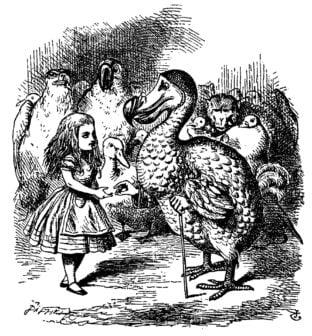 A dodo bird depicted in Lewis Carroll’s Alice in Wonderland. © John Tenniel via Wikimedia Commons
The last reliable human sightings of the dodo were in the late 17th century. Records from the time depict dodos as “fat, slow” birds that lumber around Mauritius, “almost willing their own extinction,” according to an explainer by the U.K. Natural History Museum. It was centuries later, in 1848, that the dodo got an official scientific description.
However, recent studies found that a concerning portion of dodo literature misrepresented the true physiology and behavior of dodo birds. Researchers using advanced scanning techniques also found that dodos were likely much taller, slimmer, and quicker than we thought. In a 2025 interview with the BBC, Beth Shapiro, an evolutionary biologist at the University of California-Santa Cruz, said that the dodos likely evolved on an island without predators. She added that, if anything, it was likely the animals brought along by early sailors that exposed dodos to new risks, eventually leading to their extinction.
Putting things in context
For the study, the team reconstructed the dodo brain from high-resolution CT scans of the preserved skeleton. From the data, the researchers measured physical structures associated with vision, smell, and cognition. Then, they compared the scans with the brains of birds from the pigeon family, of which the dodo is a member.
“When we compared the dodo’s brain to that of pigeons, we found that the dodo’s forebrain, linked to cognition and memory, was similar in proportion to other pigeons when compared to the rest of the brain,” Citron and study co-authors Vera Weisbecker and Andrew Iwaniuk, an evolutionary biologist at Flinders University in Australia and a neuroscientist at Lethbridge, respectively, wrote in a column for The Conversation.
The redemption arc
The dodo might not be an avian genius. But there’s no evidence to suggest that a dodo wasn’t any less intelligent compared to other pigeons (who can be pretty darn smart). As for the dodos’ trusting behavior, the “gentle animals were possibly quite social” and “used to a life without predators,” Citron explained in the statement.
The latest analysis also identified smaller optic lobes, which are found in nocturnal birds such as owls or kiwis, the researchers wrote in the column. Although we’re currently unable to study the dodo’s retina, this discovery indicates that dodos could have been active either at dawn, dusk, or even at night, which would make it stand out among modern pigeons and doves, they added. Citron posited in the statement that this may have given them an advantage over competitors.
Having said that, and as the researchers admitted in their column, these results remain “speculative.” As there are unfortunately no preserved dodo brains to study, the researchers used physiological cues—namely skull and cavity measurements—to infer the dodos’ sensory structures. As the team wrote in its paper, biologists may “never be able to determine the dodo’s sensory abilities with certainty.”
But we can try, the researchers added. In any case, it truly seems that the dodo’s “sensory world was not what we once assumed,” as the team put it in the column.







 English (US) ·