
 3 weeks ago
33
3 weeks ago
33
The good news is that Sandisk is still putting out SSDs for consumers, and these are not just cheap replacements. The Optimus GX Pro 850P is a bona fide high-end Gen 4 SSD that puts Sandisk’s name on the WD Black SN850X’s legendary design. This means DRAM, TLC flash, and good performance for any role.
Like the Black SN850P, which is a Black SN850X made with a heatsink and for the PS5, the 850P is made for the console. Its heatsink is excellent, and it would fit right into your desktop PC, too. We wouldn’t recommend shucking it for use in a laptop, but theoretically it could work there as well. Our main concern would be the pricing, which is a bit steep – this is a nice drive, but you’ll pay a premium for it.
Sandisk Optimus GX Pro 850P Specifications
Swipe to scroll horizontally
Pricing |
||||
Form Factor |
M.2 2280-S3-M (PS heatsink) |
M.2 2280-S3-M (PS heatsink) |
M.2 2280-D5-M (PS heatsink) |
M.2 2280-D5-M (PS heatsink) |
Interface / Protocol |
PCIe 4.0 x4 / NVMe 1.4 |
PCIe 4.0 x4 / NVMe 1.4 |
PCIe 4.0 x4 / NVMe 1.4 |
PCIe 4.0 x4 / NVMe 1.4 |
Controller |
Sandisk Proprietary |
Sandisk Proprietary |
Sandisk Proprietary |
Sandisk Proprietary |
DRAM |
Yes |
Yes |
Yes |
Yes |
Memory |
Sandisk TLC 3D NAND |
Sandisk TLC 3D NAND |
Sandisk TLC 3D NAND |
Sandisk TLC 3D NAND |
Sequential Read |
7,300 MB/s |
7,300 MB/s |
7,300 MB/s |
7,200 MB/s |
Sequential Write |
6,300 MB/s |
6,600 MB/s |
6,600 MB/s |
6,600 MB/s |
Random Read |
800K |
1,200K |
1,200K |
1,200K |
Random Write |
1,100K |
1,100K |
1,100K |
1,200K |
Security |
TCG Opal v2.01 |
TCG Opal v2.01 |
TCG Opal v2.01 |
TCG Opal v2.01 |
Endurance (TBW) |
600TB |
1,200TB |
2,400TB |
4,800TB |
Part Number |
SDSG81100TAH-000E0 |
SDSG81200TAH-000E0 |
SDSG81400TAH-000E0 |
SDSG81800TAH-000E0 |
Height |
9.89 mm (w/ HS) |
9.89 mm (w/ HS) |
10.31 mm (w/ HS) |
10.31 mm (w/ HS) |
Warranty |
5-Year |
5-Year |
5-Year |
5-Year |
The Sandisk Optimus GX Pro 850P is available at the same capacities as its WD Black SN850P forebear: 1TB, 2TB, 4TB, and 8TB. This also matches the original WD Black SN850X and its later 8TB SKU. Prices at the time of review for the Optimus GX Pro 850P are $309.99, $609.99, $1,139.99, and $2,249.99. These prices are well above the $234.99, $494.99, and $1,019.00 that the Black SN850P is currently demanding. We think the prices will come down on the Sandisk drive, but be aware of the comparable alternatives when making a purchase.
Latest Videos FromTom's Hardware
The drive can reach up to 7,300 / 6,600 MB/s for sequential reads and writes and up to 1.2 million random read/write IOPS. This performance is at the top for a Gen 4 drive and, frankly, is capable of delivering an excellent experience even for heavier workloads. The drive’s warranty is standard at five years with 600TB of writes for every TB of capacity. The Optimus GX Pro 850P supports data-at-rest encryption through TCG Opal v2.01, but this is not explicitly listed for the SN850P, likely as this model is designed for use in the PS5.
Sandisk Optimus GX Pro 850P Software and Accessories
Sandisk fully supports its drives with downloadable software. For the Optimus GX Pro 850P this includes the Sandisk Dashboard, which is Sandisk’s version of WD’s Dashboard, and Acronis True Image for Sandisk. The former is an SSD toolbox with all of the expected features: drive health and SMART monitoring, firmware updating, performance testing, etc. Acronis True Image is OEM-licensed software used for backing up files and imaging drives.
Sandisk Optimus GX Pro 850P: A Closer Look
Image 1 of 2
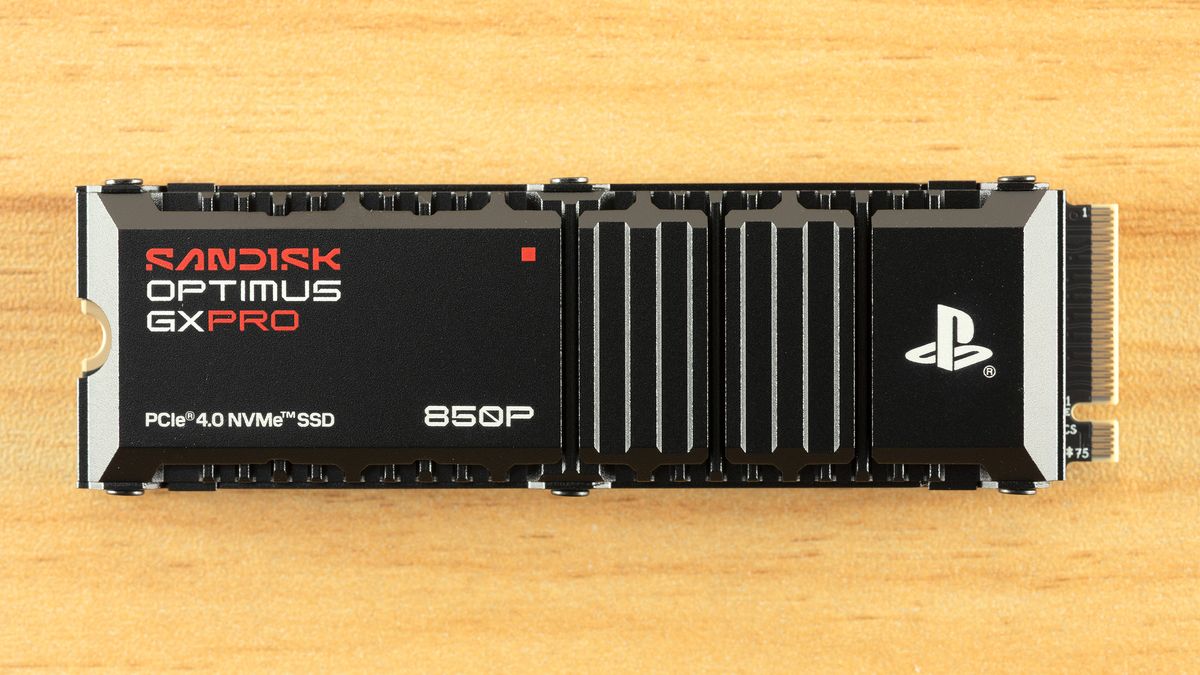
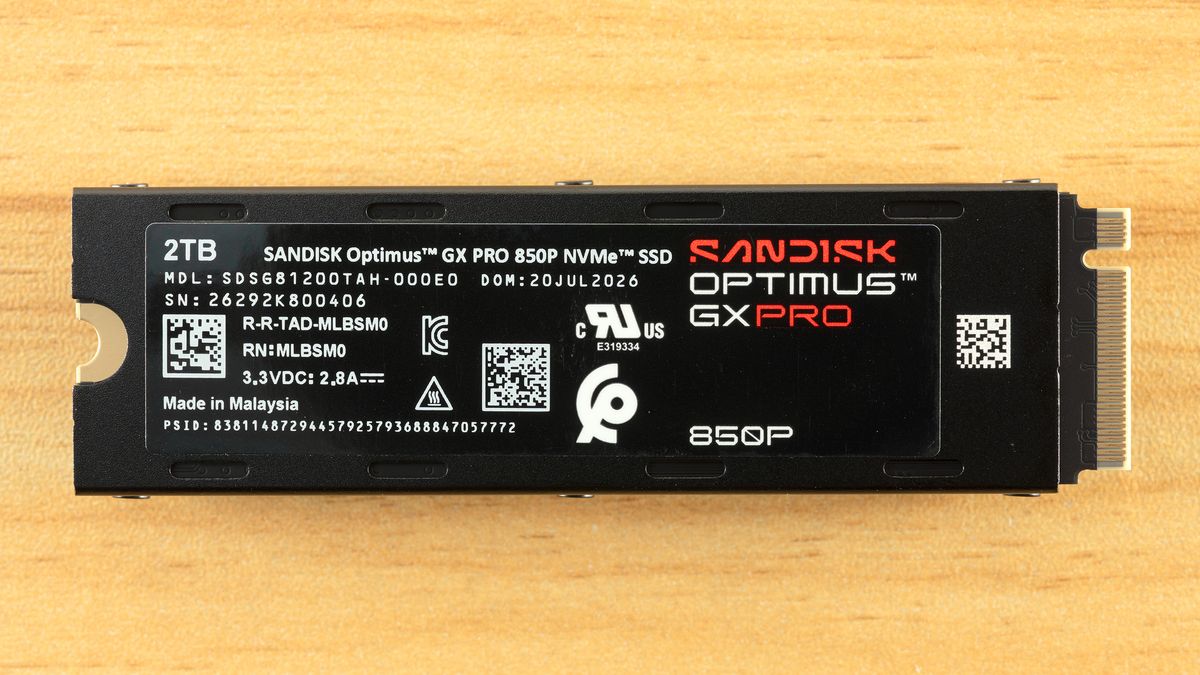
The Optimus GX Pro 850P is designed to specifically fit into the PS5 with an effective heatsink. The bare drive underneath is single-sided at 1TB and 2TB but double-sided at 4TB and 8TB. For that reason, the rated height is larger for the latter two SKUs. In general, this should not be an issue for fit in desktop PCs. The heatsink itself is finned for extra surface area for better heat dissipation and should keep the drive cool even under harsh conditions. It does not have RGB, unlike the WD Black SN850’s heatsinked SKU.
The drive label gives some additional information, such as a rating for 3.3V / 2.8A. This is ~9W, which matches the drive’s highest reported power state. This is certainly higher than the ~5W we see for many DRAM-less drives, which have half the flash channels on top of not having DRAM to worry about, but it is not enough to be a problem with this heatsink.
Stay On the Cutting Edge: Get the Tom's Hardware Newsletter
Get Tom's Hardware's best news and in-depth reviews, straight to your inbox.
Image 1 of 3
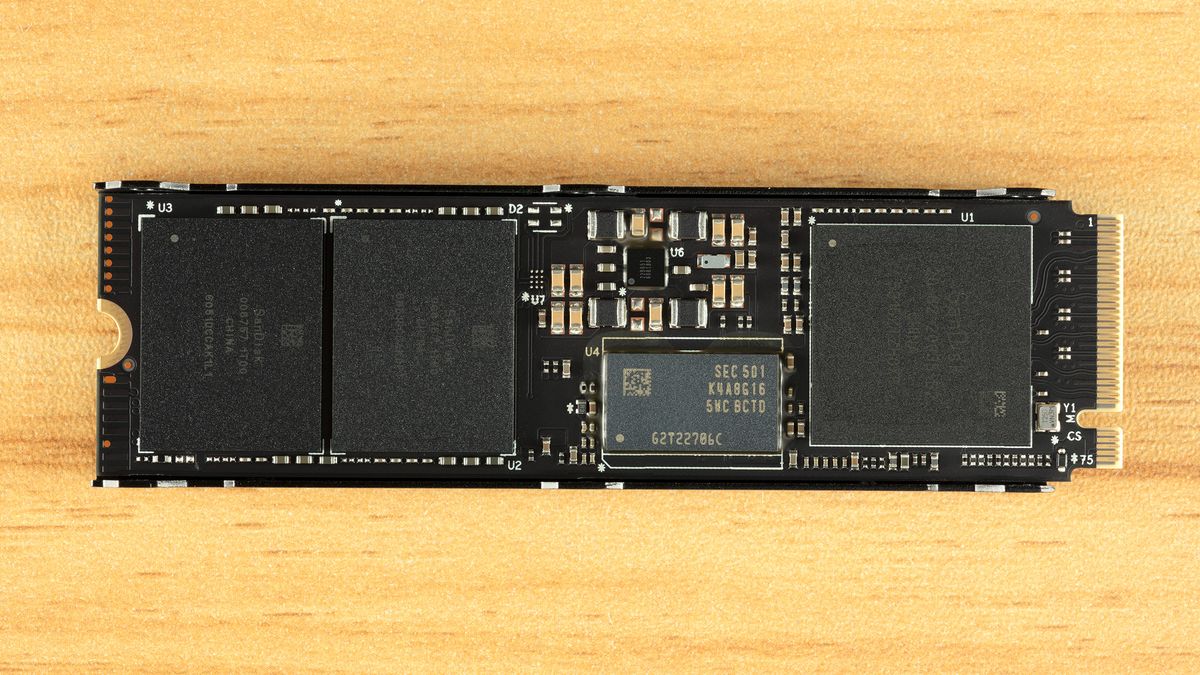
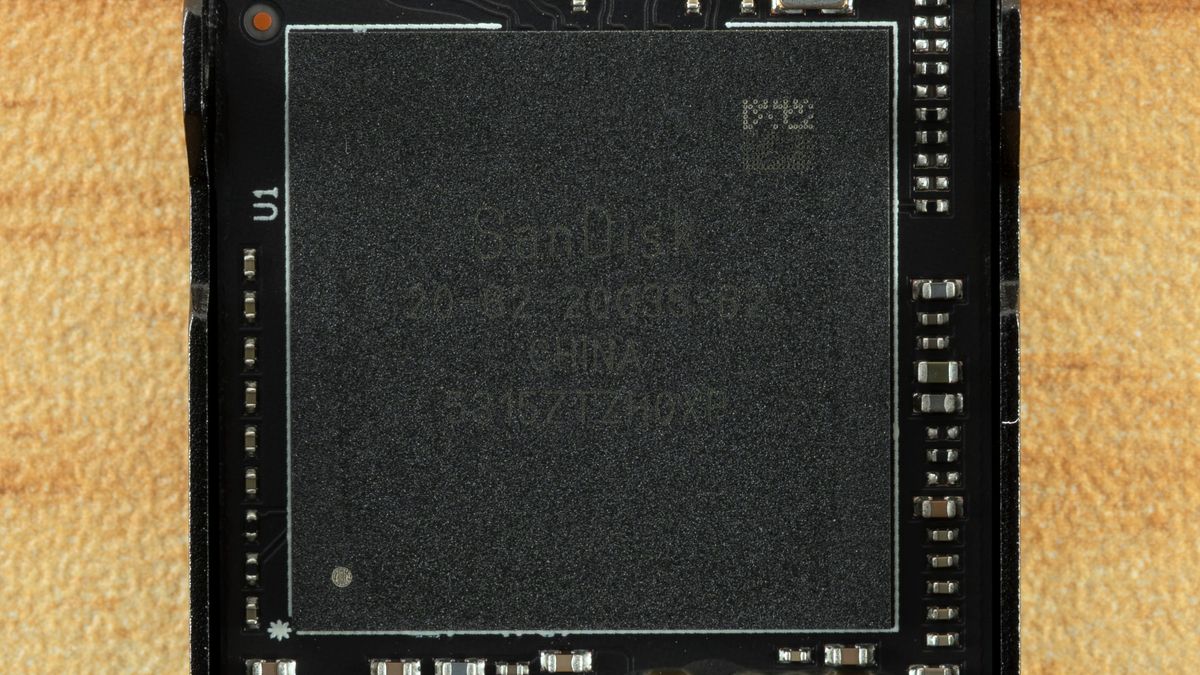
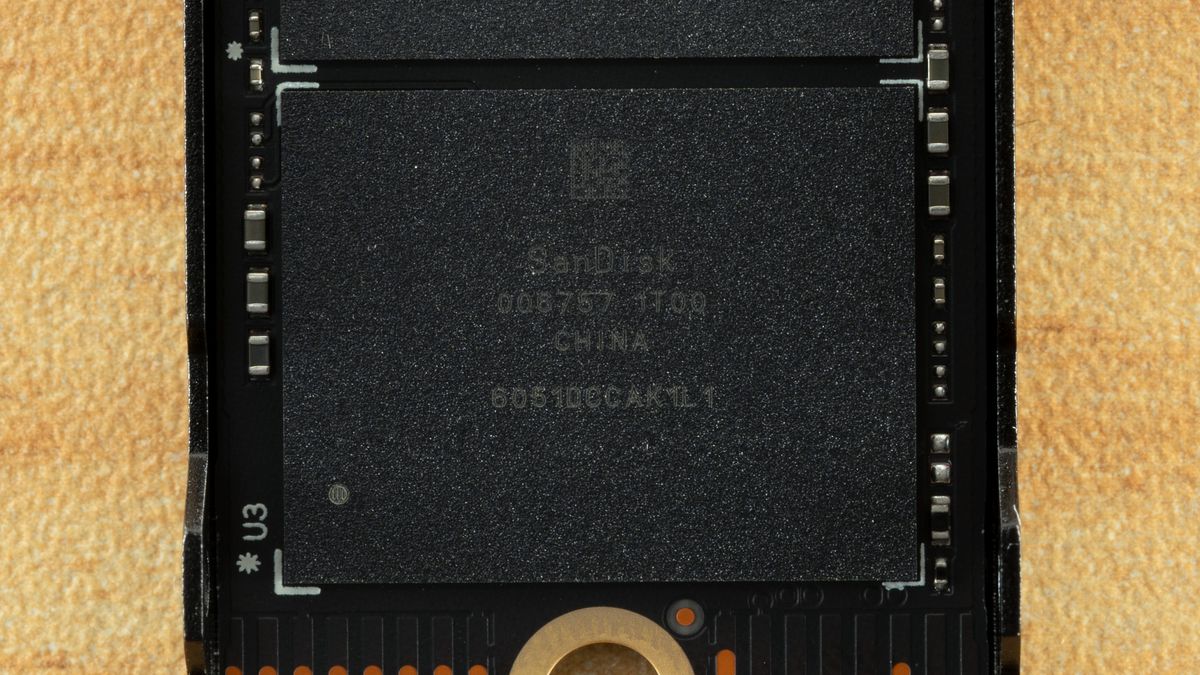
The Optimus GX Pro 850P has a relatively standard SSD layout with an SSD controller, a DRAM module, power management circuitry, and two NAND flash packages. The larger, double-sided versions of the drive will have more NAND flash packages, with two additional packages on the back. We’ve covered the controller and its iterations in the past. The DRAM, for what it’s worth, is DDR4, which is serviceable for the role volatile memory plays on an SSD: mostly as a metadata cache. The one caveat here is that our 2TB drive only has 1GB of DRAM, which is one-half the usual and likewise one-half of what we had on our 2TB WD Black SN850X sample. In practice, this should have no impact on intended workload performance and could potentially reduce cost a small amount.
The flash is potentially more interesting, as it could be the expected BiCS5, or it could have been updated. The 8TB WD Black SN850X uses BiCS6, and it can make sense to cycle in newer flash later on in a product’s lifetime. The Optimus GX Pro 850P is essentially in that line. What we can say for sure is that the flash on here was manufactured more recently than the flash on the Black SN850X samples we’ve reviewed at both capacities – newer in production date, not necessarily in generation – but the performance is close enough that there would be little perceptible difference even if it were generationally different. This drive is at the edge of what you can get out of this controller technology and Sandisk could also choose to tune it specifically for this performance range, so at the end of the day one could say this is, effectively, equivalent to the WD Black SN850X with BiCS5 TLC flash.
We believe our sample is still using BiCS5 anyway – the coding’s sixth character “C” implies that – but that statement applies to any potential BiCS6 swap. In this case, moving to newer BiCS5 means a higher I/O rate, 1,200 MT/s to 1,600 MT/s. The former is plenty to saturate a PCIe 4.0 link with an eight-channel controller like the 850P’s, but putting in newer flash makes sense from a supply perspective. Higher MT/s flash can have lower latency and potentially better power efficiency when run at a lower MT/s, but we don’t believe either is a motivation here. Real-world impacts are, again, minimal, with minor exceptions that might not exist if we were comparing to a current Black SN850X.
MORE: Best SSDs
MORE: Best External SSDs







 English (US) ·