
 2 hours ago
5
2 hours ago
5
Sandisk arrives running hot to the M.2 2230 SSD segment. A spiritual successor to the popular WD Black SN770M, the Optimus GX 7100M invokes memories of the laptop champion WD Black SN7100 with tested and true hardware. Does the class-leading responsiveness and power efficiency carry over to the smaller factor? Portable gaming system owners can rest easy knowing that it does.
We don’t want to confuse WD and Sandisk here, even if the hardware – and software, for that matter – is similar and often shared. Sandisk is making its own mark, and the Optimus GX 7100M, or 7100M for short, is proof of that. While there were few options available in the M.2 2230 form factor when the Steam Deck launched, there would soon be almost too many. Sandisk didn’t have to release this drive, but we’re glad it did, because it does fill an important hole in the lineup where alternatives have become harder to find.
This is a high-end Gen 4 drive, or as high-end as this segment gets. It’s still DRAM-less but can push the full bandwidth of the interface at both capacities. Where it shines is in its random read performance. That’s the key metric for responsiveness or real-world feel, and especially for game-focused hardware, it means the fastest loading times possible. Portable systems also need to use as little power as possible to reduce heat generation and prolong battery life. The 7100M’s pedigree is great there, too. And while 2TB was once hard to find in this form factor, because drives need to be single-sided with just one NAND flash package, the 7100M handles that and does it with faster TLC rather than lower-endurance QLC flash.
Latest Videos FromTom's Hardware
It’s a powerhouse of a product. The reason we say it fills a hole is that the alternatives are hard to find. The Crucial P310 still tends to be a great choice, but the parent company is moving away from the retail space due to AI and enterprise demand. The P310 is also QLC-based, which, while not a big deal anymore, does limit its performance in some cases and means reduced endurance. TLC-based alternatives with Phison’s E27T controller, like the Corsair MP600 Mini, are harder to find and don’t quite match that random read performance. SMI’s competing controller is more often used in budget products, where you can find it, like the Kingston NV3. The 7100M is left as the clear winner if you want the very best – especially if you like its strong software package – with no real drawbacks.
Sandisk Optimus GX 7100M Specifications
Swipe to scroll horizontally
Pricing |
$229.99 |
$449.99 |
Form Factor |
M.2 2230 (Single-sided) |
M.2 2230 (Single-sided) |
Interface / Protocol |
PCIe 4.0 x4 / NVMe 2.0 |
PCIe 4.0 x4 / NVMe 2.0 |
Controller |
SanDisk Proprietary |
SanDisk Proprietary |
DRAM |
N/A (HMB) |
N/A (HMB) |
Memory |
Sandisk 218-Layer TLC (BiCS8) |
Sandisk 218-Layer TLC (BiCS8) |
Sequential Read |
7,250 MB/s |
7,250 MB/s |
Sequential Write |
6,900 MB/s |
6,900 MB/s |
Random Read |
1,000K |
1,000K |
Random Write |
1,300K |
1,300K |
Security |
TCG Pyrite 2.01 |
TCG Pyrite 2.01 |
Endurance (TBW) |
600TB |
1,200TB |
Power (R/W) |
3.5W / 3.8W |
3.7W / 4.0W |
Part Number |
SDSP71100TAT |
SDSP71200TAT |
Warranty |
5-Year |
5-Year |
M.2 2230 SSDs are generally limited to a small range of capacities, and the Sandisk Optimus GX 7100M is no different. Lower capacities don’t make sense for an upgrade when base models typically come with at least 512GB of storage. Larger capacities, 4TB or more, are difficult to achieve in such a small form factor. The 7100M only being available at 1TB and 2TB, therefore, makes sense. We will add that 4TB is possible with slightly longer M.2 2242 SSDs like the Corsair MP700 Micro and, also, 4TB for 2230 will be possible in the future. Furthermore, if devices were designed for double-sided drives, then all these limits would be effectively doubled. From the other side of things, rising memory and storage costs mean that base units might arrive with less storage, making smaller drives relevant again. It’s a push-pull situation.
At the time of review, the 1TB was going for $229.99 and the 2TB for $449.99. At 1TB, you could get the P310 for a little bit less, but otherwise, you will be giving up performance to save money. Considering the P310 is QLC-based, the 7100M isn’t too badly priced there. At 2TB, the price gap is more significant, as you can get slower alternatives for $50 to $150 less. Unfortunately, maximum performance at 2TB is the holy grail, so paying the premium could be worth it. Right now, it’s $50 or 12.5% over the last-generation WD Black SN770M, for instance, and on paper, that sounds reasonable for a drive that’s faster and more efficient.
Both capacities of the 7100M have the same peak performance level: up to 7,250 / 6,900 MB/s for sequential reads and writes and up to 1,000K / 1,300K random read and write IOPS. Both sets of numbers are excellent for a drive in this form factor, and the drive even exceeds what the Phison E27T-based Corsair MP600 Mini can achieve. This is top-tier performance for this segment and a full notch above the WD Black SN770M and effectively matches the 7100M’s forebear, the WD Black SN7100. While the Black SN7100 did not particularly stand out for us with its performance, its power efficiency is fantastic. That bodes well for the 7100M.
SanDisk has the drive pulling 4W or less under typical workloads, which puts the drive into a good spot for mobile devices. We test with a mixed workload, which can push a drive a little bit harder than this. Either way, this isn’t a lot of power for a full-fledged Gen 4 device – the drive’s 7,250 MB/s is near the limits of the interface – so we can expect good power efficiency.
Sandisk backs the drive with the standard 5-year, 600TB of writes per TB warranty. The drive supports the TCG Pyrite 2.01 specification and only has software encryption. This is perfectly normal for a drive of this type. The TBW is, however, higher with TLC versus QLC flash.
Sandisk Optimus GX 7100M Software and Accessories
Sandisk has you covered with its software. The Sandisk Desktop App, which works on Windows and macOS, is useful for general file transfer and password protection – software encryption, as well. The Sandisk Dashboard is Sandisk’s take on WD’s Dashboard, an SSD toolbox application with a wide range of features. An SSD toolbox like this gives you information on your system and drives, including SMART and health information. It lets you test and benchmark the drive. Importantly, this software also helps you update the firmware, if necessary, and use other features such as Game Mode. Sandisk also offers an Acronis True Image download, which is great for backing up files and your OS or for cloning drives.
Sandisk Optimus GX 7100M: A Closer Look
Image 1 of 2
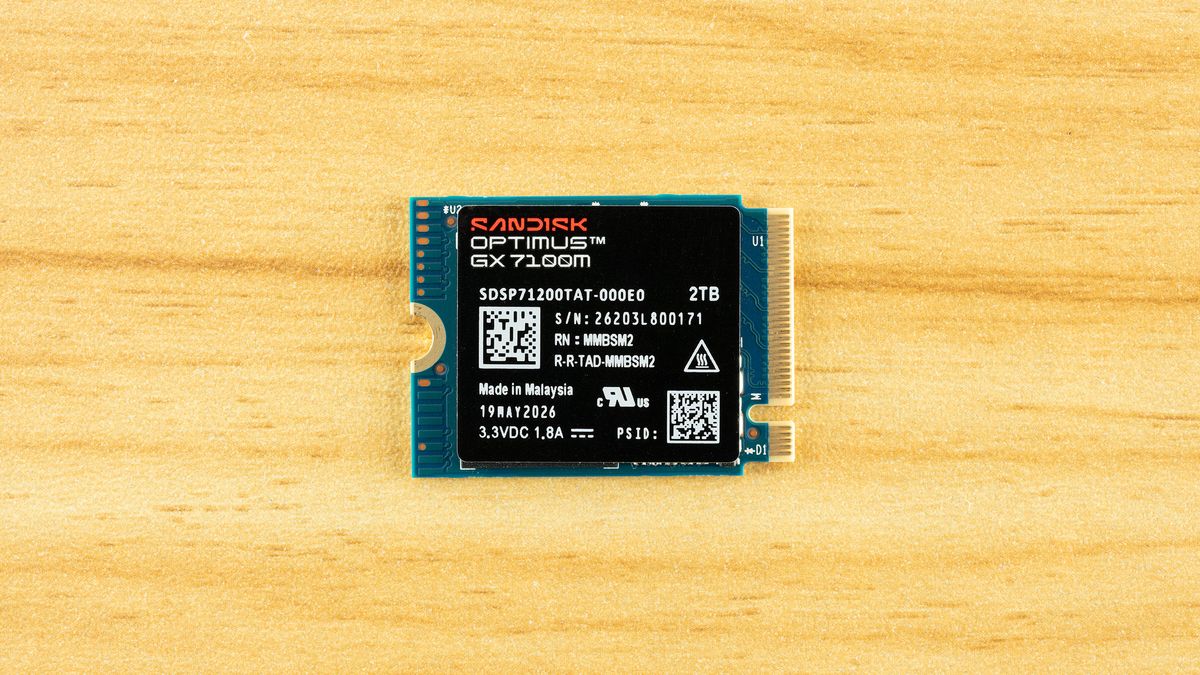
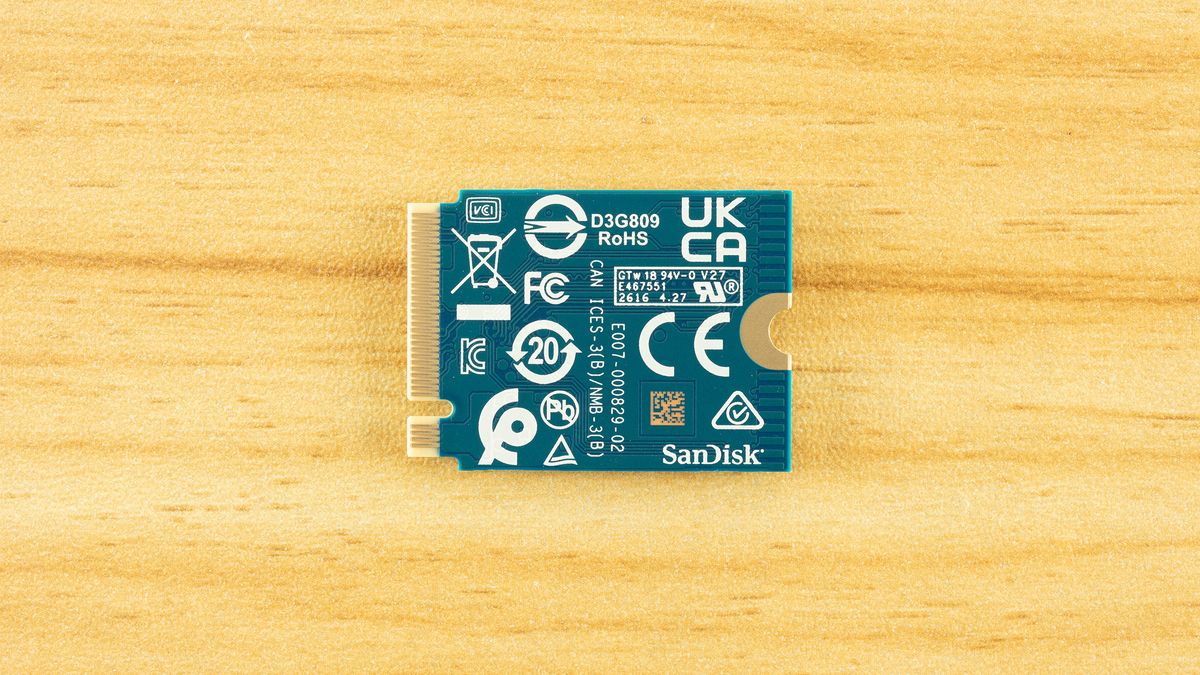
The 2TB Optimus GX 7100M is a single-sided drive, optimized for device compatibility. This does limit it to a single NAND flash package, which puts a cap at 2TB. This is because the most common dies widely available are 1Tb, or 128GB, apiece, and typically a single package – which has to stack the dies on top of each other, might have dummy dies for stability, and has to carefully maintain signal quality without exceeding height limitations – can only hit sixteen dies.
According to the specification sheet, this drive uses the M.2 2230-S3-M form factor. The M.2 format is easily recognizable as the way consumer SSDs are made these days, in contrast to the old 2.5” SATA drives. Other form factors meet the needs of the enterprise. 2230 tells us the length and width in millimeters. This is a common size for portable devices like the Steam Deck, the Asus ROG Ally, and the Lenovo Legion Go. The “M” part means it’s M-key, which we expect these days as NVMe drives using a full four lanes are common. Some drives can drop back to two lanes, like the Samsung 990 EVO and Samsung 990 EVO Plus, but are still capable of using four.
The “S3” is the part we’re looking for here, which tells us it’s single-sided rather than double-sided with a “D.” The number tells us the permitted height of the components. S1 allows for 1.2mm, S2 1.35mm, and S3 1.5mm. We would expect this drive to be S3 since it needs to pack in sixteen dies. The nominal PCB thickness for M.2 is 0.8mm, so this puts the drive at ~2.3mm, and the datasheet lists 2.38mm. This isn’t too interesting on its own, but it could be useful if you know the exact limitations of your device or need to make other measurements, such as for custom cooling. Some devices can take double-sided devices, which, as you can imagine, have similar height thresholds but with components on both sides.
One other interesting thing is the rated power: 3.3V at 1.8A puts the peak power around 6W. This is well higher than the specification sheet, which, again, is for average and also with read and write separately rather than mixed, as well as what’s listed by SMART and in our testing. We reckon this drive will always be below 5W, which normally would ensure there won’t be any heat issues. For M.2 2280, that’s broadly true, but heat is always an issue for 2230.
Image 1 of 3
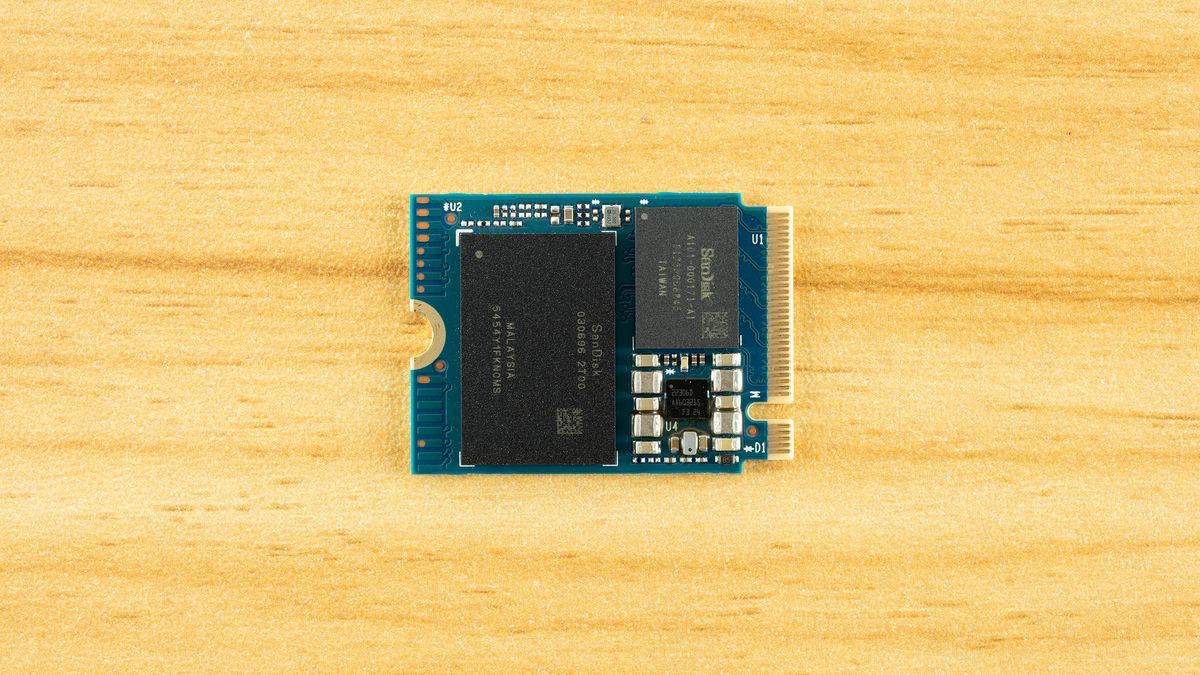
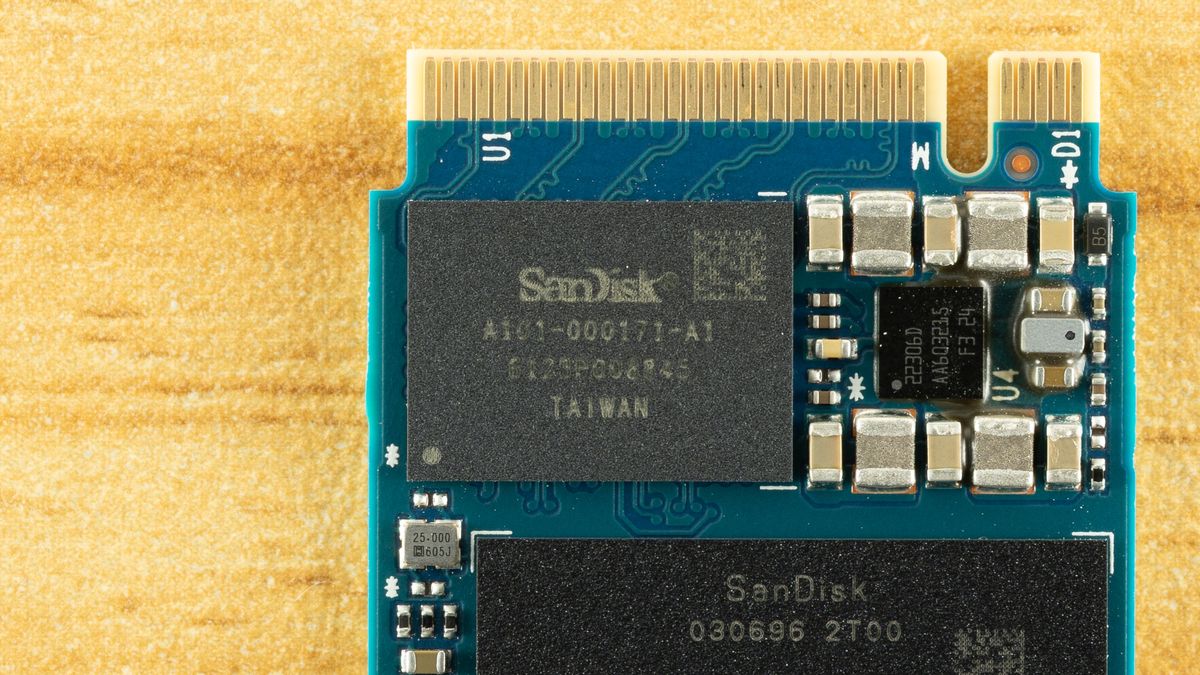
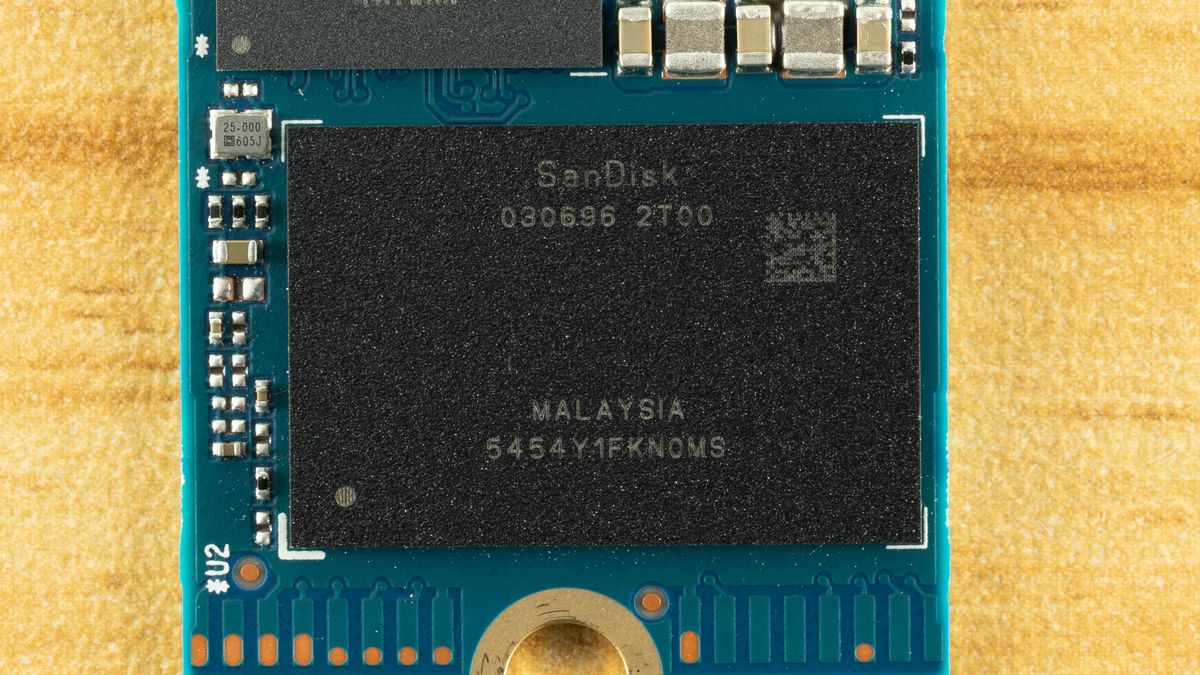
In addition to the sole NAND flash package, the drive also has a DRAM-less SSD controller and power management circuitry. The controller is proprietary Sandisk technology, listed as the A101-000171-A1. Similar to the WD Black SN7100's A101-000172-A1, which is a four-channel controller that can take fast enough flash to saturate PCIe 4.0. We would expect the drives to share the same flash, too, which would be Sandisk’s 218-Layer TLC. BiCS8 flash, whether TLC or QLC, has proven to have fantastic random read latency and also excellent power efficiency. This makes it great for the M.2 2230 segment.
The 7100M is still DRAM-less, as it can be difficult to make a DRAM package work in this form factor. In the past, it was not uncommon to see DRAM at least in M.2 2242, but modern host memory buffer (HMB) solutions are quite good. A quick look at the random 4KB results for this drive will dispel any illusions that you need DRAM to make a drive feel fast. In fact, it’s very unlikely DRAM would ever make a difference in the type of device this drive is made for, although there are always exceptions. Yes, there are some odd drives that have DRAM as part of the controller package – SK hynix’s BC711 comes to mind –, but these are rare and relegated to the Gen 3 era. An OEM Gen 3 drive is perfectly enough for a Steam Deck, but we’re in the business of gauging modern retail options.
The older Black SN770M, which is a retail version of the OEM SN740 – an extremely popular drive when the Steam Deck was still young – and a shortened version of the Black SN770, struggled with power efficiency. At least, in comparison to some of the newer 2230 drives on the block. With that problem out of the way, thanks to more efficient flash, the 7100M might very well be the best drive of its type available. We certainly think so, but knowing the pedigree of the hardware can help explain why this is.
MORE: Best SSDs
MORE: Best External SSDs






 English (US) ·