
 3 weeks ago
38
3 weeks ago
38
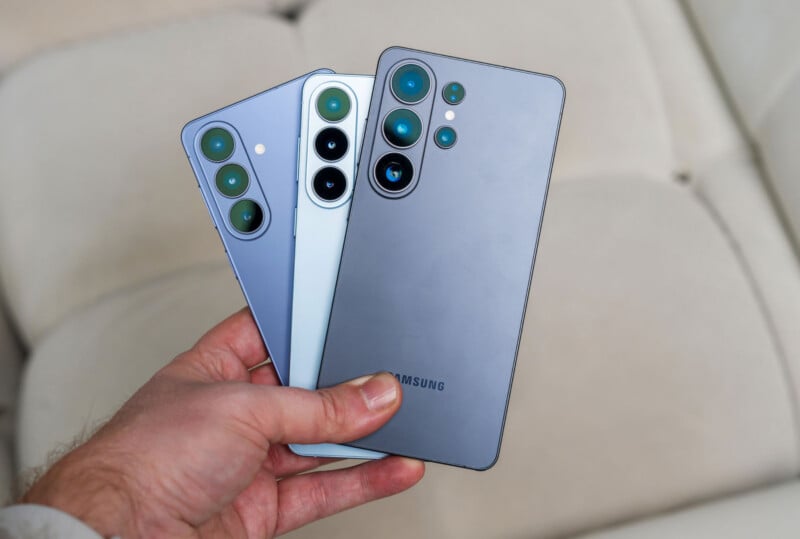
Samsung’s annual winter Unpacked event revealed the latest trio of flagship Galaxy S26 smartphones. The new devices largely preserve the familiar design language of recent years, continuing the company’s emphasis on software-driven upgrades rather than any dramatic makeover.
This goes for all three, with the Galaxy S26 Ultra headlining on top of the Galaxy S26 and Galaxy S26+. There is no radical change here, just another iterative approach bent on fine-tuning the One UI ecosystem with AI-driven features and unique screen technology. I had a chance to spend time with the new phones ahead of the official announcement, garnering some early impressions.
Looking Alike Again
Compared to last year’s Galaxy S25 family, the changes are subtle to the point of being almost academic. The Galaxy S26 Ultra is fractionally taller and wider, slightly thinner, and marginally lighter, while the S26 and S26+ grow just a touch in both size and weight. You’re probably not going to notice these differences in day-to-day use, underscoring Samsung’s conservative industrial design this time.
Where the S26 series does move the needle is in a handful of spec-level upgrades. Base storage now starts at 256GB across all three models, eliminating the lower-capacity entry points of previous years. Charging speeds also start to diverge within the lineup: the standard Galaxy S26 sticks to 25W wired charging, the S26+ steps up to 45W, and the Ultra pushes further to 60W. Still no charger in the box.
Battery capacity ticks up slightly for the S26 and S26+ at 4,300mAh and 4,900mAh, respectively, though the Ultra holds steady at 5,000mAh. Perhaps unsurprisingly, Samsung isn’t going with silicon-carbon batteries for these phones to increase capacity in the same physical space, which puts it further behind some rival Android devices that have since made the move.
All three models are powered by the Snapdragon 8 Elite Gen 5, Qualcomm’s most powerful mobile chipset to date. Apart from the general performance, some Galaxy AI features run directly on the device rather than relying solely on the cloud.
Privacy Display
While not exactly an AI feature, the Galaxy S26 Ultra exclusively offers a feature called Privacy Display. It works by manipulating pixels to reduce screen visibility when viewed from the side, effectively dimming the display at off-angles while keeping it clear head-on. Users have the option to enable it across the whole system, limit it to specific apps, or even apply it to certain notifications when they come in. The effect is purely lateral, as tilting the phone up or down doesn’t do the same thing, so someone hovering over one’s shoulder could still catch a peek.
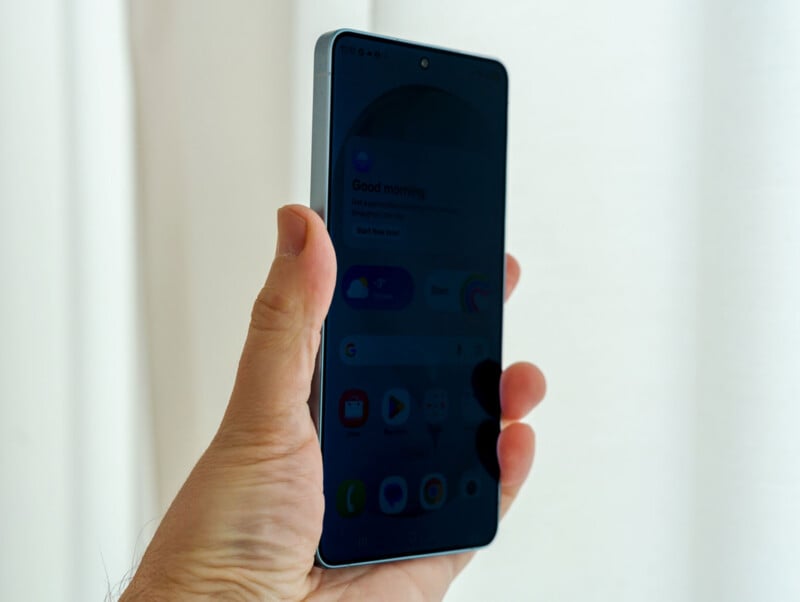 The Samsung Galaxy S26 Ultra has a new Privacy Display feature.
The feature isn’t available on the S26 and S26+, though the phones otherwise share many other software enhancements.
Screen sizes across all the devices also don’t radically change. The Galaxy S26 gets a nudge up to a 6.3-inch FHD+ (2340 x 1080) Dynamic AMOLED 2x, whereas the other two use the same Dynamic AMOLED 2x panels, so a 6.7-inch QHD+ (3120 x 1440) for the S26+ and 6.9-inch QHD+ (3120 x 1440) for the S26 Ultra.
Same Cameras Across the Board
Yet again, Samsung chose to leave camera hardware largely untouched across the lineup. Samsung is using the same cameras as before, with one notable exception being that the Ultra’s 200-megapixel main camera now features a faster f/1.4 aperture. That’s the fastest currently available on a smartphone. The 50-megapixel periscope telephoto (111mm equivalent) also gets a brighter f/2.9 aperture.
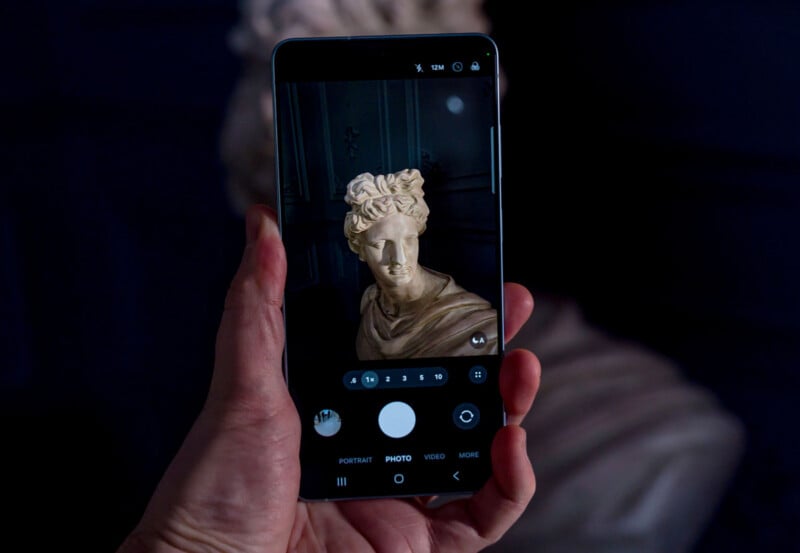 Samsung Galaxy S26 Ultra
The company says it will lead to better low-light performance and improved night photography, though it’s unclear whether any processing gains will yield significant image-quality improvements.
The Galaxy S26 and S26+ use the exact same hardware as their S25 predecessors, so there are no physical changes there.
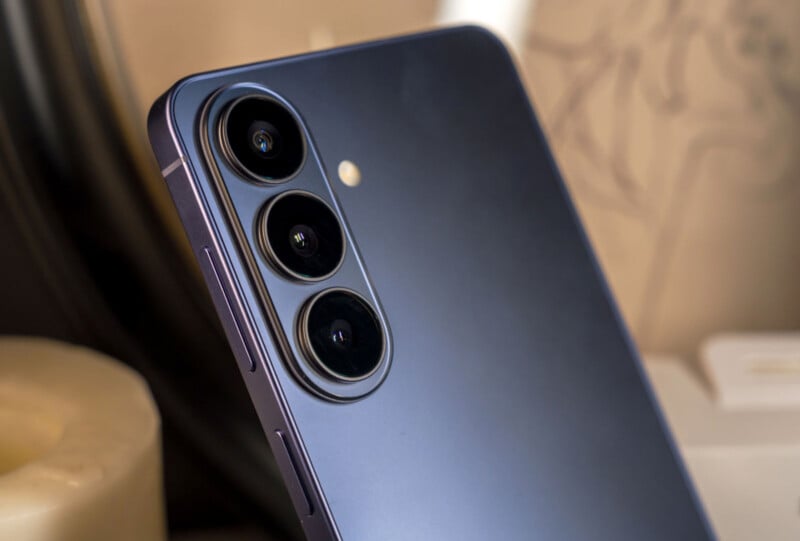 Samsung Galaxy S26+
On the video side, all three models gain a Super Steady Mode with Horizontal Lock, designed to prevent unwanted rotation while filming. When enabled, the phone maintains a level horizon even if you tilt the device while recording, preserving landscape orientation in situations where your grip isn’t perfectly steady. One catch is that it only works with the main and ultra-wide cameras, not with the telephoto lens.
Photo Editing Updates
Samsung keeps moving ahead with Galaxy AI-powered photo editing, blending voice and visual input in a way that basically builds off Samsung’s existing software suite. From the Gallery app, users can tap the Create function and either type or speak instructions to alter an image. That could include simple environmental changes, like turning an overcast sky into a sunny one, or removing an object from an image. All AI-generated results include a labeled watermark in the lower left corner, also noted in the metadata.
More complex edits enable users to circle a specific area of a photo and ask the AI to insert a new object, or even extract a person or item from another image and place it inside. It’s hard to gauge how effective this will be without proper testing, but the AI is supposed to deliver a result that blends the added element in with the primary image by adjusting lighting and context.
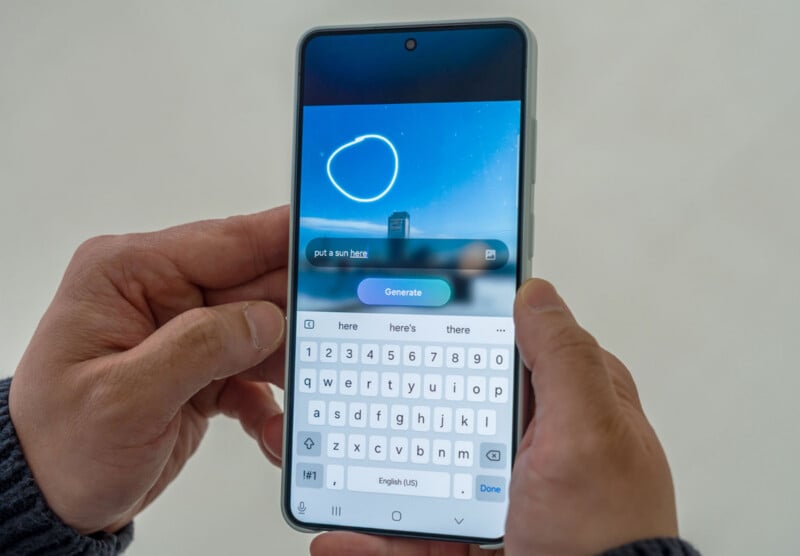 AI is a huge focus for the Samsung Galaxy S26 series.
Pricing and Availability
Taken together, the Galaxy S26 lineup feels like a year of consolidation for Samsung. Minimal hardware changes, familiar design traits, leaving the more interesting developments in software features and subtle display and camera refinements. Samsung seems to be betting that incremental improvements and deeper AI integration will be enough to carry its flagship phones forward this cycle.
All three phones are available for pre-order starting today, with general availability beginning on March 11. The Galaxy S26 Ultra starts at $1,299.99, while the Galaxy S26+ starts at $1,099.99 and the Galaxy S26 starts at $899.99.
Image credits: Ted Kritsonis unless otherwise noted






 English (US) ·