
 3 weeks ago
82
3 weeks ago
82
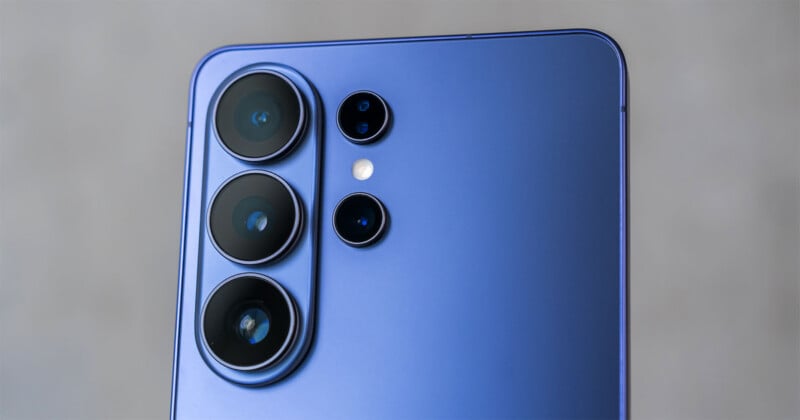
When it comes to Android phones, Samsung is among the first to come up in conversation. The company built part of that cachet on the camera performance of its flagship Galaxy S series, but has long since abdicated the role of setting the pace for mobile camera hardware.
If I were to put up the specs for the Galaxy S23 Ultra and compare them to the Galaxy S26 Ultra, there would be virtually no difference for the main camera because both use the same Samsung Isocell HP2 sensor. Granted, there’s a wider f/1.4 aperture on the newer model, but nothing else to note, physically speaking. Even with newer telephoto cameras, including periscopes, cautious choices don’t necessarily signal a leap forward.
What was once unheard of for a company that built its reputation on trying new things — gimmicky or otherwise — has become the status quo. A strange set of circumstances for a mobile photography landscape that is roaring ahead from Chinese brands, yet largely standing pat for established ones. It’s not just Samsung; this complacency is saddling Apple and Google, too. How can standing still represent a form of progress? I went straight to Samsung to find out.
Finding Room for an Older Sensor
The Korean giant has resources and vertical integration that few others in the industry can boast. The mere fact that it does a very brisk business making image sensors adds to the possibilities and potential pitfalls.
Samsung doesn’t reveal how much it makes from producing and selling image sensors. They sit inside the System LSI Business (the semiconductor arm), which also includes Exynos processors, display driver ICs, and other chips. That revenue falls under the broader System LSI reporting unit, so it’s never clear what the sensors themselves bring in each quarter in public filings.
Second only to Sony in market share, according to research firm TechInsights, Samsung focuses on high-resolution sensors with higher value, meaning the types more likely to be found in flagship-level devices. The HP2 falls under that distinction, as does the Type 1/1.4 HP9, a flagship-level sensor it sells solely to competing brands.
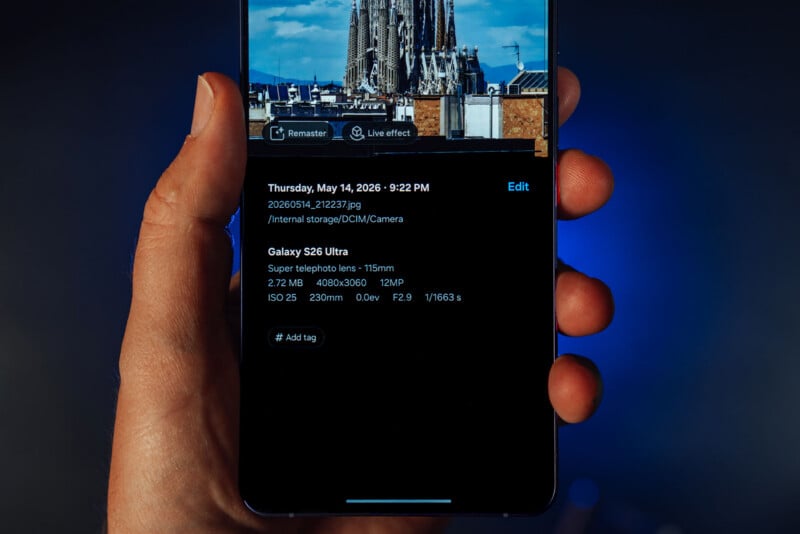
The S26 Ultra’s 3x telephoto (69mm equivalent) uses an Isocell 3LD Type 1/3.94 sensor that’s very small by flagship telephoto standards. It’s already smaller than the Sony IMX754 Type 1/3.54 sensor previously seen in the S23 Ultra (and subsequent Ultra flagships), and a far cry from the much larger sensors used by brands like Xiaomi, Vivo, and Oppo.
“We don’t think of leadership as a race to introduce new sensors every year,” Joshua Cho, Executive Vice President and Head of the Visual Solution Team, Mobile eXperience (MX) Business at Samsung, tells PetaPixel. “We made a deliberate choice in continuing with the HP2 sensor because it gives us a stable foundation to refine how the camera performs across a wide range of scenarios, like bright daylight, low light, video and zoom. We don’t define progress by changing components year to year for the sake of on-paper spec improvement. What matters more is how the camera performs in the moments people care about.”
He adds that, since image quality is largely determined by how the sensor, lens, actuator, and software stack work together, finding the “balance” among them is the higher priority. “System-level optimization” is why the sensor works better, the software around it is improved, the lens is brighter, and the ProVisual Engine processes data more intelligently.
Fair enough, but that doesn’t explain why Samsung’s own more advanced sensor — the HP9 — is available to Vivo and Xiaomi while Galaxy Ultra users are still on the HP2. Or, even why it opts not to change the main sensor after three years.
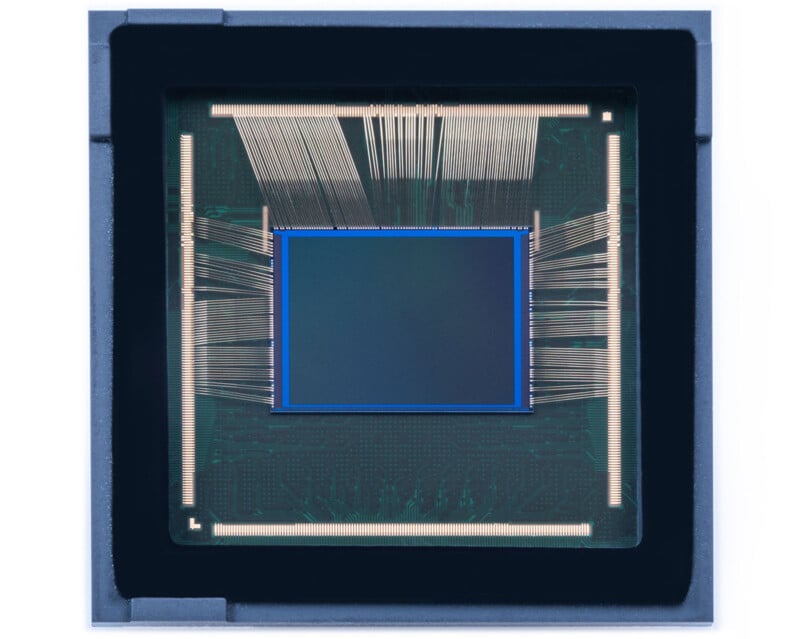 Samsung ISOCELL HP9 | Credit: Samsung
Why Is the HP9 Missing in Action?
“System-level optimization” is often cited by Samsung executives to justify this move. Competing flagships like the Vivo X300 Ultra and Xiaomi 17 Ultra both use Samsung’s HP9 for their respective telephoto cameras. Both use custom HP9 variants in collaboration with Samsung. The Galaxy S26 Ultra competes with these devices, so why not fight fire with fire, especially when it’s on your own proverbial shelf?
“A camera system cannot be defined by one component in isolation, even one as important as the sensor. Different manufacturers will take the same hardware and integrate it in very different ways,” Sunghoon Moon, Senior Executive Vice President in charge of Hardware Team, Mobile eXperience (MX) Business at Samsung, tells PetaPixel. “What ultimately matters are the results. Our approach is focused on delivering consistent, high-quality performance for real-world use cases, and we’re confident our customers will be very happy.”
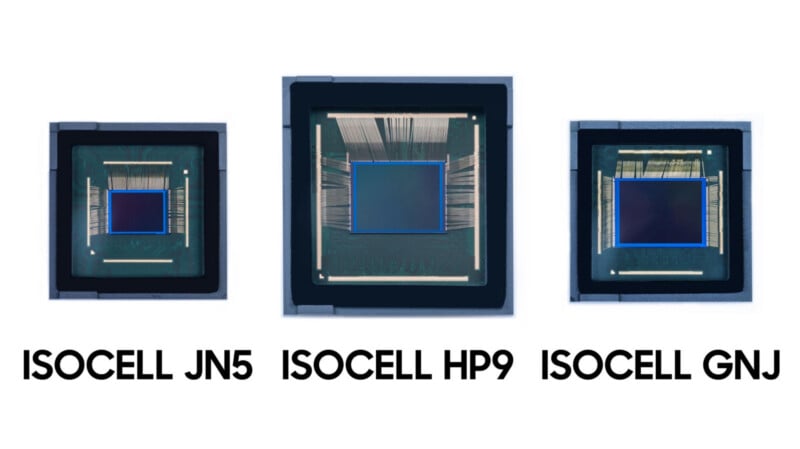 Credit: Samsung
Even so, the perception problem is that Samsung chooses to sell a better sensor to competitors while telling its own customers that the HP2 remains the right choice. A “system integration” argument would land harder if Samsung were using the newer sensor and outperforming competitors who also had it.
In fairness, Moon doesn’t claim the HP9 wouldn’t improve things; he’s saying the overall system’s needs matter more than a key spec. It’s just hard to square how a better sensor, combined with Samsung’s system-level expertise, wouldn’t produce better results than a three-year-old sensor with the same expertise applied. Moreover, it raises questions about the kind of quality images such a combination could theoretically produce.
“We continuously evaluate when a change at the component level can meaningfully raise the overall performance of the system,” says Cho. “If a new sensor or technology allows us to deliver a clear improvement across real-world scenarios — not just in one area, but in consistency, reliability, and overall image quality — that’s when it becomes the right direction to take.”
That’s not claiming the HP2 is the best sensor for the job indefinitely, it’s suggesting that no component-level change has yet cleared that bar. It also puts Samsung in an awkward spot because it implies either the HP9 doesn’t clear that bar or the bar itself is being defined in a way that protects the current approach.
“The HP2 sensor is deeply integrated into our imaging pipeline. From the early design stages, it was developed alongside the ISP and processing framework, which is what allows us to tune performance very precisely across different shooting conditions,” says Moon. “Rather than approaching this as maximizing performance at a single point in time, we’ve focused on continuously improving how the sensor performs as other parts of the system evolve.”
Size Matters
One cue explaining this approach is Samsung’s focus on design and its desire to get thinner. Moon notes that the S26 Ultra is Samsung’s thinnest Ultra yet, and that fitting newer, larger sensors creates integration challenges.
“Sensors like the HP9 offer very high resolution, but that alone doesn’t determine how well they perform in a telephoto module, and using the largest sensor isn’t always the optimal choice,” he says. “Physical factors, such as size and how well it fits within the device, also come into play.”
He’s not wrong in citing that as a genuine engineering constraint. Thinness, thermals, and battery capacity all compete with camera module size. While the likes of Xiaomi, Vivo, and Oppo demonstrate they’re more than comfortable with thick camera modules, Samsung hasn’t shown any such willingness in making that trade-off, save for maybe the Galaxy Z Fold 7.
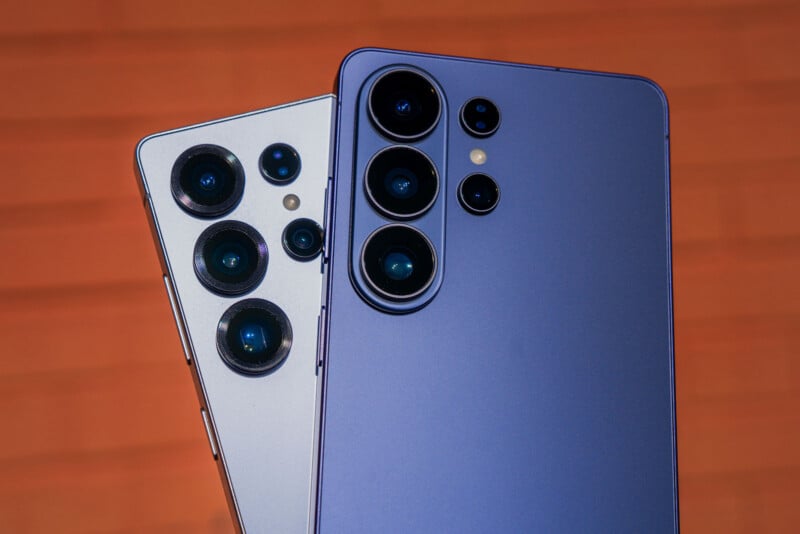 The Samsung Galaxy S25 Ultra (left) and S26 Ultra (right)
But that’s not to say those Chinese brands haven’t managed to integrate it into their own otherwise thin devices. Samsung doesn’t explicitly say the HP9 doesn’t fit; it only says that fitting sensors into thin devices is hard. It’s largely a design choice that speaks to the broader system-wide approach rather than a binding engineering challenge.
That’s also likely why the Galaxy S Ultra line looks so similar year over year. While the S26 Ultra may be the thinnest yet, it’s just 1mm thinner than the S21 Ultra. Other tweaks like rounded corners or more refined edges have arguably made a bigger difference.
Impacting Camera Performance
None of this is to say the S26 Ultra has a bad camera because it’s not in the grand scheme. It offers plenty of modes and manual controls, and includes improved video in Pro Video mode with its own codec and LUTs. Wider apertures certainly aren’t a bad thing for better light gathering. The ProVisual Engine also seems to do something to reduce noise and manage exposure that may not show up on a spec sheet.
 The best way to capture action shots is to use Pro or Expert RAW mode. This is a DNG file edited in Lightroom.
However, if we’re talking about a system, we must also consider the kind of photography that remains a challenge on Samsung’s best phones. Action photography remains one of them, where even the S26 Ultra struggles to freeze action in motion unless you use the Pro or Expert RAW modes. Same with a long exposure shot or something leaning more towards street photography. Low-light photos are a similar story in that the shutter may not stay open long enough in accordance with available light. Chinese competitors offer a slew of ways to capture these shots with little user input and a fast shutter response, clarifying that this kind of software optimization exists elsewhere — including the very same phones that use its HP9 sensor.
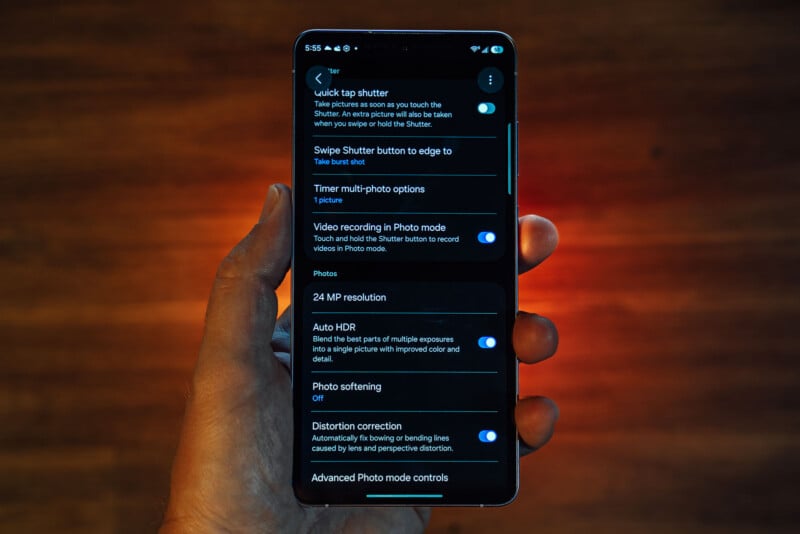
Samsung offers an alternative setup, but it requires downloading the Camera Assistant app from the Galaxy Store, which presents a more granular list of camera settings than the regular Camera app. It’s nice to have but an odd way of laying things out when they can just be combined into one settings layout.
“For our core camera interface, our approach is to keep it simple and intuitive,” says Cho. “For most users, the priority is being able to capture great results quickly, without needing to navigate complex settings. So, it’s about striking the right balance in delivering advanced capabilities for those who want them, while ensuring the overall experience remains seamless and accessible for everyone.”
In that vein, Samsung likes talking about Galaxy AI and the philosophy behind computational photography whenever it launches a new device, mainly because that’s where it invests plenty of resources. Cho draws a distinction between image enhancement — reducing noise, improving dynamic range, refining detail — and image alteration, which involves changing the actual content of a scene.
Both are available, though he adds that altered images get a watermark and content credentials aligned with C2PA standards, so viewers know the image has been modified. You could crop out the watermark, except removing the content credentials requires a third-party app.
Samsung’s current framework handles obvious cases, such as removing a photobomber or adding an element. What it doesn’t fully address is AI-driven decisions about exposure, color, and sharpness that happen automatically without user input and quietly shift what a photo looks like. Under those conditions, the lines blur a little.
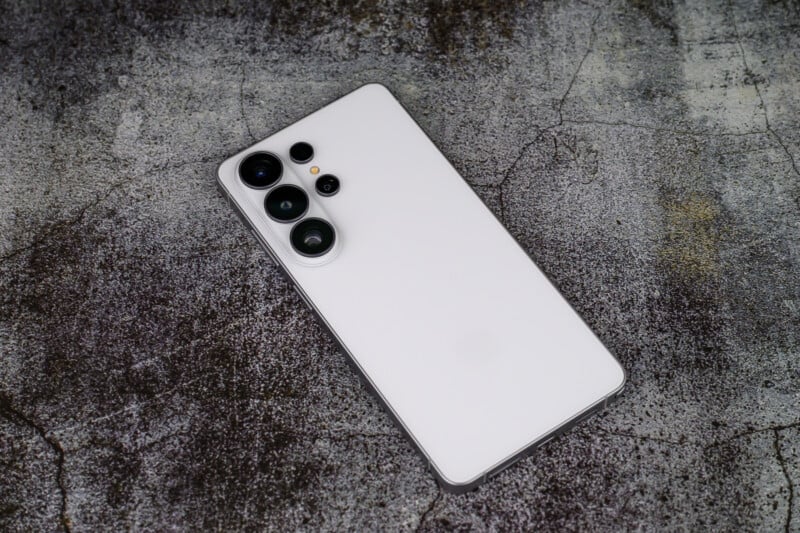 Samsung Galaxy S26 Ultra | Photo by Chris Niccolls
The Bigger Picture
The Galaxy S26 Ultra has its moments. I’ve shot with it enough myself to see that. Samsung’s position in the smartphone market also remains strong, not to mention its vertical integration with sensors, processors, and displays.
But is the company pressing that advantage or living off it? Three years with the same sensor, plus a competitor lineup that’s surpassing it in image quality, seems like a lot at once for a company that, as Cho acknowledges, “was very aggressive” in camera hardware as recently as a few years ago.
Samsung knows how to build better sensors. It just can’t find a place for it in its most expensive phones within a system it builds in-house from top to bottom. Two different entities within Samsung (the mobile and semiconductor arms) handle this from slightly different perspectives.
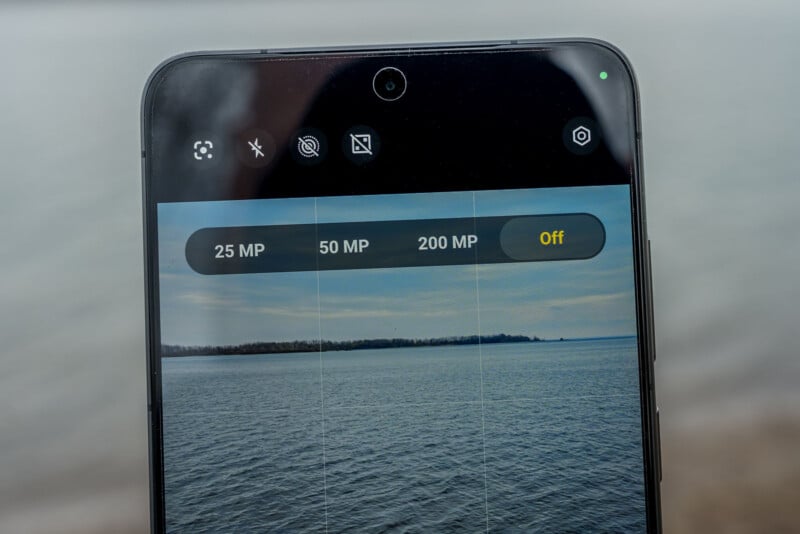 The Vivo X300 Ultra shown here sports a Samsung HP0 image sensor for its 200-megapixel telephoto camera.
“The sensor team focuses on advancing the technology itself, while our role is to ensure it works as part of a complete product,” says Cho. “Overall, it’s less about individual specs and more about how everything comes together and how consistent, dependable and seamless the camera feels in everyday use. That close collaboration is what really matters as it allows us to take advanced sensor technology and turn it into an experience that just works whenever people need it.”
It’s a contradiction and conundrum all at once. One division is trying to sell its best technology to whoever wants it, while the other must explain why its best phones don’t need it.




 English (US) ·