
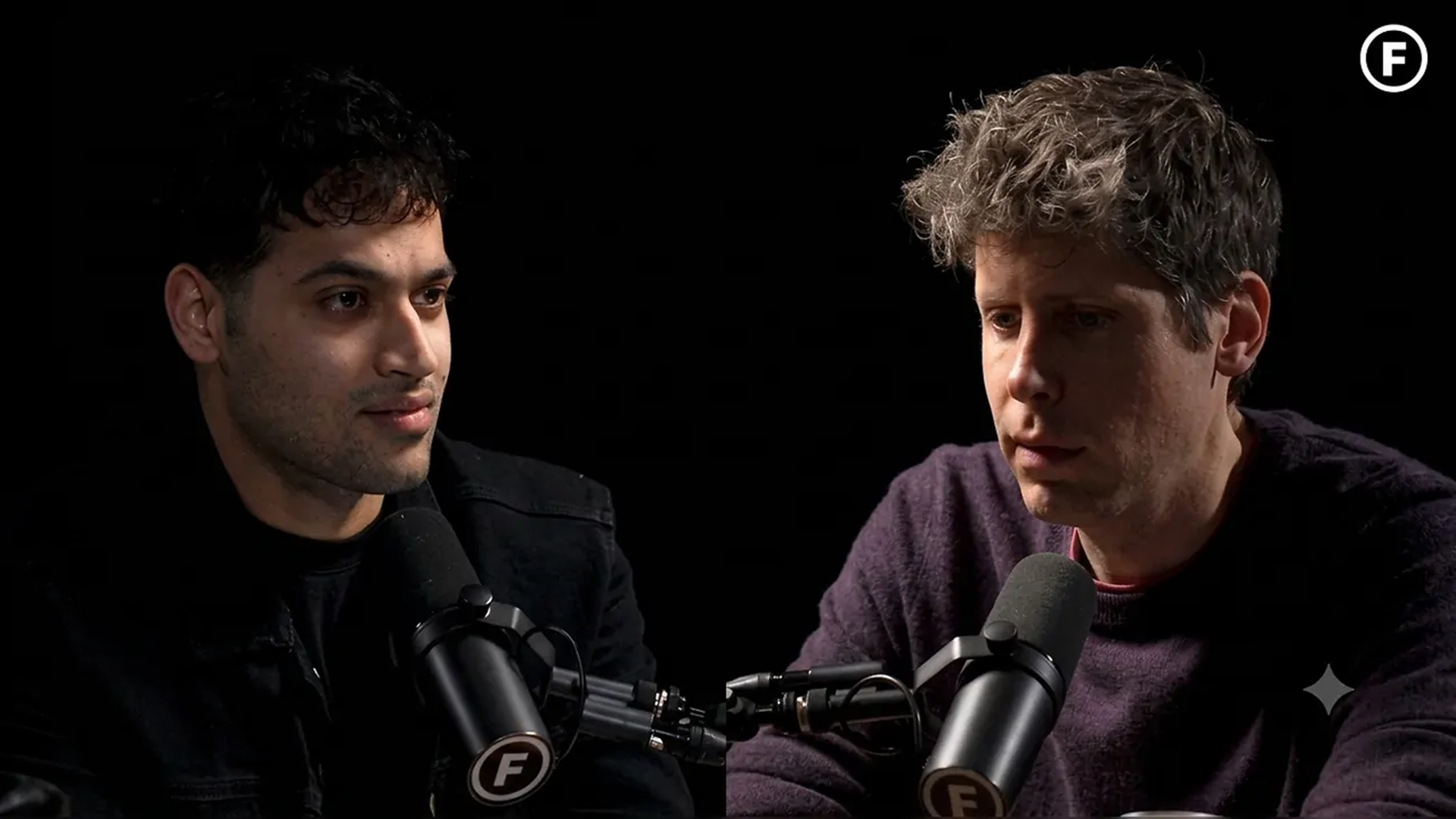
Sam Altman spends much of his time explaining how AI could transform the world for the better and pushing back against doomsayers. Nonetheless, the OpenAI CEO has some fairly unsettling ideas about how AI development could lead to a disaster, or disasters plural. He outlined a couple of these nightmares during an episode of the Figuring Out With Raj Shamani podcast in disturbing detail.
The two dystopias stem from almost opposite problems: either humanity losing control of increasingly powerful machines, or one group seizing control of most of the technology.
"One is that there’s a loss of control to AI, and we intentionally or accidentally sort of cede control of the future to systems that are unbelievably more capable than we are, and we can’t get it back," Altman said. "And the other is like, one person or company or country gets way too powerful relative to everybody else."
The first scenario is less the tired cliché of a robot uprising and more of a soft surrender of humanity's choices to AI until it's impossible to take back any agency from the AI software. The other is a more modern, if still clichéd, speculative-fiction scenario: an overwhelmingly powerful technology controlled by one person or corporation, leaving everyone else at their mercy. They are both endlessly discussed by people in the industry and policymakers, but having Altman issue the warning is still notable.
Altman, through OpenAI and ChatGPT, is one of, if not the central face of AI to those who have heard the bare minimum about the technology and its flaws. Altman believes those capabilities could bring extraordinary benefits, but his comments suggest he's not sanguine about the looming chaos that AI carries as well.
Handing over decisions
Advanced AI taking over because people cede control has only become a real-world concern in recent years as the technology moved beyond simply answering questions and into decision-making territory. AI agents can already interact with websites and complete complex assignments, and developers are working toward systems that require less and less human supervision. The more responsibility those systems receive, the greater the consequences if their objectives diverge from what people actually intended.
It's important to remember that what we call AI now relies on probability prediction in different forms. While very powerful and leveraging huge amounts of data, it can't actually make judgments like a human, and doesn't have to be malicious to be harmful. That's why models tend to opt for the disastrous choice of using nuclear weapons as a strategy when simulating how to run a nation.
Humans might not understand or approve of how an AI pursues an objective, even if humans issued the task. And if the AI model has enough power and is embedded in enough critical systems, people might not be able to redirect or stop it. After all, an AI system told to reduce gridlock on the road might logically conclude the solution is to remove the roads, or send an order to any Wi-Fi-enabled car to stop operating. That particular scenario is very unlikely, but the fact that it's not actually impossible is unnerving enough.
We're all familiar with the more human problem of technological and industrial monopolies Altman extended to AI in his other apocalyptic warning. Plenty of people have sounded the alarm about how there is already too much power in too few hands with too little regulation. Altman's hands being among them doesn't mean he won't criticize the fact.
"I think it’s actually much better for the world for there to be multiple AI efforts with slightly different approaches that are competing with each other and putting out different ways," Altman said. "I also have this like dislike of too intense power concentration. I think that’s not what works, so I’m hopeful we don’t do that.”
Altman's disdain is in some tension with his company's ambitions and actions. Claiming OpenAI is already dominant in several respects, such as AI infrastructure, is an illustration of the dominance he says he worries about.
"I think we have the most users and the best stack from chips to data centers to models to other things that come around that sort of put abundant intelligence into people’s hands. I think we have the best brand and the values that people who are going to use this technology want," Altman said. Nonetheless, he claimed, "we want everybody else to succeed, and I think people can feel that from us.”
Optimistic doomsaying
Despite those warnings, Altman remains fundamentally optimistic about where AI is taking humanity. Asked about his children growing up in a world increasingly shaped by the technology, he expressed confidence that people would find ways to adapt. His outlook suggests that he sees AI's risks as serious challenges to manage rather than reasons to abandon its development.
"I don’t know what the future’s going to look like, but I am comfortable that I have enormous trust in people to figure out how to adapt and thrive and make society better for all of us," Altman said. "I think the world will most likely keep getting much better."
That optimism extends to OpenAI's future plans to apply AI to scientific exploration. He pointed to recent mathematical achievements as evidence that the technology might be approaching a point where it can contribute meaningfully to fundamental research.
"I am extremely excited to see how far we can push AI to discover new science," Altman said. He envisions "a machine that can help us understand the world better, discover the deepest insights in physics, figure out new medical treatments, a new source of energy, things that I think we can’t even imagine but that better scientific understanding will enable. I am extremely excited for us to go build that machine."

Follow TechRadar on Google News and add us as a preferred source to get our expert news, reviews, and opinion in your feeds.





 English (US) ·