
 4 hours ago
7
4 hours ago
7
Rocket Lab announced the Neutron rocket in 2021, aiming for a first flight in 2024.
Artist's illustration of the Neutron rocket. Credit: Rocket Lab
Rocket Lab announced Wednesday that its Neutron launch vehicle won’t fly until 2027, citing an issue discovered during manufacturing of the rocket’s carbon composite structures.
The announcement was public confirmation of what nearly everyone inside Rocket Lab and the wider space industry already knew. The most recent official update from Rocket Lab in August suggested the company still held hope of delivering the first Neutron rocket to its launch pad at Wallops Island, Virginia, before the end of this year, a schedule that would have almost certainly pushed the first flight into 2027.
But Rocket Lab’s statement Wednesday about Neutron’s schedule suggests the company is still struggling with manufacturing the rocket’s large booster stage. Neutron’s reusable first stage is made of carbon composite structures, which offer low weight, high strength, and corrosion resistance. But carbon composites in aerospace are generally harder to manufacture than metallic structures.
Peter Beck, Rocket Lab’s founder and CEO, identified a manufacturing defect as the reason for Neutron’s latest schedule slip. The problem lies in the dome sections at the ends of the rocket’s first stage propellant tanks.
“Recently, we identified an issue with the manufacturing process for the propellant domes specifically, and this caused us to delay production and investigate further,” Beck said in a video released by Rocket Lab.
Scaling up
Engineers discovered voids, or air pockets, between layers of carbon fiber that make up the domes’ composite structure. Carbon composite manufacturing involves laying down carbon fiber layers in a mold, then curing, or heating, the material to bind the fibers together. But this is a tricky process, especially for large structures that won’t fit into an autoclave, a high-pressure thermal curing chamber common in modern aerospace factories.
The Neutron rocket’s first stage is the “largest pressurized structure ever made out of carbon composite,” Beck said. “Because of its scale, we’ve had to develop new out-of-autoclave processes to build Neutron, and this includes custom cure cycles for the very large pieces, like the forward and aft domes for the propellant tanks on Stage One.”
Inspections revealed voids in a newly cured forward dome, defects that could affect the structure’s strength, durability, and reliability, Beck said. “They don’t necessarily mean that the dome would fail in flight, but our practice is to proceed only when we believe the system has the appropriate margins.”
Engineers traced the voids to a recent design change intended to strengthen the rocket’s structure. Rocket Lab introduced the design change after a Neutron propellant tank unexpectedly ruptured during a hydrostatic pressure test in January, a failure blamed on a manufacturing defect at a “critical join” in the tank.
Officials said the failed carbon composite tank was manufactured by a “third-party contractor using a manual hand-lay process,” a decision made to allow tank testing to move forward while Rocket Lab brought online an automated fiber placement machine, which is now operational. Rocket Lab also deleted joints in the first stage tank structure and increased the thickness of some sections of the carbon composite.
“Those thicker sections are where the voids formed,” Beck said.
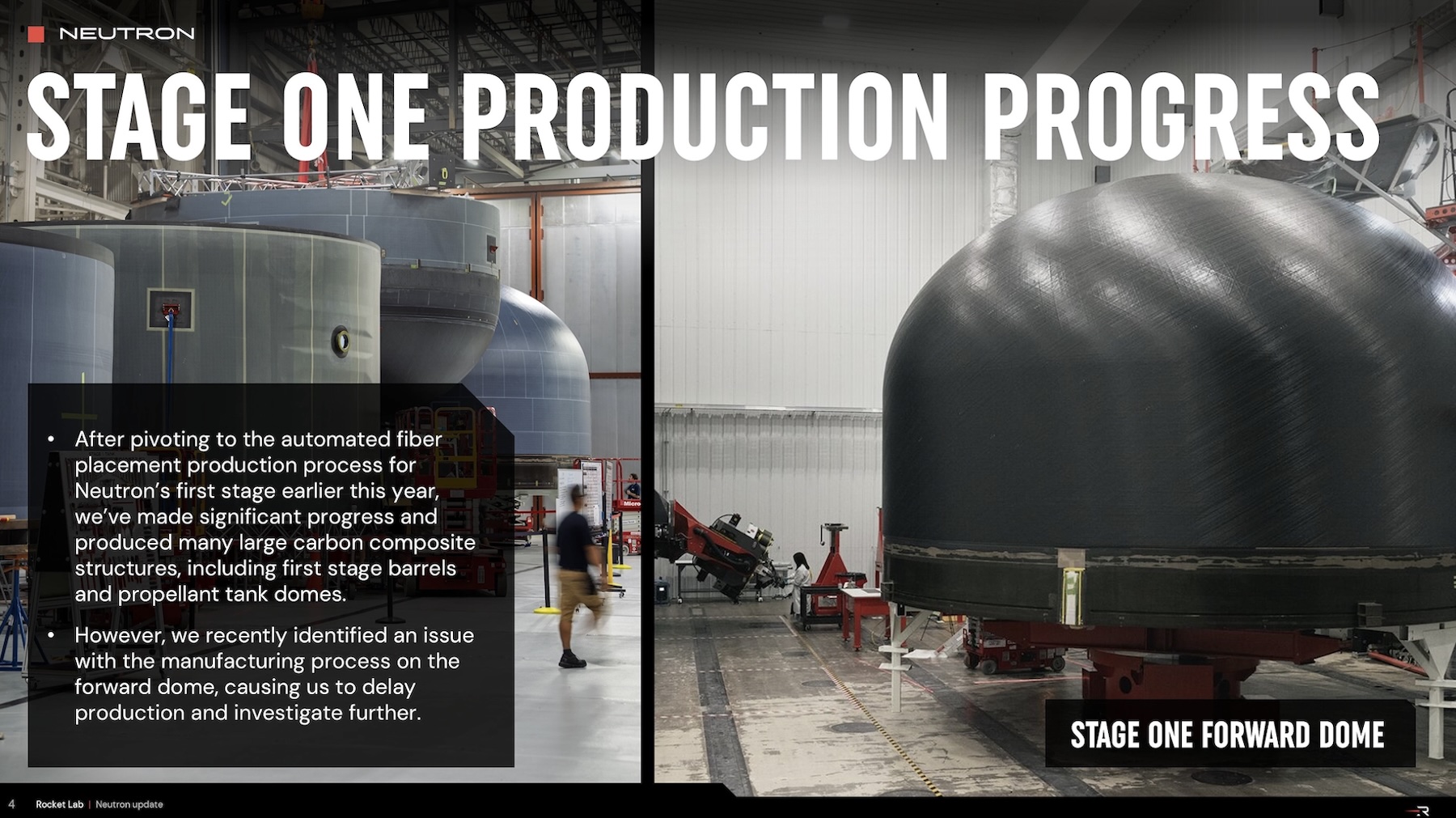
Propellant domes inside Rocket Lab’s Neutron factory.
Credit: Rocket Lab
Propellant domes inside Rocket Lab’s Neutron factory. Credit: Rocket Lab
Curing the void
Rocket Lab said the problem appears to be solved after modifying the manufacturing process again. An aft propellant dome made with the updated procedure passed inspection.
“We’ve solved the problem,” Beck said. “That gives us complete confidence to move forward with the new forward dome. That process to make a new forward dome, combining with all the time that it took to investigate, identify, and resolve the issue, has pushed Neutron’s first launch date to next year.”
The Neutron rocket is significantly larger than Rocket Lab’s Electron launch vehicle, also made of carbon fiber. The light-class Electron rocket is 3.9 feet (1.2 meters) in diameter, while the medium-lift Neutron measures 23 feet (7 meters) across at its widest.
Rocket Lab completed qualification testing on Neutron’s expendable second stage and payload fairing last year. The rocket’s design is unique: The upper stage and payload rest inside the first stage’s nose cone during the initial phases of launch. A few minutes after liftoff, Neutron’s booster stage will open its clamshell-like nose cone to release the upper stage and payload to continue accelerating into orbit. Then the first stage will close its payload fairing and return to landing on an offshore platform for reuse.
Neutron’s first stage methane and liquid oxygen tanks are the largest elements of the rocket, and they must withstand internal pressure and the rigors of launch and reentry.
Rocket Lab’s checklist for the first Neutron flight is long. Final qualification of the first stage is still pending, as is qualification of the rocket’s methane-fueled Archimedes engine, nine of which will power the Neutron booster. Rocket Lab reported in August that it was heading into the “final stretch” of engine qualification testing.
Once that is complete, teams will begin the launch campaign on Virginia’s Eastern Shore. Launch campaigns for new rockets often take months before a first flight, involving multiple integrated fueling tests, countdown rehearsals, and a static fire.
Engineers often discover new problems during integrated testing, requiring repeat tests and tweaks to procedures and hardware on the launch pad and the rocket. That is the purpose of such testing.
Rocket Lab announced the Neutron rocket in 2021, aiming for a first flight in 2024. The Neutron development timeline has now doubled.
Beck said Wednesday that Neutron’s development remains “on an ambitious timeline.” In previous statements, Beck has emphasized Rocket Lab’s focus on quality and its unwillingness to launch an “unproven product.”
“Our aim is to make orbit on the first try,” Beck said last year. “You won’t see us using some qualifier about us just clearing the pad, and claiming success and whatnot, and that means that we don’t want to learn something during Neutron’s first flight that could be learned on the ground during the testing phase.”
Rocket Lab has achieved great success with its Electron rocket, with a capacity of deploying up to 660 pounds (300 kilograms) of payload into a low-altitude orbit. Electron has made 97 flights to date, with 56 consecutive successes.
With Neutron, Rocket Lab seeks to compete for a wider range of launch contracts, eyeing opportunities to sell launches to the US military and operators of satellite megaconstellations. Its lift capability to low-Earth orbit is nearly 29,000 pounds (13,000 kilograms).
“We’re building the program’s long-term infrastructure at the same time as we build our first rocket, so that we can scale quickly, unlock global launch crunches, and commercial customers, governments, and our own future satellite services are also counting on it,” Beck said Wednesday. “But I’ve also said that we won’t rush to the pad with unnecessary risk, and that development programs like Neutron have their challenges.”
Neutron’s latest challenge popped up just as the rocket’s prospective customers clamor for more launch capacity. SpaceX, the market leader, is pivoting to the giant Starship rocket and will, in the next few years, retire from commercial service its workhorse Falcon 9 rocket, without which many satellite startups would be unable to put their payloads into orbit affordably.
That puts Rocket Lab in the mix to scoop up business from satellite operators whose payloads don’t match up with Starship’s capabilities. But there’s stiff competition. Other rocket companies, such as Relativity Space, Stoke Space, and Firefly Aerospace, are working on medium-lift rockets to address the same market.

Stephen Clark is a space reporter at Ars Technica, covering private space companies and the world’s space agencies. Stephen writes about the nexus of technology, science, policy, and business on and off the planet.







 English (US) ·