
Sony Pictures Releasing
Fans of cryptid lore may know all about the Mothman of Point Pleasant, West Virginia. The story goes that between 1966 and 1967, a large, humanoid moth-like creature was seen lurking in the shadows of the town. It was said to have large, round, red eyes, a black body, and a massive wingspan. When it flew through the air, it didn't flap its wings but soared silently at enormous speeds. People who encountered the Mothman claim to have experienced an eerie, hypnotic effect from staring into its eyes. On December 15, 1967, the Silver Bridge in Point Pleasant unexpectedly collapsed, killing 46 people. Mothman, as legend dictates, has been directly blamed for the collapse. Newspaper reports from the time noted that it was actually corrosion cracking that caused the collapse.
The details of the Mothman sightings were detailed in John Keel's famed 1975 book "The Mothman Prophecies." The rise of the Mothman, Keel noted, was connected to then recent alleged sightings of UFOs and a general surge of other supposedly supernatural events occurring in the world. Keel, it should be noted, is well known as an author of books on UFOlogy, ghosts, and the paranormal, and he is credited for inventing the phrase "Men in Black." After Keel's book was published, the Mothman entered the lexicon of other popular cryptids like Bigfoot, the Loch Ness Monster, and the Jersey Devil. These days, one can visit a notably callipygian Mothman statue in Point Pleasant and purchase Mothman plushies at Build-A-Bear.
Eventually, director Mark Pellington and writer Richard Hatem adapted Keel's book into an eerie, moody cult 2002 horror movie also called "The Mothman Prophecies." The film is currently streaming on Netflix and stars the likes of Richard Gere and Laura Linney.
The Mothman Prophecies channels The X-Files
Sony Pictures Releasing
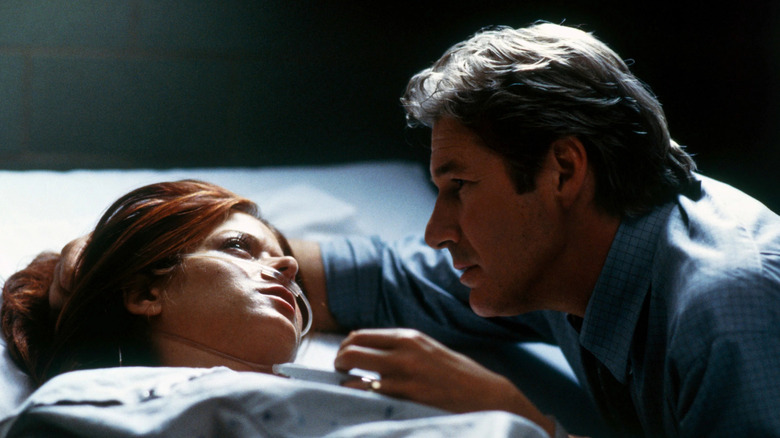
The movie version of "The Mothman Prophecies" is less reminiscent of John Keel's literature and has more in common with the larger "X-Files" franchise (which was, after all, very popular in the years leading up to its theatrical release). It's a mysterious and morbid affair that's heavy on atmosphere. Richard Gere stars as John Klein, a fictional Washington Post reporter whose wife, Mary (Debra Messing), was injured years earlier after swerving her car to avoid hitting what she believed to be the Mothman. Upon being taken to the hospital, however, it was discovered that Mary had a brain tumor, which led to her dying shortly after. The causal connections in "The Mothman Prophecies" are all equally tenuous and unexplained.
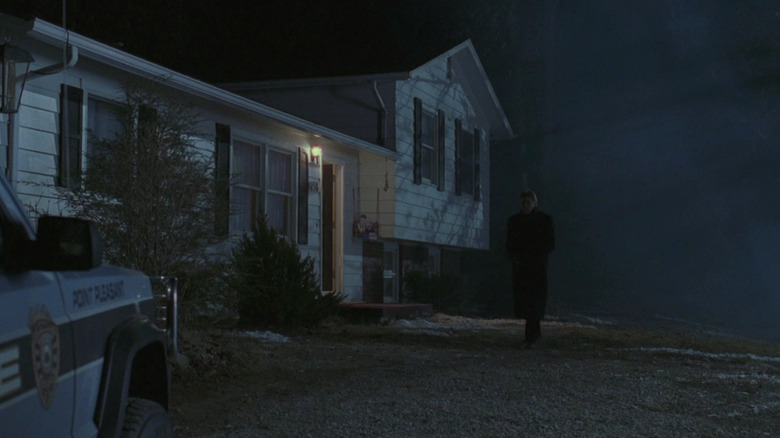
In the present, Klein feels the Mothman is kind of haunting him. While driving through Ohio one night, he finds himself mysteriously miles off course in Point Pleasant, West Virginia, without any knowledge of how he got there so quickly. He also has no memory of banging on the door of the home of local sheriff Connie Mills (Laura Linney) at 2:30 a.m. three nights in a row. Connie and Klein get to talking, and she tells him all about the weird stuff people have attributed to the Mothman, including strange dreams and cryptic phrases that appear to be floating through people's collective consciousness. Why did a voice tell Connie, "Wake up, number 37?"
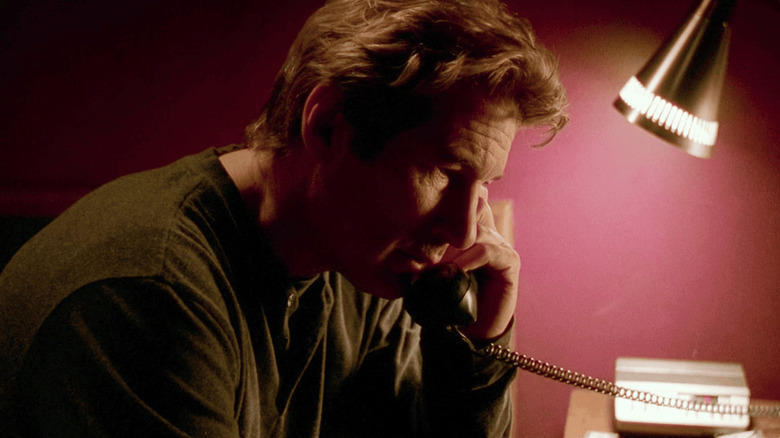
In the film's scariest scene, Klein is alone in a hotel room when he receives a call from a whispering, unnamed being. At this point, Klein's rather convinced that he is dealing with the supernatural, so he begins to test the Mothman's powers over the phone. The creature can seemingly see into the room and describes objects in his hands.
The Mothman Prophecies has gained more appreciation over time
Sony Pictures Releasing
The thing about "The Mothman Prophecies" is that it doesn't quite follow the "facts" laid out in John Keel's source material. Rather, it tells a wholly original story. Far from an attempted docudrama, it's a vibes-heavy horror movie mood piece that doesn't answer the questions it raises, preferring to remain deliberately enigmatic and vague. Hence, there aren't any clear glory shots of the actual Mothman, as the film focuses more on the creature's cryptic prophecies and psychically projected prognostications.
Perhaps that's why critics were initially lukewarm on the film, which only has a middling 52% critical approval rating on Rotten Tomatoes. Roger Ebert gave the movie two stars. He liked its photography and filmmaking acumen, but he didn't care for the vagueness of the titular monster and felt the script was lacking, writing:
"The director is Mark Pellington ('Arlington Road'), whose command of camera, pacing, and the overall effect is so good, it deserves a better screenplay. The Mothman is singularly ineffective as a threat because it is only vaguely glimpsed, has no nature we can understand, doesn't operate under rules that the story can focus on, and seems to be involved in space-time shifts far beyond its presumed focus."
Incidentally, "Arlington Road" is an excellent conspiracy thriller.
Since its theatrical release, though, "The Mothman Prophecies" has undergone a bit of a reevaluation. As Den of Geek observed in 2022, the film has "garnered a cult following in recent years as a creepy, underrated flick." Indeed, /Film listed it among the best horror movies nobody talks about anymore earlier this year, arguing that it "leaves you with an effective sense of unease." You can check it out on Netflix and see if you agree.






 English (US) ·