
 6 hours ago
10
6 hours ago
10
Credit:
Paul Horn/Inside Climate News
Credit:
Paul Horn/Inside Climate News
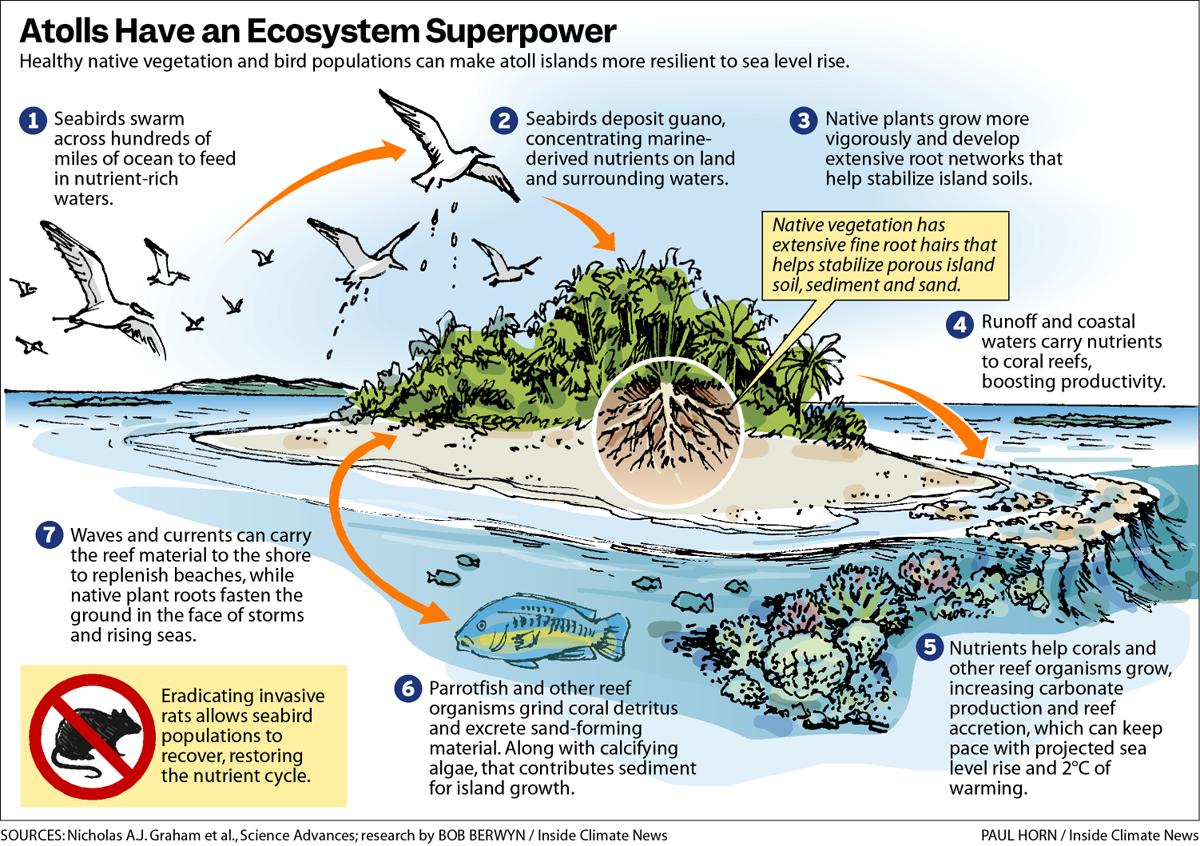
The new study measures the “reef accretion potential” for the islands, showing it to be twice as high on lagoonal and ocean-facing reefs around rat-free islands with abundant seabirds as around rat-infested islands. That would be “sufficient to closely keep up with predicted sea-level rises to the end of the century under a 2° Celsius warming scenario,” said co-author Casey Benkwitt, a California-based restoration scientist with The Nature Conservancy.
Reef growth rates without seabird populations are less likely to keep pace with projected sea-level rise, she added.
Graham cautioned that the study doesn’t imply a miracle solution for global warming impacts to low-lying islands. It didn’t make direct before-and-after restoration comparisons, and the data came from islands with different levels of seabird abundance and rat infestations, differences the research team tried to smooth out with an ecosystem energetics framework.
And reef accretion doesn’t always mean an atoll is growing vertically, because global warming is also changing waves, winds, and currents that affect where the material ends up. The study also focused on mostly uninhabited or sparsely populated islands with room for native ecosystems. On developed atolls, he said, restoration efforts can help but won’t replace the need for engineering solutions.
The study helps show a nearly complete loop, “from ocean-foraging seabirds, through native forests and coral reefs, back to the construction and stabilization of the islands on which the birds breed,” ecologist Hillary Young wrote in a Science Advances Focus commentary. Quantifying the loop provides “much-needed evidence that the fate of an atoll cannot be understood or managed by treating its land and sea separately,” she wrote.
Local conservation can influence physical resilience to rising seas, but, she wrote, “rapid reductions in greenhouse-gas emissions remain essential to long-term viability of these systems.”
Bob Berwyn is an Austria-based reporter who has covered climate science and international climate policy for more than a decade. Previously, he reported on the environment, endangered species, and public lands for several Colorado newspapers, and also worked as editor and assistant editor at community newspapers in the Colorado Rockies.
This story originally appeared on Inside Climate News.







 English (US) ·