
Explosions are really important to scientific breakthroughs. So, researchers assembled a global coalition to set up an entire laboratory dedicated to making stuff go boom.
In a recent statement, Texas A&M University announced the launch of the Detonation Research Test Facility (DRTF), the largest lab in the world for experimenting with controlled explosions. According to the university, the lab will “turn raw energy into physical breakthroughs” across a variety of scientific disciplines. In addition to exploring the physics of combustion across engineering, astrophysics, and more, DRTF’s facilities will allow experts to examine how explosions can lead to industrial disasters.
“The DRTF is a large engineering facility that we’ve designed to be able to create explosions and control them at scales [unattainable] in a regularly sized laboratory or a plant,” technical director Scott Jackson said in a video on the lab. “So we can study what it takes to turn a flame into a detonation…or to completely quench it so we don’t have to worry about it causing loss of life or property damage.”
Starting a fire
The facility was approved in 2021 and wrapped up its safety and commissioning phase last year. The idea for the lab actually emerged from the coal mining community. Specifically, the mining community and government officials wanted scientists to weigh in on whether natural gas would explode and detonate.
The final lab can do that, and much more. The DRTF specifically reproduces detonations, or explosions spiraling out of fast-moving shock waves of flames, in this case through a methane-air-filled tube about 500 feet (152 meters) long. The setup is enclosed with steel walls and an earth-covered muffler to minimize noise. Through all stages of detonation, advanced sensors and laser diagnostics record the chaotic dynamics of the flames for scientific analysis.
“Depending on the fuel, the conditions of the fuel, and the background gas, ignition generates high-speed turbulent flames (deflagrations) and generates shock waves,” Elaine Oran, DRTF scientific director and an aerospace researcher at Texas A&M University, told Gizmodo in an email. “The region behind the shock waves may ‘spontaneously’ transition into detonations.”
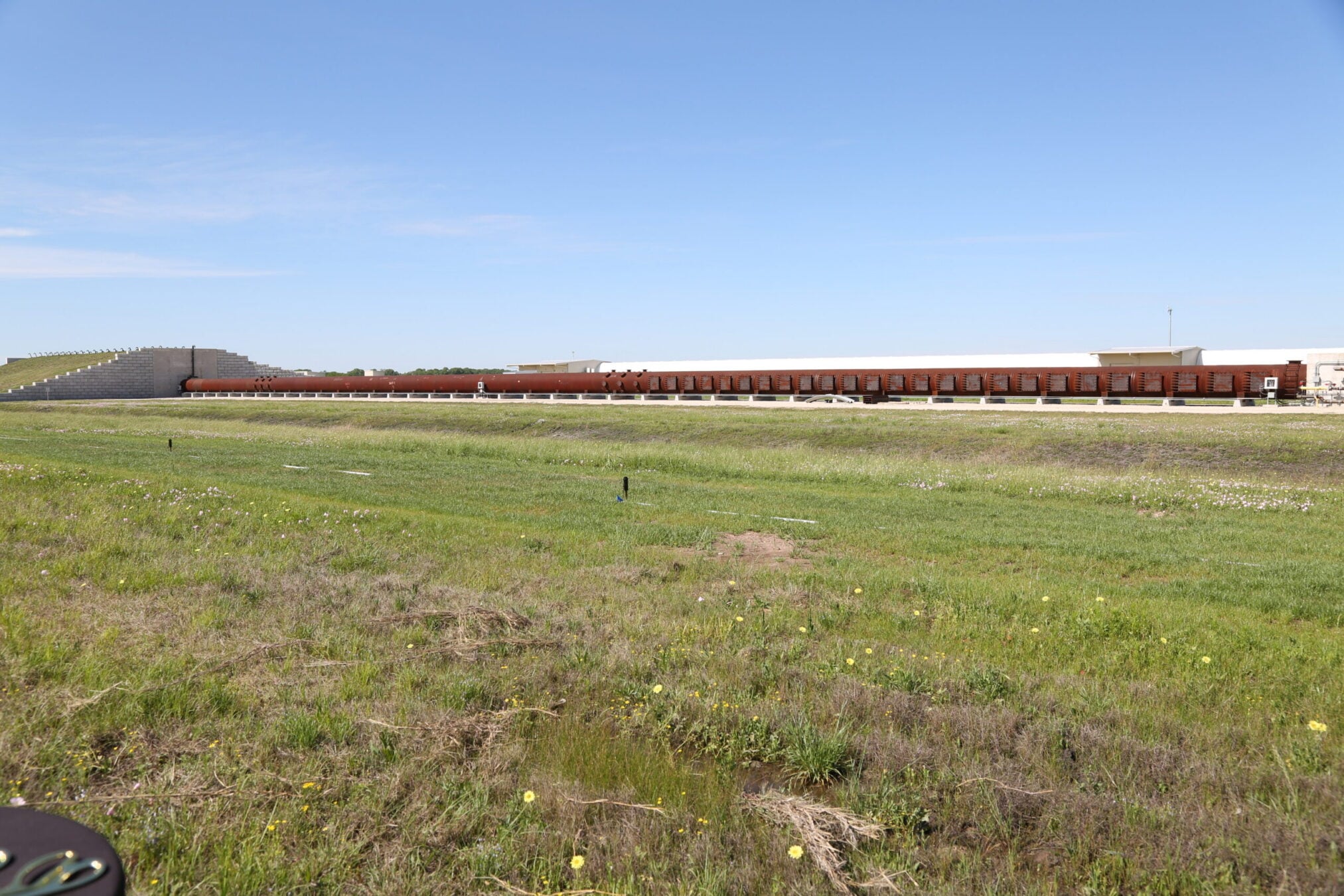 The DRTF’s detonation tube seen from afar. Credit: Texas A&M University College of Engineering
“There’s a lot of nervousness because, you know, something on this scale with this type of energy—you just can’t help but be nervous,” Zachary Weidman, a PhD student at Texas A&M University, said in the video. “So at this point, we’re starting to get papers out [and] getting ready to bring in other researchers that would like to look at certain phenomena.”
Explosive science
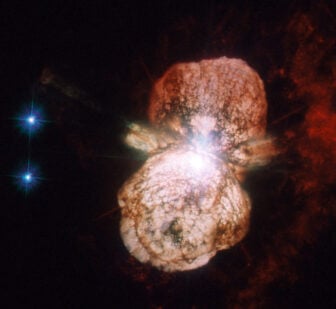 Detonations cause many phenomena at various scales, including supernovas such as the pictured death of the binary star system Eta Carinae. Credit: ESA/NASA
Again, explosions are everywhere in science, from the smallest to the largest scales. Our universe began with a big explosion. Dying stars go out in a chaotic detonation of cosmic gas, dust, and gravity—a supernova—and sometimes spiral into black holes. Nanodiamonds, an extremely tiny yet sturdy diamond, come out of mini-detonations of carbon atoms crammed into tight structures.
“An explosion in any context is a localized release of energy that is so strong and fast that it generates a shock wave,” Oran told Gizmodo. “The DRTF will be used to delve into aspects of explosions ranging from the most fundamental behavior of fluids with localized energy release to the effects on surrounding or imbedded obstacles and materials.”
On (comparatively) smaller scales, detonation could drive next-generation hypersonic aircraft. Jackson explained that the DRTF, in less than five seconds, can produce detonations at Mach 5, or five times the speed of sound. Detonation-based engines, if realized, would thrust themselves forward using the rapid release of explosions at extreme speeds.
“Whatever we learn about the generation and interactions of reaction waves contributes to the knowledge base and helps with issues ranging from safety to engine propulsion to the origin of the universe,” Oran said.








 English (US) ·