
 4 weeks ago
13
4 weeks ago
13
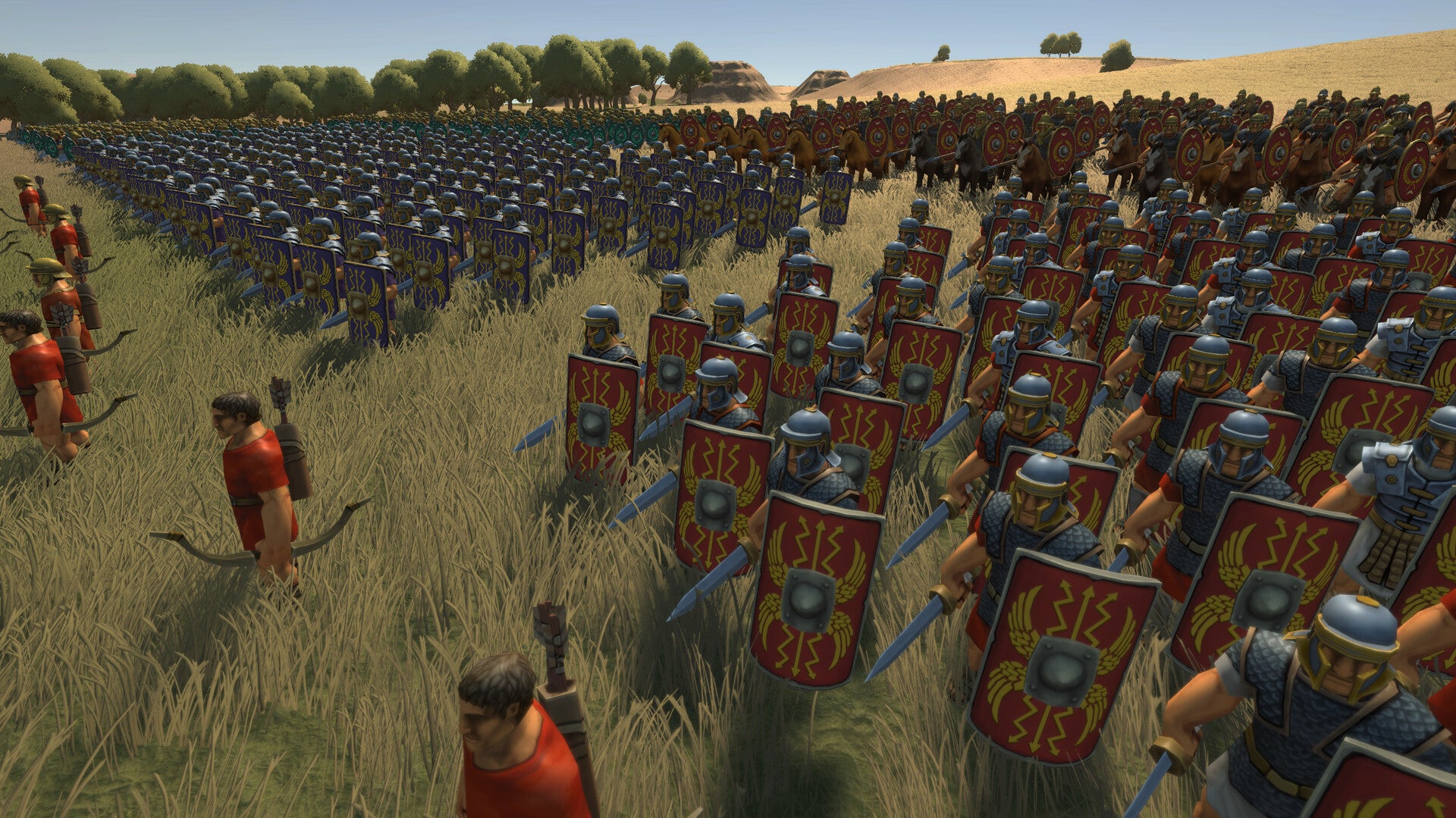
Historical real-time tactics game Strategos is out in early access today, boasting over 120 factions and 250 units based on “the major and minor powers of the ancient Mediterranean”, according to developers Strategos Games. If you are a brazen tomfool, you might summarise it as Total War without the sprawling campaign map element. If you are an excessively brazen tomfool – brassy to the point that a formation of Greek Hoplites would use you as solid cover while manouvering around some pesky Achaemenid Persian archers – you might also say that “Strategos” sounds like a spiky brand of cereal, rich in essential iron and horse sweat.
We neither of us are tomfools, however. We know better than to write such nonsense out loud. I’ve still yet to play Strategos, but I’ve been reading more about its “command and control” simulation, after covering the news that MicroProse would publish the game, and it does sound like a worthwhile complication of the process of clattering phalanxes together like frying pans.
In brief, there’s a gap between giving an order and receiving or executing that order. Orders are issued by generals, rather than arriving magically in every unit’s brain whenever you left-click. To receive an order directly, units need to be within earshot of a general (some generals are louder, making them better commanders). If the general is too far away, they’ll need to send a courier, creating a delay. Couriers can be intercepted and killed. Do you see? I have played wargames that make communication a feature in this way, but not recently.
Even when under orders, units may act independently, based on what’s going on nearby. They may choose their own targets. They can be goaded by enemies. Having one of your generals ride up to offer morale support and instructions is one way of countering this, along with keeping units in reserve to plug the line.
Units may also take unprompted tactical breathers after a certain amount of time spearing each other’s bellies, rather than grinding away till they rout, as in Twar. As the developers explained to Strategy And Wargaming last March, “[o]ngoing combats can also periodically shift into a mutual ‘passive’ mode where the two sides, although still locked into melee, fall back for a rest during which combats are not resolved and they can rally (and they may hurl some missiles at each other if available), which is part of the ‘Pulse Model’ of ancient warfare that inspired much of Strategos.”
I consider all this very juicy, and I’m sad we don’t have some review impressions to share with you. That said, the game has only just launched into early access, so there’s time yet to flank the bastards and treat them to a vigorous Wot-I-Thinking. The plan is for it to launch into 1.0 in early 2027 or so. The current build includes five historical campaigns, nine reenactment battles, and one map-based campaign, and the devs aim to “add additional scenarios and units (including chariots), along with a more refined map-based campaign”. Read more on Steam.
Update: Oops, it seems couriers in Strategos can't actually be intercepted and killed, hence my deletion above. They are broadly a visual representation for a delayed order. Here's a quote from an interesting Steam thread in which the game's primary developer lays out the reasoning here.
The couriers are a visual representing the concept of order delays that is less abstracted and more immersive than say a WEGO timer (where you can only give commands every X seconds), but still somewhat abstract.The greater or smaller command radius of the generals, and the greater or lesser number of couriers, or lower speed of those couriers, reflects various distinctions in command ability between types of factions and command organization. That is, in real life a war chief of a Germanic warband army may only be able to shout orders and have a primitive command and control structure, but a more organized Roman, Persian or Hellenistic force might have a series of flags, horns, and so on for giving immediate orders, and many more and more well trained staff to send riders/runners as couriers out, and so on. These complex realities are represented in gameplay by distinctions in the immediate command radius size and number of couriers a general has. A dead general's unit also has many fewer and slower couriers and a smaller command radius, to represent the effect on command and control of his death.
Making couriers a killable, gameplay relevant unit would both be "bottom up" and granular rather than "top down" and holistic design, and lead to extreme negative consequences for the simulation as a whole. I briefly experimented with making them killable and/or have to navigate around enemies just to see anyway, and it resulted in a chaotic and unplayable mess that was also arbitrarily frustrating.






 English (US) ·