
For nearly a century, archaeologists believed that two huge, linear structures near Egypt’s Red Pyramid were ramps to move stones. They might have been wrong.
A new analysis of the pyramid, located at the Dashur necropolis in modern-day Cairo, suggests that the “ramps” were actually large dams. If true, this means that ancient Egypt’s architects and construction workers used a hydraulic system to supply water to the construction site nearly 5,000 years ago, according to an early-access version of the study provided by npj Heritage Science. Contextually, this interpretation is consistent with how King Snefru’s reign, during which the Red Pyramid was built, also saw the emergence of the earliest instances of large-scale hydraulic engineering, the team explained in the paper.
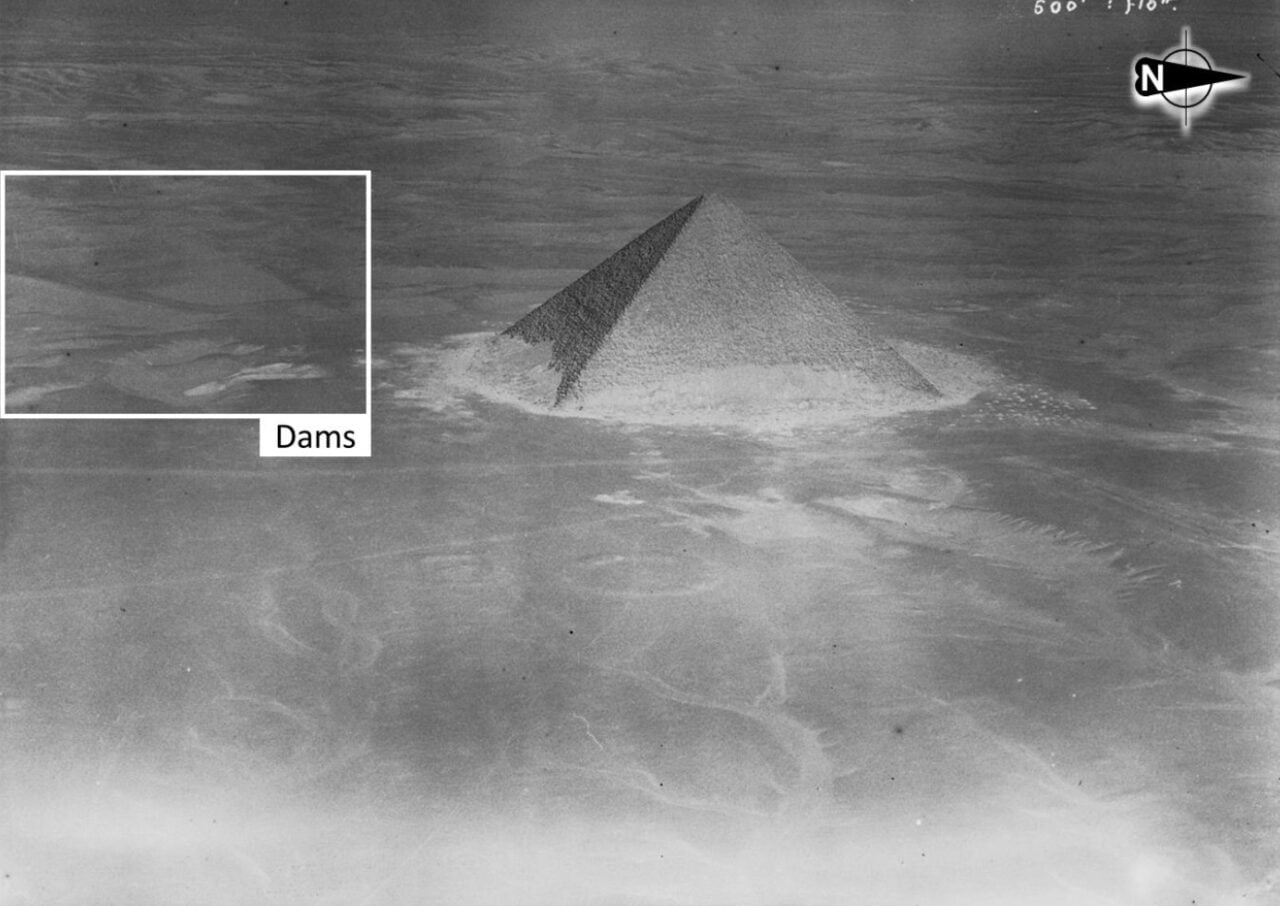 Royal Air Force pictures (1925) from the Red Pyramid, with a view on two dams on the background (white rectangle). Credit: UCL Institute of Archaeology
“While the pyramid complexes themselves have been extensively investigated, associated technical infrastructures such as dams, flood-control walls, diversion works, canals, and workers’ installations remain far less well characterized,” wrote the researchers, a team of French and Egyptian archaeologists, in the paper.
The ‘builder pharaoh’
Snefru’s reign lasted from approximately 2,613 to 2,589 BCE. During this time, the pharaoh commissioned numerous big architectural structures, including the Sadd el-Kafara dam. According to the paper, this dam, with an estimated original height of 45 feet (14 meters), is “widely regarded” as one of the largest, oldest dams in world history. A major flood event later toppled the dam, but the initiative represents “clear evidence that state-level hydraulic engineering and flood risk management were already underway during Snefru’s building program,” the paper noted.
Snefru (also the father of Khufu, who commissioned the Great Pyramid of Giza) was “obsessed” with pyramid construction, according to an explainer by the Red Pyramid’s official website. On the other hand, Snefru’s adoration of pyramids allowed Egyptian architects to find out—sometimes the hard way—what weight distribution, geometry, or structural integrity would prevent the giant structures from collapsing, the explainer added. In that sense, the Red Pyramid, the third largest pyramid in Egypt, was his “crowning achievement.”
A birdseye view
The latest study was a comprehensive investigation combining satellite images, historical documents, and digital terrain models. The two linear structures of interest were previously studied during the previous two centuries, but they were never architecturally excavated and, to this day, remain buried under a thick layer of sand. Currently, the structures are in a militarized zone with restricted access, according to the paper.
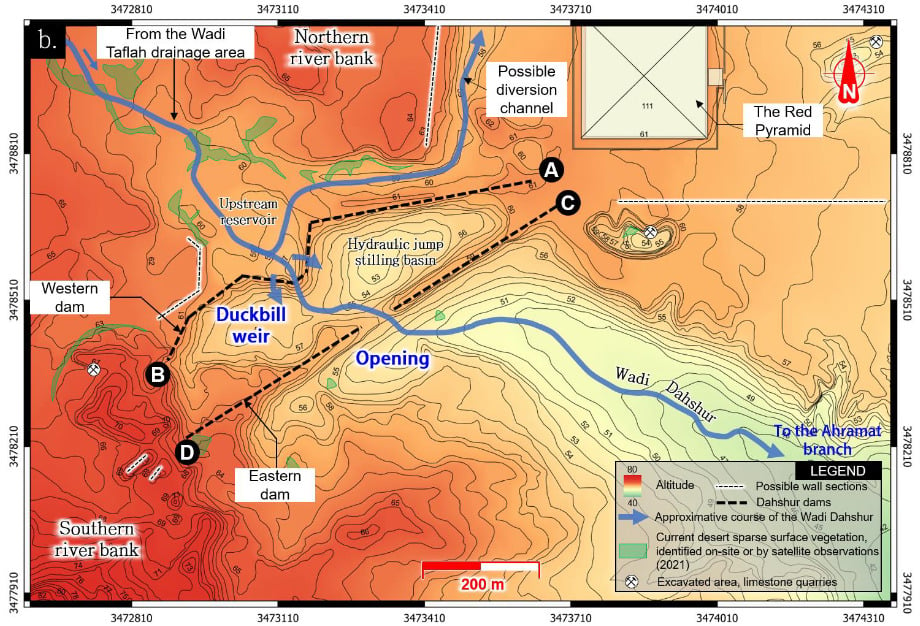 An annotated map of the locations of the dam-like structures. © Landreau et al., 2026
The team concluded that the combination of distinct geological features best points to the structure being some sort of a dam stretching nearly 2,000 feet (600 meters). The numerous zigzag paths are an odd design for a transport route, as was previously assumed, but it makes a lot of sense given that similar designs are common to dams and spillways.
In the paper, the team hypothesized that this area constituted a duckbill weir, a barrier used to control water flow in drainage and irrigation systems. There also seems to be a diversion channel, roughly 0.6 miles (1 kilometer) running parallel to the Red Pyramid, which could mean that this structure was used during the pyramid’s construction.
Buried in the sands
However, the team stressed in the paper that its conclusions come with a number of uncertainties, primarily due to the lack of excavations in the area. Having said that, the paper’s suggestions “highlight elements that would be worth scrutinizing during any eventual excavation to verify, refine, or dismiss our hypotheses and interpretation,” the team explained.
But the convergence of evidence currently identifiable does seem to tell us that there’s a lot more going on near the pyramids and that we’re increasingly developing the tools to study them at greater resolutions, the team said in the paper. If the researchers’ hunch is correct, it would mean that water management played a much more significant role than we believed in Egypt’s Old Kingdom.
“Other hydraulic structures are most probably lost in the desert, waiting to be identified as such,” the team concluded.








 English (US) ·