
 2 hours ago
6
2 hours ago
6

Published Apr 18, 2026, 9:00 AM EDT
Tough love isn't the only way to raise a kid
 Image: Capcom via Polygon
Take a glance at a trailer for Pragmata and you could probably make some educated guesses about its story. Set on the moon, Capcom’s sci-fi game stars Hugh, an astronaut who finds himself stranded on an abandoned lunar base run by a rogue AI. The parallels to modern tech write themselves in your typical tale of evil robots and the shady corporations that created them. It’s generic sci-fi fare filled with dated anxieties, but there’s a morsel of meat on that bone for you to chew on between shootouts.
If that sounds shallow, that’s because Pragmata’s heart isn’t really in creating a tech cautionary tale. AI and 3D printing are just convenient ways to generate clever hacking action and place diverse biomes on the moon. The real focus of Pragmata is an unexpectedly sincere parenting story. And while the tale of a father and his kid is just as played out as evil robots in prestige games these days, Pragmata separates itself from the God of Wars of the world by offering a bold thesis: maybe raising a kid is fun and cool, actually.
When Pragmata begins, it seems like we’re headed for a story we’ve seen a lot over the last decade. After an accident on the base, Hugh crosses paths with Diana, a blonde-haired android who looks and acts like a little girl. She’s insistent on helping him fight off some incoming robots, but Hugh shoos her off. It sure looks like the start of an unwitting partnership. The macho Hugh will have to pair up with this annoying pest, and perhaps slowly learn to become a surrogate father to her amid constant tension. Games like The Last of Us floated into my head in the opening moments, tales of strained relationships between tortured men and children who have to work to earn their affection.
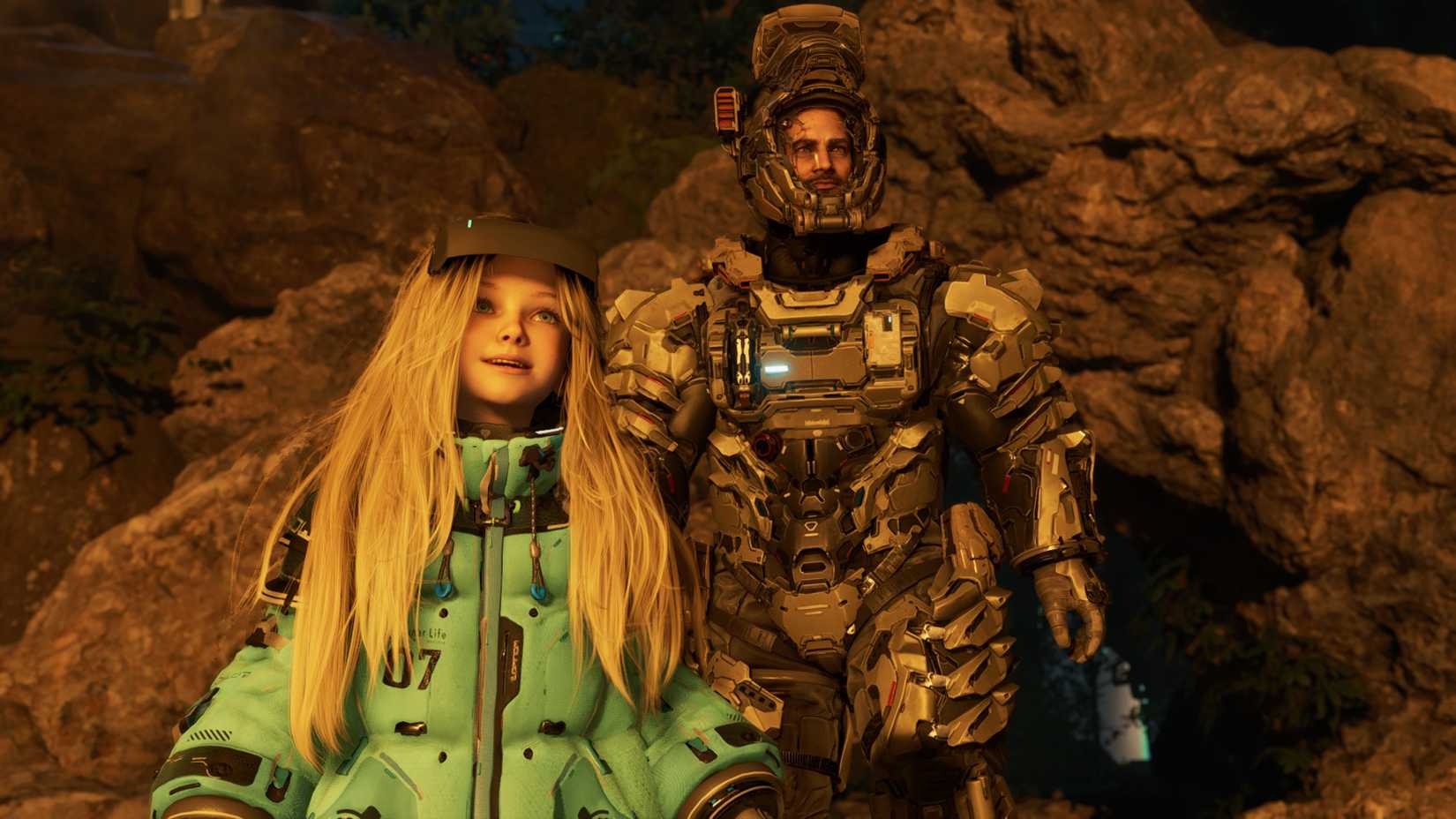 Image: Capcom via Polygon
Hugh’s unwilling parent arc ends almost immediately. As soon as Diana helps him hack a robot, his stoic demeanor changes. He soon becomes a big softie who shows nothing but warmth to Diana. The switch flip almost seems like a self-aware development joke. What if Dead Space’s Isaac Clarke actually turned out to be a pretty chill guy under all that armor? It’s a subversive characterization that’s reminiscent of Ichiban Kasuga in Yakuza: Like a Dragon. Kasuga, a painfully sincere goofball, entered that soap opera after 15 years of players controlling Kazuma Kiryu, a comparatively chilly hero who hid his heart of gold under a pristine suit. Hugh doesn’t quite have Kasuga’s puppy-dog energy, but he does feel like the guy who melts into a gooey puddle when he meets that puppy dog.
That attitude makes Hugh’s relationship with Diana, and his role as a guardian, very different from that of, say, Kratos. In the modern God of War games, Kratos approaches his son Atreus with a heavy dose of tough love. He communicates with him exclusively through barked commands. He dishes out harsh life lessons like “don’t be sorry, be better.” He won’t even call Atreus by his proper name until he’s earned Kratos’ respect. It becomes apparent that Kratos loves his son throughout God of War and God of War Ragnarok, but we only arrive at that through a relationship built on conflict. Kratos believes he needs to be hard on his son to prepare him for the real world. In return, Atreus teaches him when it’s time to let your guard down and be vulnerable with the people you care for.
Hugh has no such inner turmoil. He immediately embraces Diana as a little pal he’s happy to hang out with. When there are no robots around, Hugh entertains Diana's questions about Earth with patient answers. He goes out of his way to find gifts for her, like 3D printed slides and swings, to help give her some taste of a normal childhood in a cold moon base. When the two are hanging out in their safe house, Hugh has the option of playing hide and seek with her over and over again, something he doesn’t really complain about. The reward for interacting with Diana is that she occasionally draws a picture for him, which Hugh proudly hangs up on the computer modules that let him 3D print gun upgrades. Precious.
 Image: Capcom via Polygon
Pragmata presents a very different picture of fatherhood than we’re used to seeing in games, and it stands out in small ways. If Diana doesn’t pull off a hack in time, causing Hugh to get knocked off his feet by a robot, she’ll apologize with a bit of shame in her voice. Hugh tends to respond with a smile, sweetly telling her that it’s okay before standing back up and getting back in the fight. Imagine Kratos responding the same way after Atreus misses a crucial arrow shot against an ogre. Little moments like that present an alternate picture of fatherhood that’s rarer to see in games that thrive on conflict, one where a parent-child relationship is built on support and encouragement.
Yes, you can still label it as a “dad game,” the likely product of aging developers putting their feelings about fatherhood into an action game where they are the big hero protecting their kid. I couldn’t blame anyone for feeling a little tired about seeing another story like that. Big-budget games sometimes feel like they only have a few levers to pull when they want to tell grounded, human stories within fantasy — and we sure don't see the same commitment to telling nuanced stories of motherhood. (Capcom’s own Resident Evil Requiem struggles to center Grace’s story of reluctant motherhood in the shadow of her own mom’s death, giving half of her screen time to Leon S. Kennedy’s traumatic reckoning.)
But to write Pragmata off wholesale as yet another fatherhood tale is to miss the broader point it works towards: Pragmata is an adoption story. During a dialogue that triggers midway through the story, Diana asks Hugh about his own parents. He reveals that he was adopted. He’s not cursed with daddy issues that he’s passed down to Diana, nor is he suffering because he felt like he didn’t truly belong. Hugh loves his parents, and he excitedly tells Diana all the life lessons they taught him. In the game’s most on-the-nose moment, Diana remarks that the way Hugh describes his parents sounds a lot like him. A jolt of pride radiates through him, as if he’s realizing in real time that he’s become the person his parents hoped he would become.
 Image: Capcom via Polygon
Hugh’s attitude towards Diana instantly makes sense in that context. It becomes clear why he welcomed her on his journey with hardly any hesitation, and why he’s so ready to protect her like he would his own daughter. It’s not far off from the idea of The Last of Us, but it's freed from the baggage of Joel claiming Ellie as an adopoted kid as a means of working through his trauma over his daughter’s death. Ellie never asks to be in that role and it creates an uneasy story where we’re left to question the power dynamics in that fraught relationship. It’s morally dense, and not the warmest depiction of an adoptive parenting situation. Hugh stands in contrast to Joel, putting Diana’s developmental needs front and center.
There’s a chrome-plated elephant in the room, of course: Diana isn’t actually a little girl. She’s just an android that looks and acts like a kid, which makes any interpretation of Pragmata as a meaningful parenting story messy. Hugh accepting Diana as a person because she simulates real emotions is an uncomfortable detail at a time when people are forming romantic relationships with chatbots. Even if you set that poor timing aside, a subservient robot isn’t exactly the best stand-in for a human child. It implies that the perfect kid is an obedient sidekick for an adult to program to their liking, inviting the same kind of questionable power dynamics that have earned Pragmata’s peers some scrutiny.
Call it a messy metaphor, but the well-intentioned parenting story under that metal is sweet and sincere. It’s rare to see a big-budget video game where the main character is instantly excited about the prospect of being a dad. Hugh doesn’t have to be dragged into accepting his role as a guardian, nor does he need to go through a personal transformation just to show Diana a crumb of kindness. His immediate focus is on nurturing her curiosity, teaching through positive reinforcement, and coming to terms with the idea that a parent should be willing to give everything to create a better future for their kid. And that child shouldn’t have to carry your blood to deserve those things.



 English (US) ·