

I still can’t quite believe that the upcoming sci-fi game Pragmata actually exists. It’s been almost six years since it was unveiled all the way back at the PlayStation 5 reveal event with a flashy CG trailer and, while I and two other of my TechRadar colleagues have all been served an identical short demo at various events over the last 12 months (the same one now available for everyone to try for free), I’ve been desperate to see a lot more of what it has to offer.
But after getting the chance to play roughly two hours of the game in an extended hands-on session at developer Capcom’s London headquarters, I certainly wasn’t disappointed. Picking up shortly after the segment from the demo ends, I was pleased to discover that the linear corridors soon give way to some absolutely stunning, more open environments that let the game’s incredibly unique combat mechanics shine.
I got my first proper taste of what the game will actually be like to play, how it’s structured, and the ways in which everything revealed so far fits together. Pragmata isn’t just a real game that’s going to hit shelves next month - it’s shaping up to be a great one.
Article continues below
Deep space
Pragmata is a wholly original IP, with Capcom flexing its more experimental muscles as it did with 2024’s sublime, and criminally underappreciated, Kunitsu-Gami: Path of the Goddess.
Set on a lunar base that’s been overrun by hostile robots, Pragmata puts you in the space boots of Hugh - seemingly the last surviving member of a squad of astronauts sent from Earth to find out exactly what’s going on. Having been rescued from the brink of death by Diana, a young android girl, my first objective is to reach a nearby communications tower to send a distress signal back home.
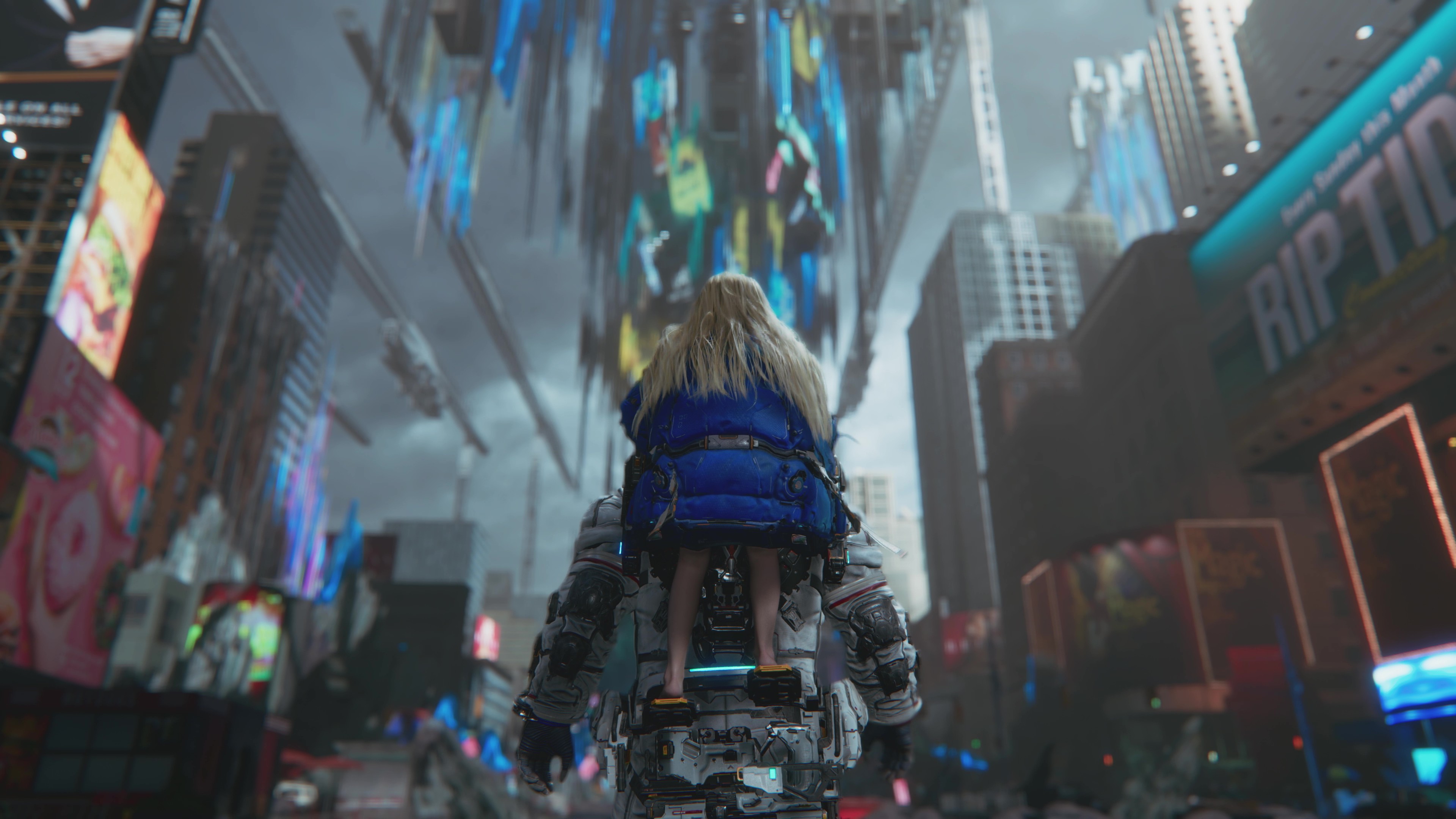
This, it turns out, is nestled right in the heart of a giant replica of central New York contained entirely within the station, 3D printed by giant machines using a newly discovered filament material that was the subject of the facility’s research. Nothing quite compares to the feeling of emerging from a sterile, white-panelled futuristic corridor into a photorealistic modern city, and Capcom has taken its already impressive graphics technology to another level here.
Built on the excellent RE Engine (the same proprietary engine behind the recently released, and similarly pretty, Resident Evil Requiem), light dances off the range of materials on show incredibly authentically.
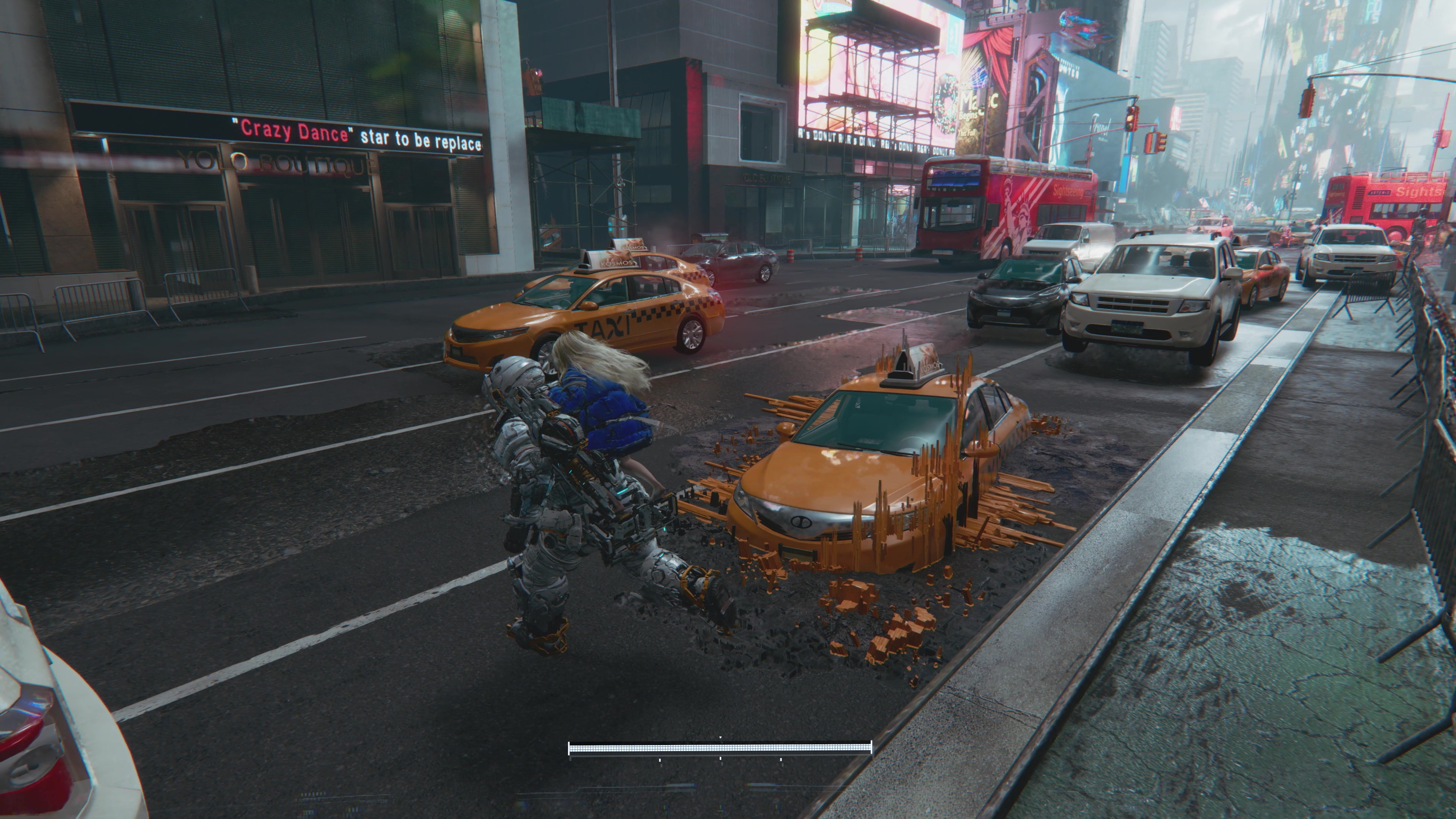
The wet street is covered in reflective puddles and, like any real road surface, uneven patches of newer asphalt where potholes have been repaired. The surrounding buildings seem plucked right out of the real city, too, and I was delighted to discover that angling the camera to peer through windows revealed perfectly modelled interiors with everything from fully legible menus in cafes to rows of products in shops.
There are loads of references and in-universe details to discover too, with some of my favorites including mock Broadway posters and a huge sign advertising ‘Daiana’s Donuts’ - a cute nod to your robotic friend. The realism is impressive in and of itself, but more abstract elements are woven in wonderfully to remind you that this slice of Earth is wholly artificial. One of your first tasks is scaling down a vertical street that stretches off into the sky, bouncing off the sides of yellow taxis suspended in mid-air. The area’s construction is visibly unfinished too, with multiple buildings and objects that trail off into strips of brightly colored filament - including a few floating bridges that you later need to finish the printing of in order to get around.
The build was running on a PlayStation 5 Pro, but given Capcom’s accomplishments in optimizing Requiem for the base PS5, and even the comparatively much more underpowered Nintendo Switch 2, I’m confident that this visual excellence will translate across every platform. This sequence is also clearly the inspiration behind the very first Pragmata trailer, and it’s a real testament to how far we have come that in-game visuals running on an off-the-shelf console look so much better.
Making memories
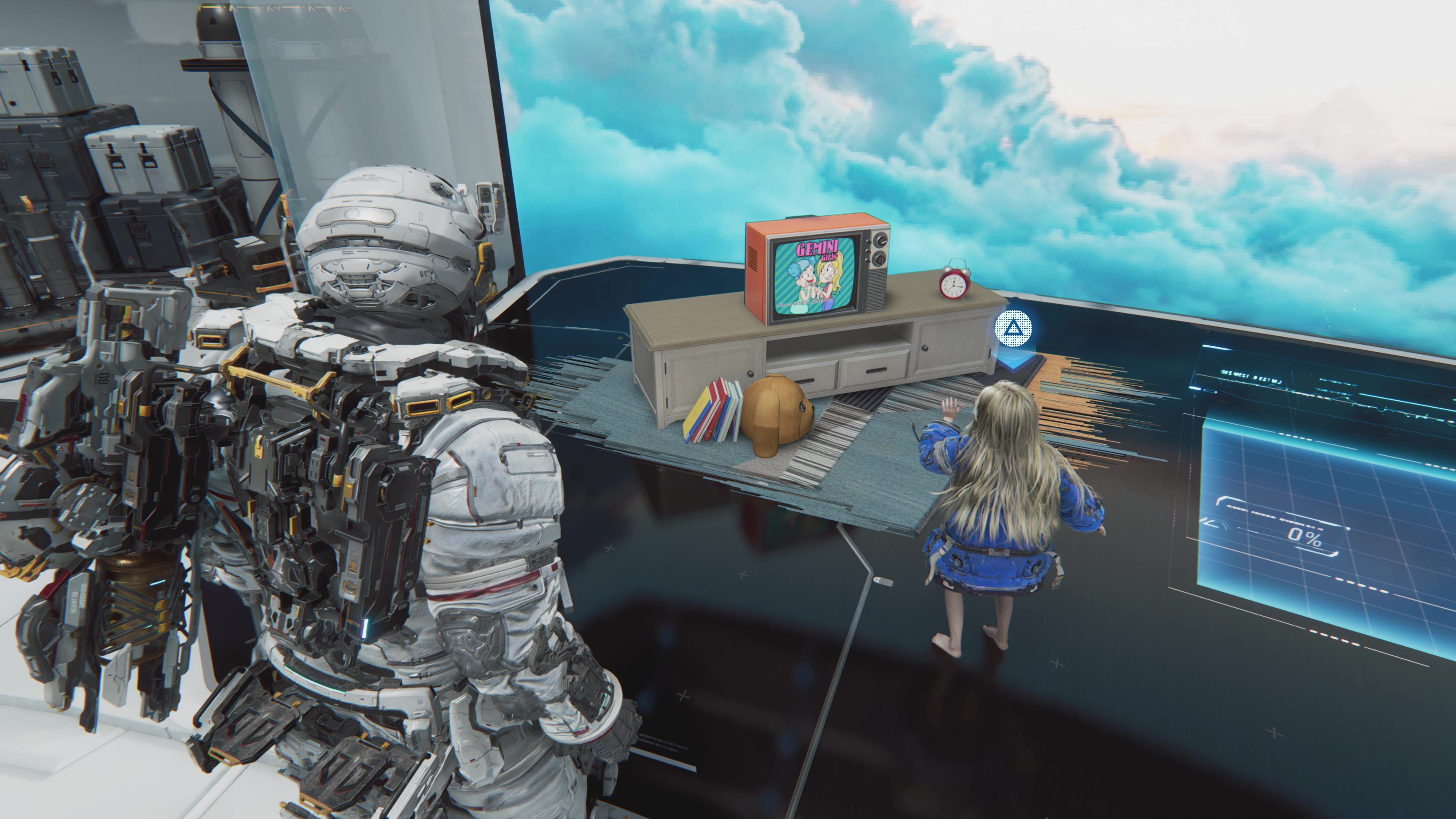
Part of the reason Pragmata can look so good is undoubtedly that it’s not an open-world game, allowing the developer to cram as much detail as possible into every self-contained zone. Each chapter takes you to a new area of the space station, all joined together by a high-speed train that leads to a central hub. This is where you can unwind between missions and upgrade your gear, but also spend a bit of time with Diana.
Finding one of the collectible ‘Earth Memories’ lets you decorate this hub with toys like a little television set, each one with its own dialogue and animations. There’s something very heart-warming about watching Diana wander around like a real child, and although her occasional bluntness is frequently played up for laughs, her interactions with Hugh show the pair beginning to develop a real bond. Dialogue reveals that Hugh was brought up in foster care and clearly sees something of himself in Diana, and I’m interested to discover how he will square his very human attachment with her nature as a machine.
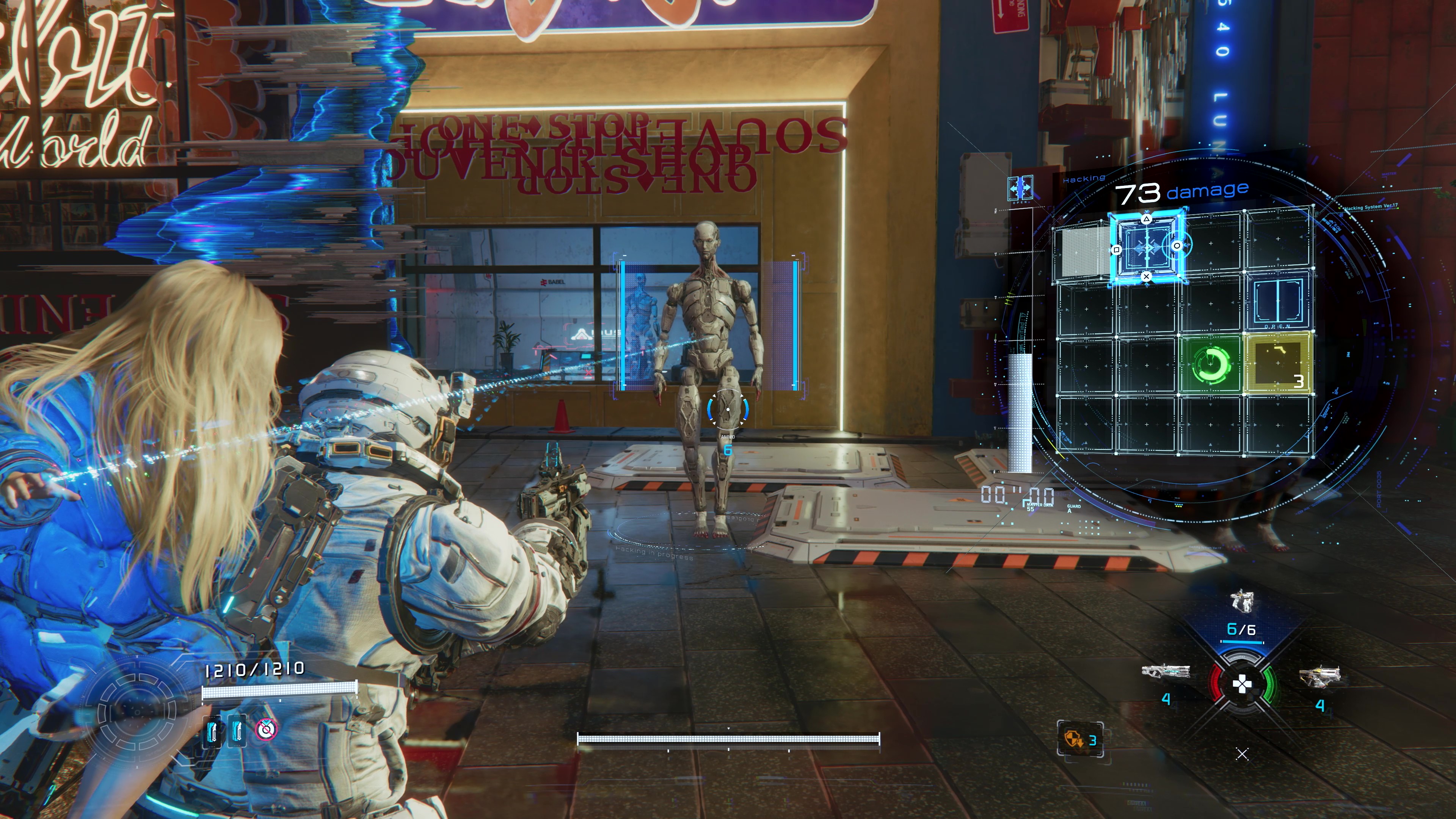
Although the fundamental mechanics remain the same from that earlier demo, combat is still a highlight. You encounter waves of varied electronic enemies as you explore, defeated by a combination of puzzle-solving and third-person shooting. Tapping the DualSense Wireless Controller’s face buttons moves a little cursor around an on-screen grid, linking together different modules to inflict bursts of damage and critical effects. It’s a formula that still feels excellent and is surprisingly intuitive given how complex it looks.
Weapons are introduced at a steady pace, too, giving you new tools to experiment with. While the grenade-launcher-like Riot Gun is undeniably the most effective of the bunch when you’re up against large groups, the long-range, slow-to-charge Shockwave Gun is perfect for hitting exposed weak points on larger foes. Even the Stasis Net and Decoy Generator, which both serve to distract with their respective electronic meshes and holographic Hughs, are surprisingly handy and buy you valuable time to inflict lots of damage with increasingly elaborate puzzles.
After blasting my way through basic grunts, a final battle against a hulking armoured boss really put my multi-tasking skills to the test by forcing me to navigate around large area of effect attacks and dodge incoming projectiles while simultaneously solving puzzle after puzzle to keep its defences low.
I’m curious to discover what other challenges are in store when Pragmata launches for PC, Nintendo Switch 2, PS5, and Xbox Series X and Series S on April 17, 2026.

Follow TechRadar on Google News and add us as a preferred source to get our expert news, reviews, and opinion in your feeds. Make sure to click the Follow button!
And of course you can also follow TechRadar on TikTok for news, reviews, unboxings in video form, and get regular updates from us on WhatsApp too.







 English (US) ·