
 3 weeks ago
36
3 weeks ago
36
Researchers at Germany's Karlsruhe Institute of Technology (KIT) have published a study proposing a purely mechanical anti-drone weapon that fires thin steel chains at drones, entangling their rotors and knocking them out of the sky.
The work, led by Professor Claus Mattheck at KIT's Institute for Applied Materials and published in the journals Aerospace & Defence and Konstruktionspraxis, comes as Germany grapples with a surge in unauthorized drone flights over critical infrastructure.
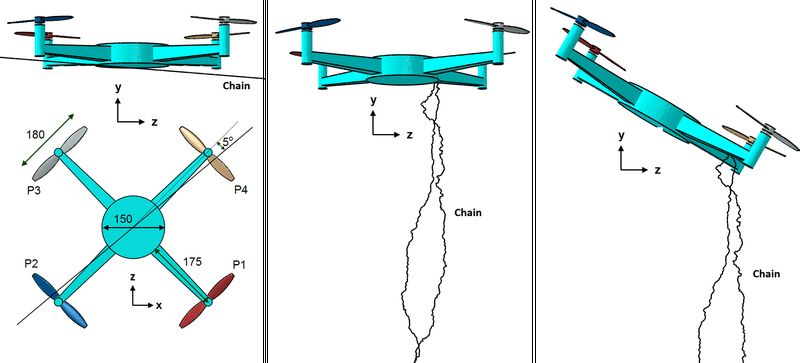
Mattheck's team also conducted live firing trials at the Sternenfels ballistics center in Baden-Württemberg using a catapult-based launcher. Though these were designed as basic viability tests, the researchers noted that they didn’t factor air resistance into their computational models, meaning that the ring vortex generated at the launcher’s muzzle could affect how the chain spreads after firing.
Firing chains at drones is the polar opposite of other anti-drone tech we’ve seen in recent months, such as directed-energy and electronic warfare systems. The UK's DragonFire laser, scheduled for installation on Royal Navy destroyers by 2027, uses a 50 kW fiber-combined beam to burn through targets at the speed of light.
That costs thousands of dollars and requires substantial power infrastructure, while the KIT team's chain projectile weighs 70 grams and can be fired from a portable launcher. Mattheck noted that a falling chain poses less risk of collateral damage than a solid projectile of equal mass, and that the steel chain outperformed textile nets in initial catapult-based range tests. The biggest tradeoff is range: like a shotgun, the system is only effective at short distances.
Germany recorded over 1,000 suspicious drone flights above military facilities, airports, and other critical infrastructure in 2025 alone, according to senior security officials. Munich Airport was shut down multiple times due to unidentified drone activity last October, and the Bundestag has approved more than 100 million euros ($116 million) in counter-drone funding for 2025 and 2026 in response.

Follow Tom's Hardware on Google News, or add us as a preferred source, to get our latest news, analysis, & reviews in your feeds.







 English (US) ·