Phison Pascari X201P 15.36TB SSD Review: Fast PCIe 5.0 write performance for AI and ingest servers
1 hour ago
12
Phison’s Pascari X201P meets its rated specs and pairs 12 GB/s sequential writes with a steady 600K random write IOPS, making short work of AI checkpoints. It gives ground at low and moderate queue depths, where QD1 writes and mixed workloads lag, and it ran warm on our bench.
Reasons to buy
+
Fast sequential and random writes
+
Tight write latency under load
+
Quick AI checkpoint saves
Reasons to avoid
-
Slower low-queue-depth writes
-
Mixed-workload performance trails at middle QDs
-
Runs warm
Why you can trust Tom's Hardware
Our expert reviewers spend hours testing and comparing products and services so you can choose the best for you. Find out more about how we test.
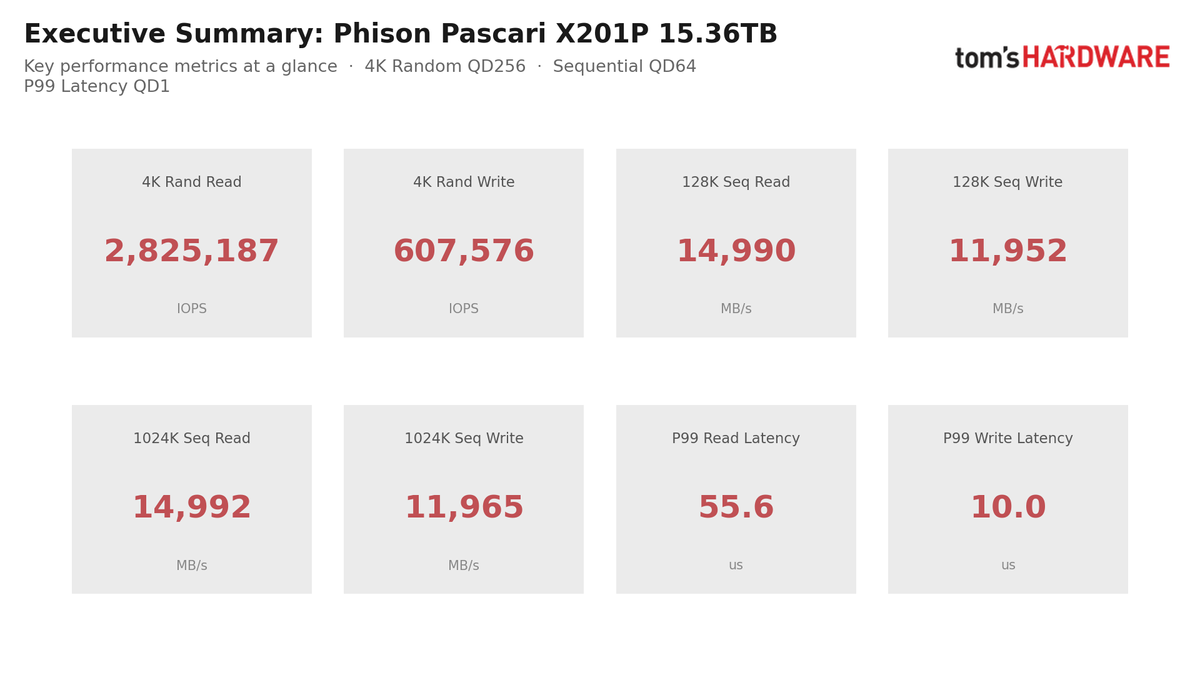
Phison is serious about enterprise storage, and the Pascari X201P was not released lightly; it came in the night, under NDA, alongside this week’s Supercomputing 2026 event. The drive is part of the Performance X-Series, which handles intensive workloads where consistency is the name of the game. We were nevertheless pleasantly surprised by its write performance, with a steady 12 GB/s for sequential and over 600,000 random write IOPS, considering it’s marketed at the 1 drive write per day (DWPD) endurance point.
Part of that surprise comes from the fact that this is Phison’s read-intensive PCIe 5.0 data center drive, a successor to the X200P. It comes in the U.2 form factor — which can be more convenient in many cases — from 1.92TB to 30.72TB, and an E3.S version from 3.84TB, in both single- and dual-port models. It stands next to its mixed-use sibling, the X201E, which is the one rated for 3 DWPD. What makes the X201P exciting, in part, is its own 16-channel X2 controller and the flash that’s inside.
Image 1 of 3
(Image credit: Tom's Hardware)
(Image credit: Tom's Hardware)
(Image credit: Tom's Hardware)
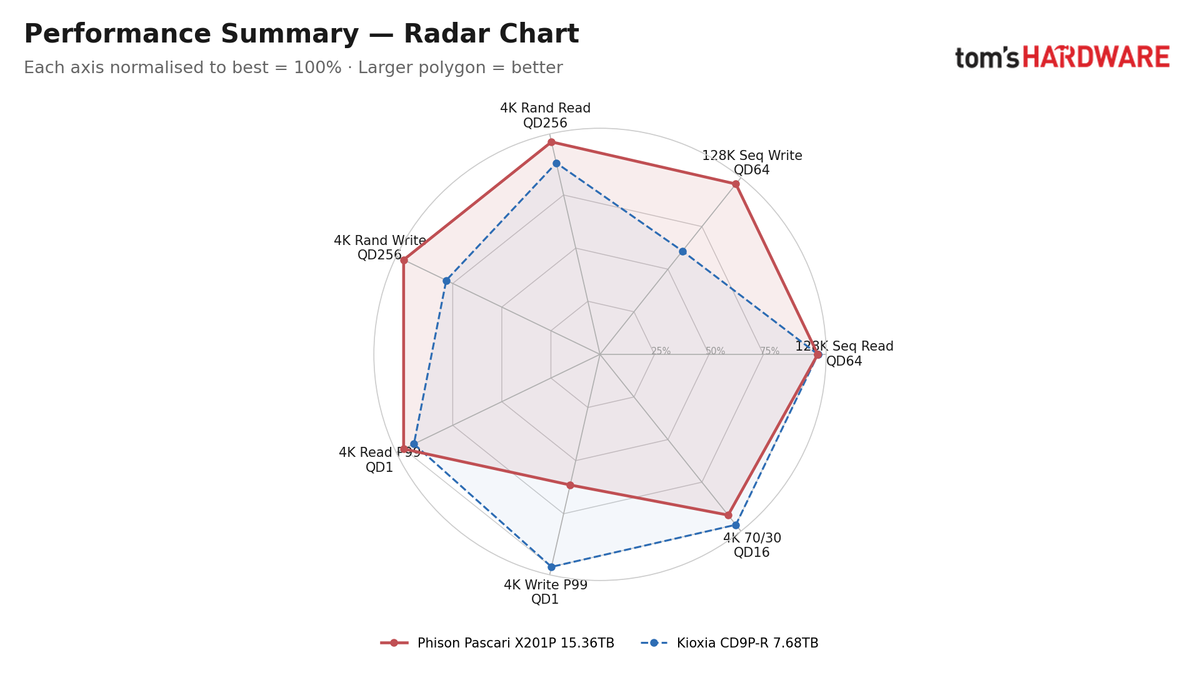
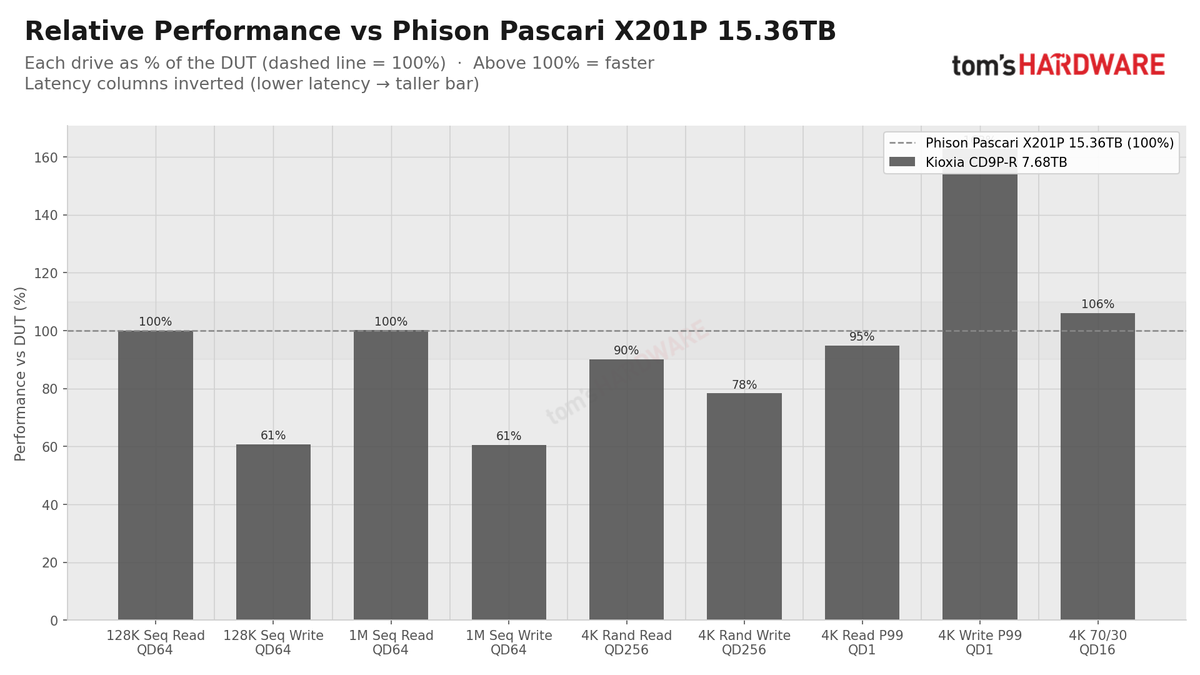
This drive is aimed at AI, analytics, and database servers, with its case made in the 4K 70/30 mix at higher queue depths. It passed Phison’s one-million-IOPS mark at QD128 in our testing of the 15.36TB model, and the drive met all of its rated specs, though its random read rating required polled I/O to reach on our bench. It faced challenges with QD1 writes, log commits, and the middle range of our mixed sweeps. Given its blend of performance, capacity, and endurance, we consider it a very competent entry from the company that was perhaps better known in the consumer SSD market until recently.
Latest Videos FromTom's Hardware
Phison Pascari X201P Specifications
Swipe to scroll horizontally
Product
1.92TB
3.84TB
7.68TB
15.36TB
30.72TB
Pricing
N/A
N/A
N/A
N/A
N/A
Form Factor
U.2 (15 mm)
U.2 (15 mm)
U.2 (15 mm)
U.2 (15 mm)
U.2 (15 mm)
Interface / Protocol
PCIe 5.0 x4 / NVMe 2.0d
PCIe 5.0 x4 / NVMe 2.0d
PCIe 5.0 x4 / NVMe 2.0d
PCIe 5.0 x4 / NVMe 2.0d
PCIe 5.0 x4 / NVMe 2.0d
Controller
Phison X2
Phison X2
Phison X2
Phison X2
Phison X2
DRAM
Yes (size not published)
Yes (size not published)
Yes (size not published)
Yes (size not published)
Yes (size not published)
Memory
3D TLC
3D TLC
3D TLC
321-layer 3D TLC
3D TLC
Sequential Read
14,800 MB/s
14,800 MB/s
14,800 MB/s
14,800 MB/s
14,800 MB/s
Sequential Write
2,300 MB/s
4,600 MB/s
9,200 MB/s
11,800 MB/s
10,000 MB/s
Random Read
1,400K
2,700K
3,300K
3,250K
2,800K
Random Write
75K
230K
480K
600K
490K
Security
ISE or SED (TCG Opal 2.02)
ISE or SED (TCG Opal 2.02)
ISE or SED (TCG Opal 2.02)
ISE or SED (TCG Opal 2.02)
ISE or SED (TCG Opal 2.02)
Power-Loss Protection
Yes
Yes
Yes
Yes
Yes
Endurance
1 DWPD
1 DWPD
1 DWPD
1 DWPD
1 DWPD
Power (Active / Idle)
≤25 W / ≤5 W
≤25 W / ≤5 W
≤25 W / ≤5 W
≤25 W / ≤5 W
≤25 W / ≤5 W
Part Number (ISE)
XP208H081T92P322T0410
XP208H083T84P324T0910
XP208H087T68P328T1910
XP208H0815T3P3216T310
XP208H0830T7P3232T710
Part Number (SED)
XP208H081T92P222T0410
XP208H083T84P224T0910
XP208H087T68P228T1910
XP208H0815T3P2216T310
XP208H0830T7P2232T710
Height
15 mm
15 mm
15 mm
15 mm
15 mm
Warranty
5-Year
5-Year
5-Year
5-Year
5-Year
The drive met or beat every rated performance figure that we can test, which should be the target of any enterprise SSD released today. If there’s an exception, it’s due to how we test; Phison lists a ceiling of 3,250K IOPS for 4K random read, which is higher than our bench allows with our interrupt-driven I/O, which we use rather than a polled approach. We also run a polled test on every drive for cases like this, and our result was 3,283K IOPS at the same queue depth Phison specifies, which shows the drive does exceed its specification.
Phison Pascari X201P Features and Management
Swipe to scroll horizontally
Feature
Phison Pascari X201P
NVMe Specification
NVMe 2.0d
OCP Specification
Datacenter NVMe SSD v2.0, with v2.6 telemetry features
Host Link
PCIe 5.0 x4, single port (2x2 dual-port models offered)
Power-Loss Protection
Yes
End-to-End Data Protection
Yes
Security Options
ISE, SED (TCG Opal 2.02) or non-SED; AES-XTS 256-bit
Sanitize
Cryptographic erase and block erase
LBA Formats
512-byte and 4,096-byte, each with optional metadata
Namespaces
Up to 128
Power States
Six: 25 W, 22 W, 20 W, 18 W, 15 W and 12 W maximum
Temperature Thresholds
77°C warning, 85°C critical
Thermal Management
Host-controlled thermal management supported
Firmware Slots
Seven; activation without reset
Out-of-Band Management
NVMe-MI 1.2 over SMBus and PCIe
Flexible Data Placement
Not supported
Tested Firmware
X2WM6026
Phison Pascari X201P: A Closer Look
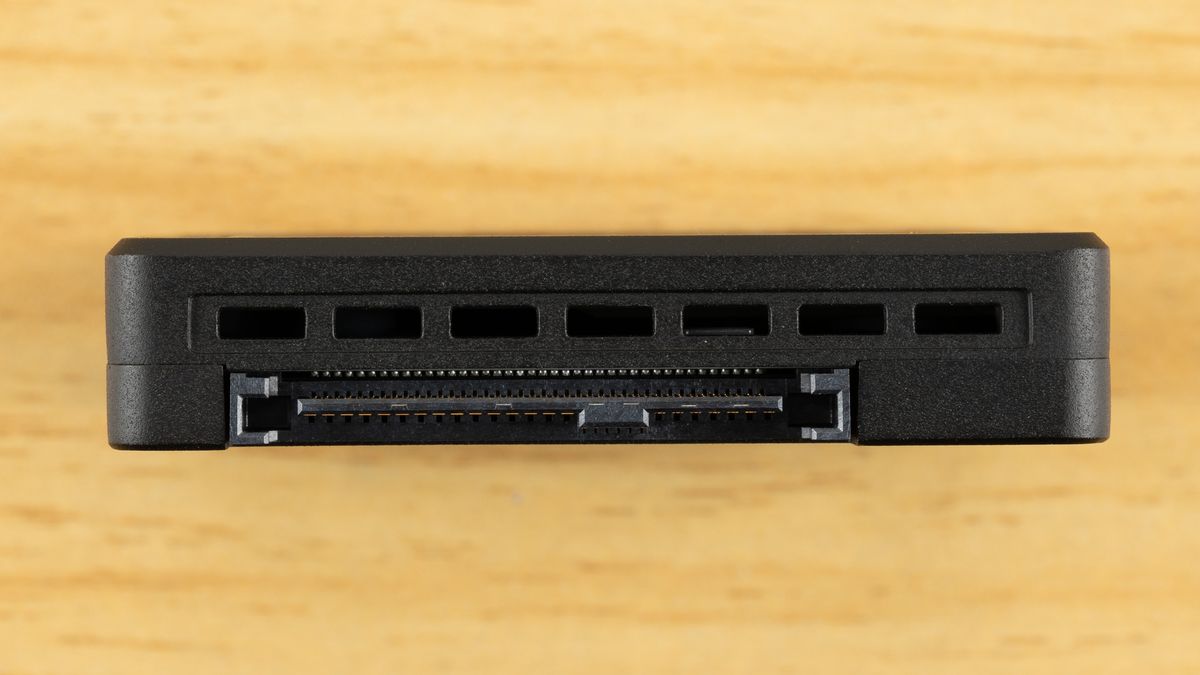
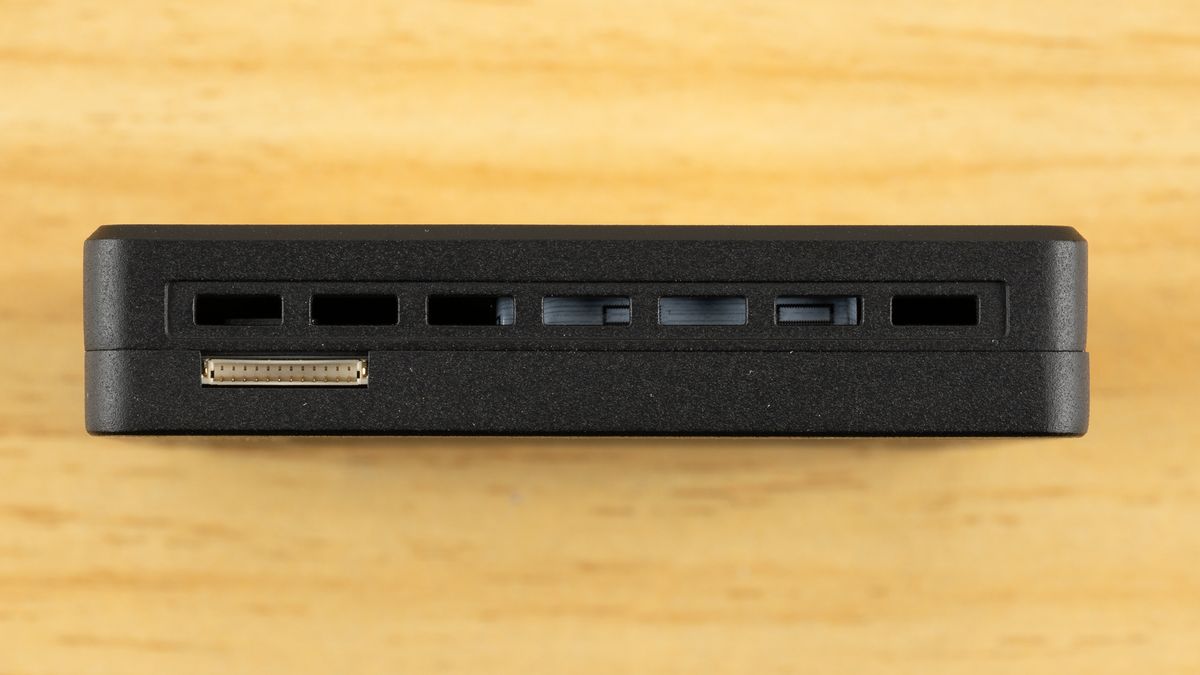
Image 1 of 3
(Image credit: Tom's Hardware)
(Image credit: Tom's Hardware)
(Image credit: Tom's Hardware)
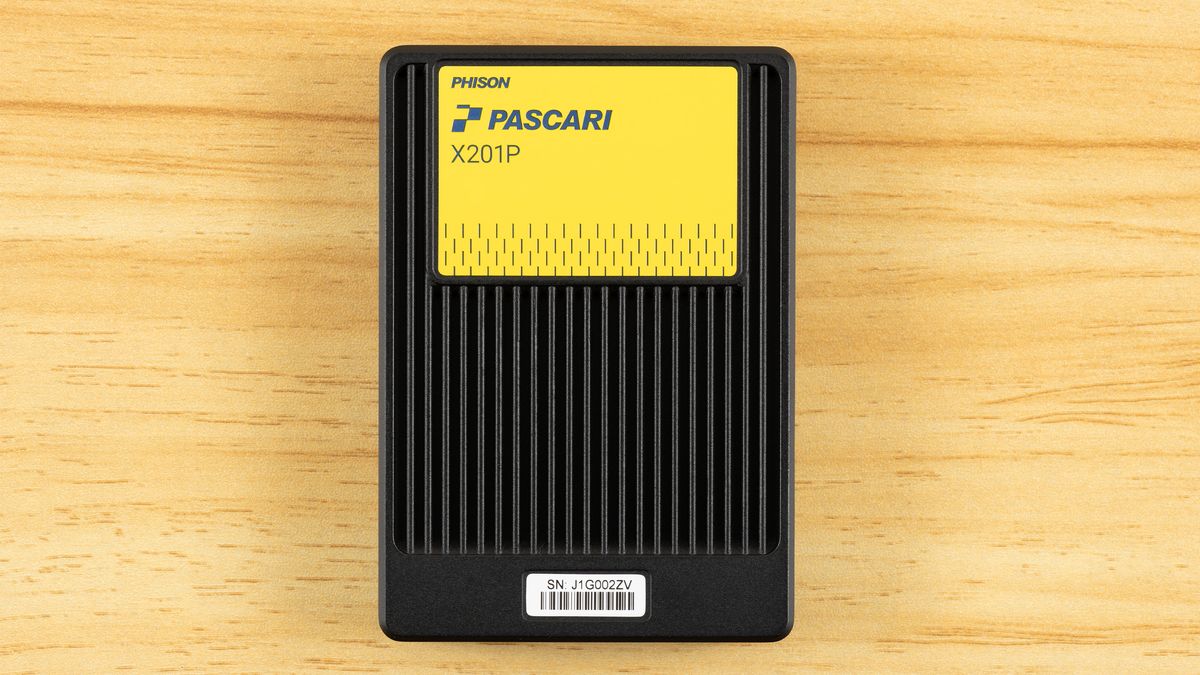
Our sample is in the U.2 form factor, 15mm thick. We have the single-port SKU, ISE model XP208H0815T3P3216T310, with firmware X2WM6026. Some data we previously saw from the drive was reportedly on X2WM6025, but we confirmed X2WM6026 for all relevant results. We mounted the drive on a PCIe 5.0 x4 add-in card adapter for U.2, standing upright in the slot.
Phison did not provide firm hardware details, but we were able to discover some things on our own. The flash was probably the easiest, as the company claimed it was a 321-layer part. That can only be SK hynix’s V9 TLC, which is not flash we’ve tested before in any product. It’s exceptionally fast and uses a three-deck design, which is relatively new for TLC flash. The flash could be credited with some of the exceptional performance measurements we see on the drive.
As for the proprietary controller, we’ve heard that it’s using a combination of the standard Arm Cortex-R5 — these would be the main cores — with AndesCore RISC-V on the side. We’ve seen the latter before on the Phison E28 consumer SSD controller, which did have some enterprise-like aspects to it. The E28 is the newer design, built on a 6nm process with Andes’ newer N45 cores alongside the N25F, while the X2 is a 12nm part that, as far as we can tell, sticks with N25F-class co-processors.
Stay On the Cutting Edge: Get the Tom's Hardware Newsletter
Get Tom's Hardware's best news and in-depth reviews, straight to your inbox.
In this case, the X2 has twice the flash channels, which enables a superior level of performance out of TLC flash, as in enterprise you do not rely on pSLC. That mix of cores sets the X2 apart from other 16-channel PCIe 5.0 enterprise controllers: Marvell’s Bravera SC5 and Silicon Motion’s SM8366 rely on Arm cores throughout, whereas Phison pairs its Cortex-R5 cores with small RISC-V co-processors.
Shane Downing is a Contributing Writer for Tom’s Hardware, covering consumer storage, PC hardware, and AI.
bit_user
Thanks for the review! I haven't yet finished reading it, but wanted to comment on one particular aspect:
So, this is basically what I saw with my Optane P5800X, which is that you can't come even close to saturating the interface with 128 kiB transactions at QD=1. QD=8 will do it. I don't recall how it did with QD=4, but I think that wasn't quite enough. What's weird about it is 128 kiB is the largest transaction size the drive supports! I think my Samsung 990 Pro supports either 1 MiB or 2 MiB transactions, in which case you can basically saturate the interface with QD=1.

 1 hour ago
12



 English (US) ·