
 3 hours ago
8
3 hours ago
8
Michael Mann has shown time and again in films like Thief, Heat, Miami Vice and Public Enemies that he is one of American film’s greatest explorers of the underworld. “It’s like a kind of cultural anthropology,” Mann tells me from his office in Los Angeles. “If you make films, you get to do that in a different place with a different subject every few years. For me, the exploration is the high.”
With its unsettling atmosphere and soaring beauty, Mann’s 1986 film Manhunter reimagined how a thriller could look, sound and feel in an early high point for the director. To commemorate its 40th anniversary Manhunter: The Final Cut, a 4K restoration and director’s cut with three minutes of new footage, will see a theatrical release in New York and Los Angeles this weekend with a nationwide US rollout to follow.
Based on Thomas Harris’s bestselling horror novel Red Dragon, Manhunter follows FBI agent Will Graham (William Petersen), who has been lured out of retirement to hunt down an elusive serial killer before he performs another ritualistic killing on the night of the next full moon. Graham has been called on for his uncanny ability to access the methods and motives of killers by adopting their states of mind, though it has come with its own personal costs. When we meet Graham at his secluded beach house (rented to the film by pop artist Robert Rauschenberg) he’s recently returned from a stint in a psychiatric unit after a meltdown and a violent confrontation with the last prolific killer he captured but got too close to, Dr Hannibal Lecter (presented on screen for the first time here by Brian Cox).
In a wounded and dreamlike fugue, Graham wanders through crime scenes late at night trying to psychically commune with the killer. Like the character he played, Petersen, who oscillates perfectly between dazed and hair-triggered here, had a hard time extricating himself from his work. “Your brain may know you’re acting, but your heart doesn’t,” Petersen said in a recent press release for The Final Cut. “Acting is a wonderful profession for giving you a rounded understanding of humanity. But you have to be careful not to get lost in it.” As soon as the film wrapped, Petersen shaved his beard and dyed his hair blonde to shake the role.
Stephen Lang, who plays the ethically bankrupt tabloid reporter Freddie Lounds, remembers it as a challenging but rewarding shoot. “ I’ve worked with other directors who are considered within the business to be demanding, Jim [James] Cameron being one of them. And when asked the difference between the two, I have said that Jim and I discuss everything. We debate everything. When Michael says jump, I generally say: ‘How high?’ I don’t challenge Michael,” Lang says. “Michael could be tough and he could be short. But you also knew he was extremely generous as a director. He could be a lot of things. There’s a volatility to him, as there is in so many artists. Michael is not only a film-maker, he’s an artist. An auteur.”
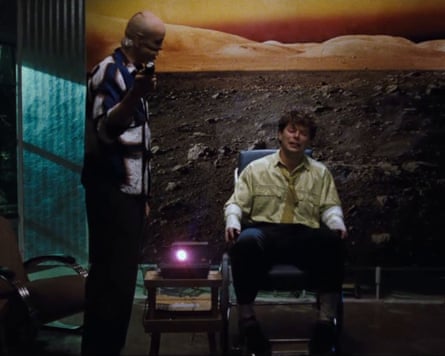
It’s hard not to see some of Mann himself in Graham. Known for an immersive pre-production process that leans heavy on investigation and research, Mann spent time with the FBI’s violent crimes and behavioral science units in preparation for Manhunter. He even corresponded for some time with an imprisoned murderer named Dennis Wayne Wallace, who would be the main inspiration for the film’s killer, Francis Dolarhyde (Tom Noonan in a career-defining role).
“He’d write what he called ‘Jim Morrison psych-poetry’ to me, and tell me his whole story,” recalls Mann of Wallace. “ He had fantasized a love affair with Cinnamon Cindy, a go-go dancer at the Mellow Yellow in Gardena, California. Their song was In-A-Gadda-Da-Vida, which is why that’s used at the end of the picture. He also walked around wearing a hard hat with the Mad Magazine decal on it that said: ‘Support mental illness or I’ll kill you.’”
In Wallace, Mann also saw how childhood abuse acted as a catalyst for brutality and used this insight to create a character that was at once evil and empathetic. “If Wallace soiled anything, shit was rubbed in his face,” says Mann. “He was literally leashed to a tree outside in the front yard. And that kind of abuse reduces self-esteem to some impossibly low level. You couple that with a strong ego and that’s how you get a Francis Dolarhyde.
“I wanted to evoke that contradiction about killers. These people who commit heinous crimes who are at the same time victims themselves – how does one relate to that? Which is the dilemma for Graham.”
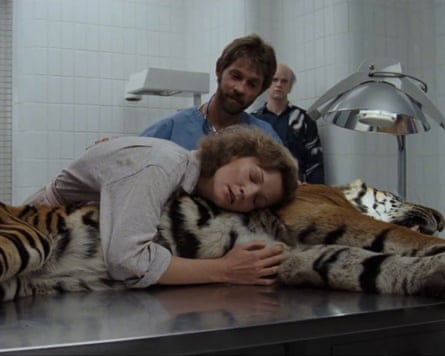
We come to empathize most with Dolarhyde when he falls for Reba (Joan Allen), a blind woman he works with at a photolab in St Louis. Back at Dolarhyde’s place, they drink gin and tonics and, unbeknown to Reba, watch home movies of the family he plans to kill next. His eyes float between Reba and the bikini-clad woman in the home movie, a smiling mother playing with her child in a pool. There’s some shared humanity between this stranger on screen and the woman next to him that Dolarhyde appears to register. Later, they lie naked in bed together and Dolarhyde kisses sleeping Reba’s hand and weeps. You begin to see that maybe beneath the madness of this man, beneath his sense of godlike superiority over his victims, is some bottomless need for a love he never had. “To me that was evoking the Dolarhyde that had been there as an innocent child,” Mann says. “The person he could have evolved into had he not been the victim of such abuse.”
Despite the macabre content, Manhunter comes in as glossy and delectable a package as you can imagine. It’s got just enough juicy 80s B-movie DNA to offset everything vile unfolding on screen. Manhunter’s greatest achievement is its marriage of visual splendor and psychological depth. There’s a heightened, swooning quality to the look of the film that has never been replicated: all hypermodern, minimalist spaces flooded with alien light.
The juxtaposition of Mann’s commitment to authenticity in research and writing with his complete disregard for it visually makes for a satisfying and hyper-real combination. Despite initial disappointment at the box office, Manhunter has continued to dig its claws into culture and has had a lasting influence few could have seen coming. Its icy synth-dominated score set the table for modern crime scores, particularly Cliff Martinez’s collaborations with Nicolas Winding Refn. It’s hard to imagine the myriad of films and shows about criminal profiling existing without it.
“It influenced a lot,” agrees Mann. “I was trying to find how I could push the medium forward, that was very much on my mind. How do I make it so expressive that you really feel you are in this place?”
-
Manhunter: The Final Cut is out in the US now with a UK release on 25 September and an Australian release to be announced





 English (US) ·