
Apple offers some of the best workstations going, with everything from the MacBook Pro to Mac mini finding its die-hard adherents among professionals of all stripes, Sometimes, though, even the biggest Mac fans need to run software in a Windows environment, whether for software testing or you need to use a professional software suite that has no native Mac support. Enter Parallels 27, the latest version of the best virtual machine software that offers the best of both worlds for Apple users.
This latest version of Parallels brings some big changes, including a complete rewriting of the graphics pipeline for the Apple Metal API, OpenGL 4.3 support (one of the most demanded updates among Parallels users), and the full move over to Apple Silicon-only. While that last bit might irk some who still cling to their Intel-based Macs, many more are going to take issue with the subscription-based model for its most in-demand features.
Despite that, however, there’s no denying that Parallels 27 is the best way to host guest OSs on your Mac, and for most the pros are going to far outweigh the cons.
Latest Videos FromTechRadar
Parallels Desktop: Plans & Pricing
Parallels 27 comes with four different plans for various use cases: Standard, Pro, Business, and Enterprise.
The Standard plan is available as both an annual subscription and a one time purchase, with the annual subscription list price running $99.99 (about £75 / AU$145), while a one-time, perpetual license costs $219.99 (about £165 / AU$320). It should also be noted that the one-time purchase does not come with free upgrades to newer versions of Parallels, though the subscription plan does.
For the Pro plan and above, an annual subscription is required, starting at $119.99 (about £90 / AU$175) for a Pro plan and $149.99 (about £110 / AU$220) for a Business plan. Enterprise customers will need to contact Parallels’ sales department to negotiate an Enterprise plan rate.
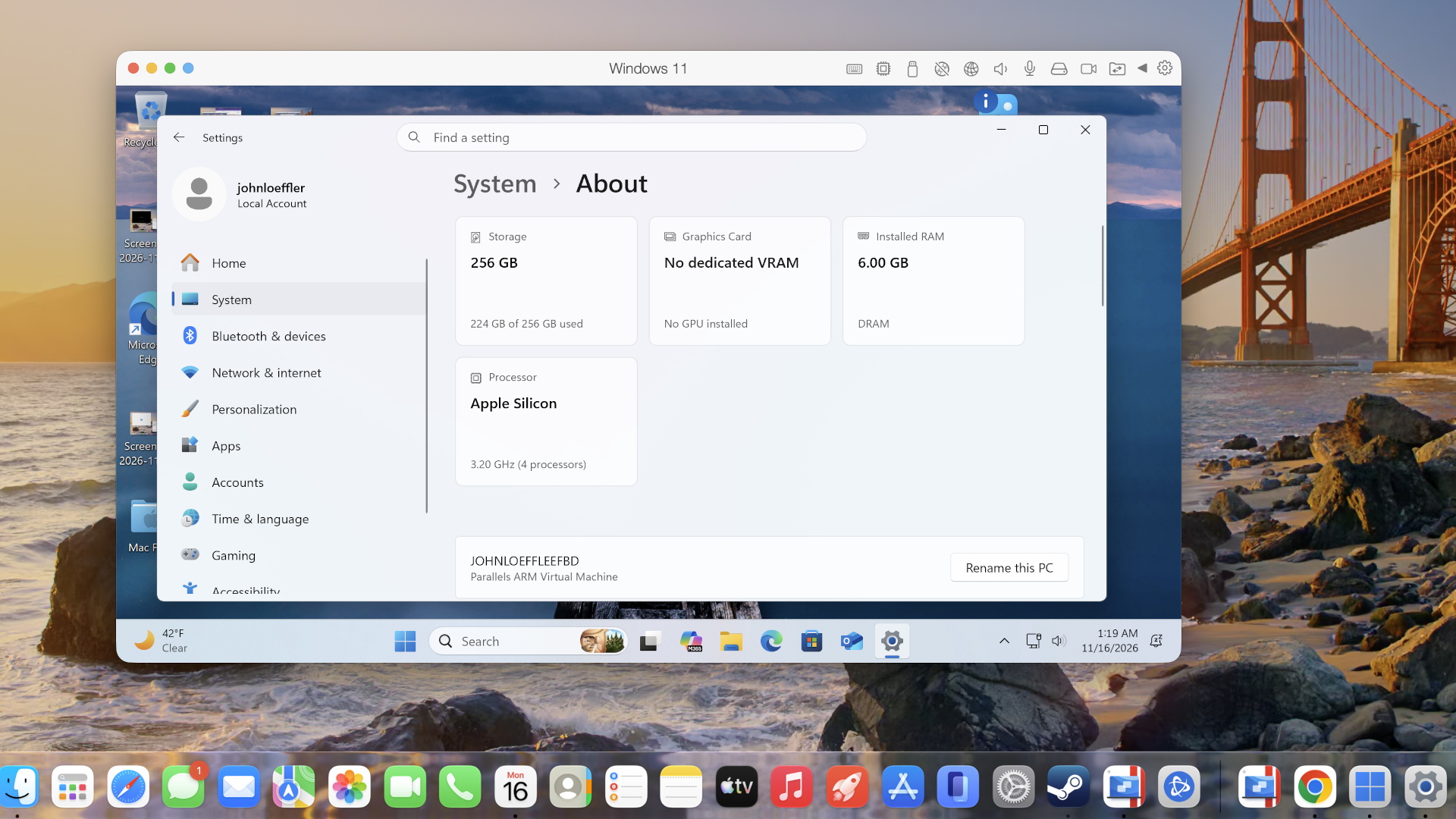
For most casual users, the Standard plan is the way to go, though it is limited to four virtual CPU cores (vCPUs) and 8GB of virtual RAM (vRAM), though this should be more than enough for basic office software and productivity apps. Stepping up to the Pro tier or higher gets you up to 32 vCPUs and up to 128GB vRAM. The Pro plan comes with AI Agent Integration (MCP), disk and memory cleaner, system and performance monitoring, and screen capture and recording, among others.
The Business plan includes those features, plus volume licensing with centralized license admin, automated CI/CD workflows for developers, and automated deployment and update support through Jamf and Intune integration. The Enterprise plan includes things like policy enforcement, compliance visibility, and many other IT tools for large businesses.
The biggest sticking point for Parallels 27 is going to be these prices, largely because there are open-source alternatives out there, but they come with their own trade-offs that might not be worth the savings. None of this, by the way, includes the price of a Windows 11 license, and for businesses in particular, this expense can add up very quickly with multiple deployments across many Mac systems, but this would also be the case with open-source VMs.
Parallels Desktop: Features
The biggest change to Parallels with version 27 is the end of Intel-powered Mac support. Parallels 27 was developed with macOS 27 in mind, and that OS update is Apple Silicon only, so Intel Macs will need to stick with Parallels 26 from here on out. Fortunately, Parallels will continue to support Parallels 26 with security and maintenance updates for some time at least.
It’s also worth pointing out that Parallels 27 uses Windows on Arm by default, and this version of Microsoft’s OS has inherent Intel x86 app compatibility issues that Parallels can’t do anything about. There is an early technology preview allowing you to import existing Intel x86-based Windows VMs, but these will run significantly worse than a Windows on Arm VM since the entire instruction pipeline needs to be emulated.
The other big change is the rewritten graphics driver for OpenGL 4.3 support based on Apple’s Metal API, one of the most requested features if Parallels support forums are any indication. A lot of professional software tools that are Windows-only (like ArcGIS Pro and various CAD software) use OpenGL 4.3, so earlier versions of Parallels struggled with these apps, if they were able to run at all. Parallels 27 is still capped at DirectX 11.1, however, so apps that require DX 12 won’t work. You also need to make sure you have the latest version of Parallels Tools installed to make sure that OpenGL 4.3 will work properly.
Further, on Apple M4 systems or newer, there is now support for Apple’s Scalable Matrix Extension instructions in both Windows and Linux environments, which can speed up AI workloads in compatible apps.
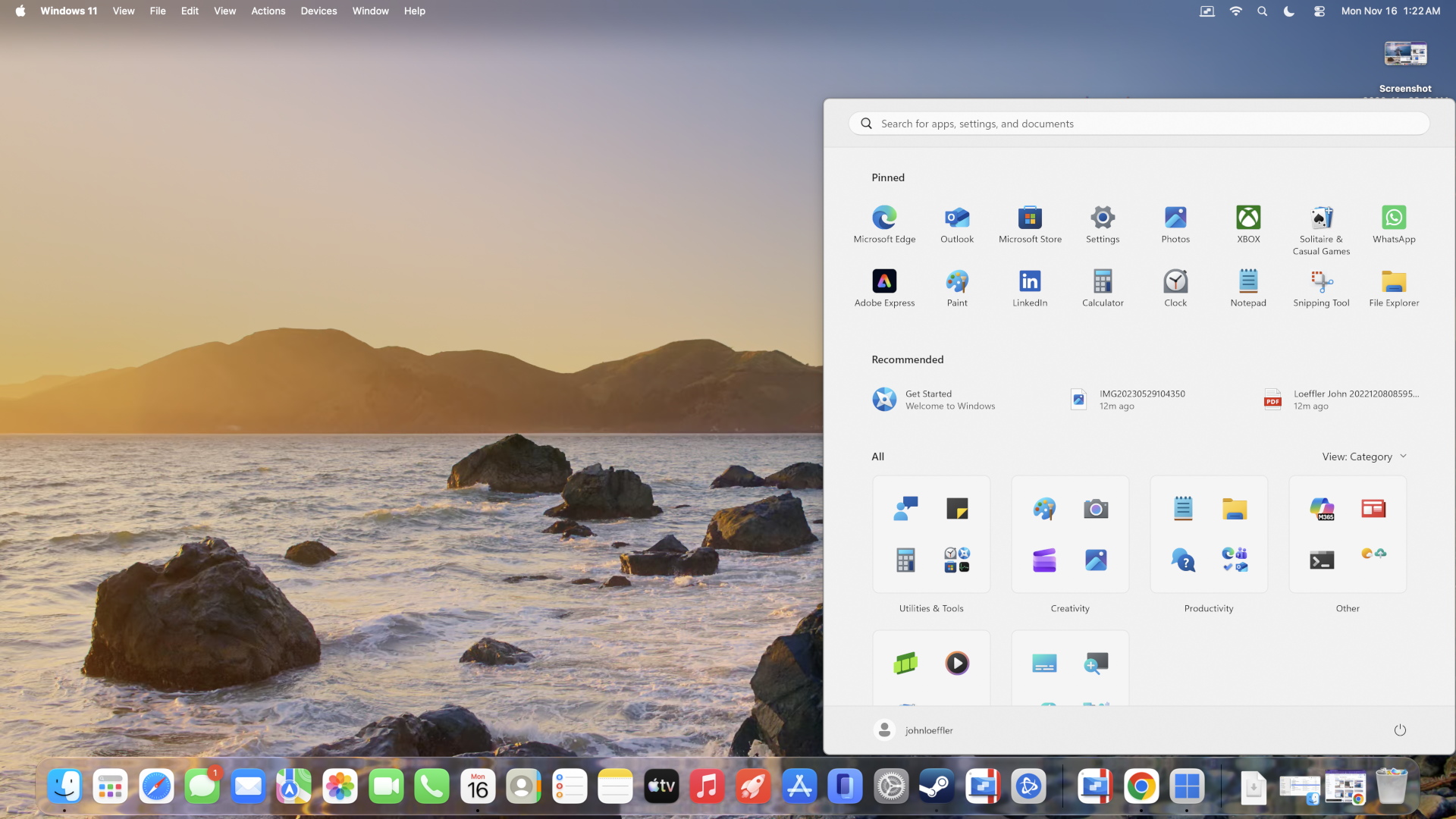
Beyond those changes, Parallels 27 retains the core features of earlier releases, with options to run the guest OS in a window on your macOS desktop, to have it use its own Space on you Mac, or to have individual apps work as-if-native through Parallels Coherence mode. There’s a shared folder between the host and guest OS to make file transferring simple, and drag-and-dropping from one desktop to another is seamless.
Parallels Desktop: Interface & Use
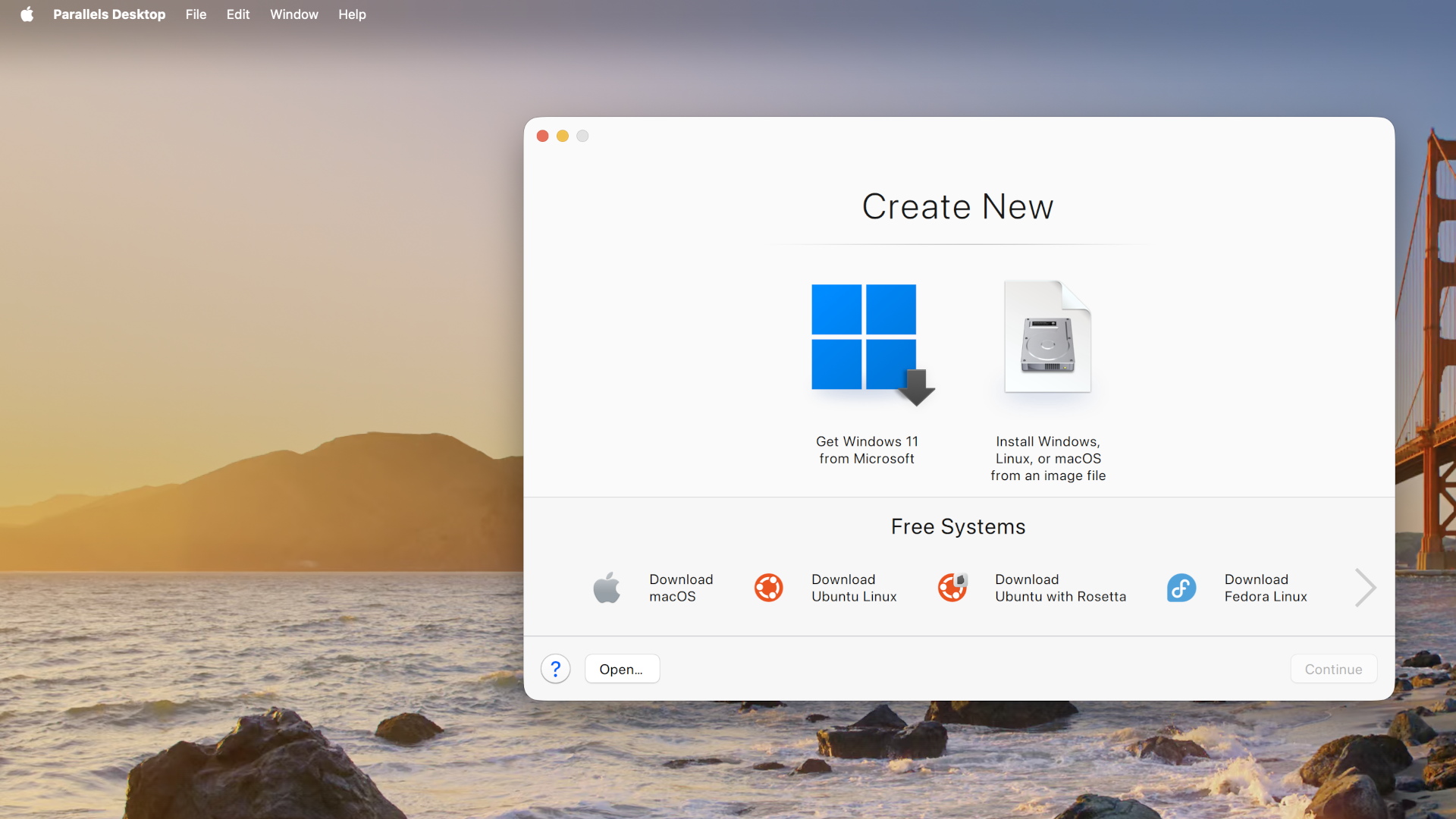
The strongest argument in favor of Parallels, generally, is how low-lift setup and installation is. Unlike a lot of VMs out there, setting up the guest OS is as simple as a couple of button clicks and about 15 minutes of installation time. If you’ve never had to set up a VM before, I can assure you that this is arguably the easiest installation process you’re going to find on the market.
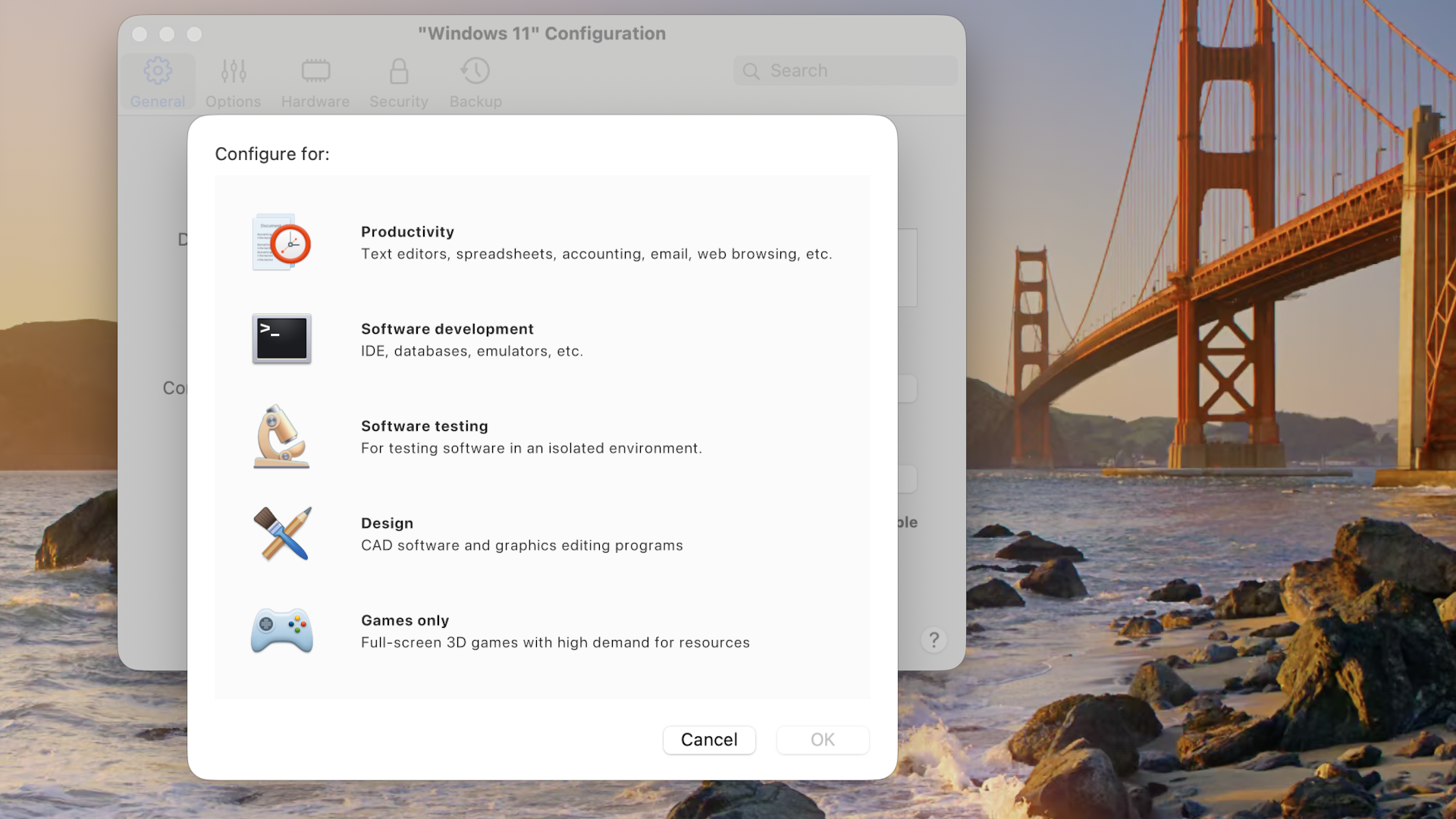
You also have a lot of control over how many resources in terms of CPU cores and memory to assign to the VM, especially at the Pro tier and above, and these settings can be changes nearly on the fly if you need more performance (you do have to stop the VM first though, so save your work before doing so).
Once everything is set up, Parallels feels like just another app on the Mac desktop, with your chosen guest OS running in a window you can click in and out of as needed. If you want a full screen desktop experience, you can get that too.
Coherence mode is very useful if you need to work primarily in macOS but need occasional access to a Windows or Linux app for that work, but I’d argue that this isn’t the best reason to buy Parallels (Crossover does the same thing, by and large, and doesn’t require a whole operating system installation taking up memory and storage resources).
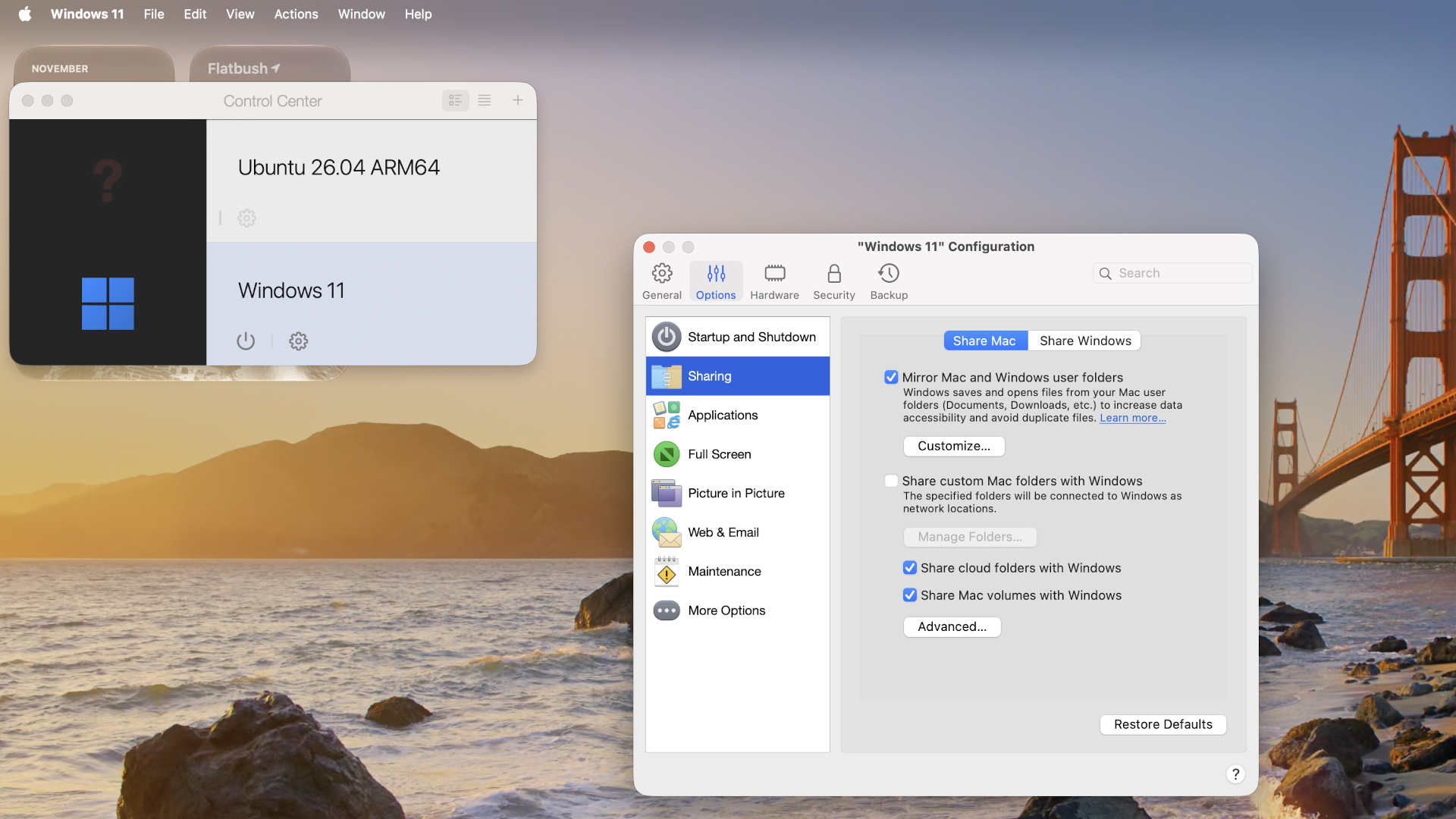
The seamlessness of the overall experience can make you forget that you are using a guest OS, however, so if your organization handles sensitive data, whether from a legal/compliance perspective or internal policy, be sure to manage permissions properly as far as folder and clipboard sharing go, since separation is not the same thing as isolation. Fortunately Parallels has settings to restrict such sharing, but you will need to configure them appropriately for your specific requirements.
The same is true with any VM, of course, but the ease of integration with Parallels is such that complacency might actually be a problem if you’re not careful. In a lot of ways, the complexity and foibles inherent to competing VMs make it harder to forget you are using a VM, and their more ragged interfacing actually helps keep you from oversharing. That simply isn’t the case with Parallels 27.
Parallels Desktop: Support
Despite the ease of use, there are still going to be difficulties with some apps and setups that users might run into. Fortunately, for subscription customers at least, you do get phone, chat, and email support as long as your subscription is active to help diagnose any issues.
Those with a bit more experience with VMs also have access to an extensive knowledge base covering everything from installations to device sharing and common configuration issues. There are also regular security and performance updates that subscription customers will have access to.
There are things, however, that no amount of support is going to help with, particularly if you’re looking for Windows PC gaming support. DirectX 11 games and older should work well enough, but recent titles using DirectX 12 simply aren’t available, and no game is going to run nearly as well as they will natively, whether through a Mac-native version or running the game on a comparable Windows PC.
For game devs (though understandably, this will be a very small subset of you), this latter point is important to keep in mind, and I would definitely recommend using an actual Windows PC for any build testing you need to do if you absolutely must code a game on a Mac.
Parallels Desktop: Performance
Of course, any time you are working with a virtual machine, you’re going to have to sacrifice some performance given the hardware restrictions. Performance is going to depend pretty heavily on what kind of CPU and memory allocations you make, so the higher you can afford, the better your experience will be.
That said, even at the Standard plan’s four cores and 8GB memory restrictions, actual app performance is generally very good, though it will have much more limited multitasking capabilities. This is most obvious when comparing the same benchmarks across different configurations. In Cinebench R24 on a 10-vCPU/12GB-vRAM configuration on an Apple M6 chip, I was able to get a score of 184 for single core performance, which is more or less what you get with a 4-vCPU/8GB-vRAM configuration (TK). Its multi-core score drops with your allocated core count, however, from a 10-vCPU score of 999 in Cinebench R24 down to 601 with a 4-vCPU/8GB allocation.
Similarly, in Geekbench 7, the 10-vCPU/12GB allocation netted a single-core score of 3,495, compared to the 4-vCPU/8GB allocation’s 3,417, which is only about 2% slower. Compare these to the native run of Geekbench 7, which scored 4,052, and you get at worst a roughly 16% hit to single-core performance with Parallels, which is genuinely pretty outstanding for a VM.
The more limited configuration, however, came in with a roughly 31% lower multi-core score (10,356 to the 10-vCPU’s 15,044), and fares even worse next to the native score of 22,180, or about a 53% lower overall performance.
This means that for single app use, you won’t see too much of a difference between a Standard and a Pro plan, but if you plan on doing a lot of work in Windows, including multitasking with several apps, the Pro plan is probably worth the investment.
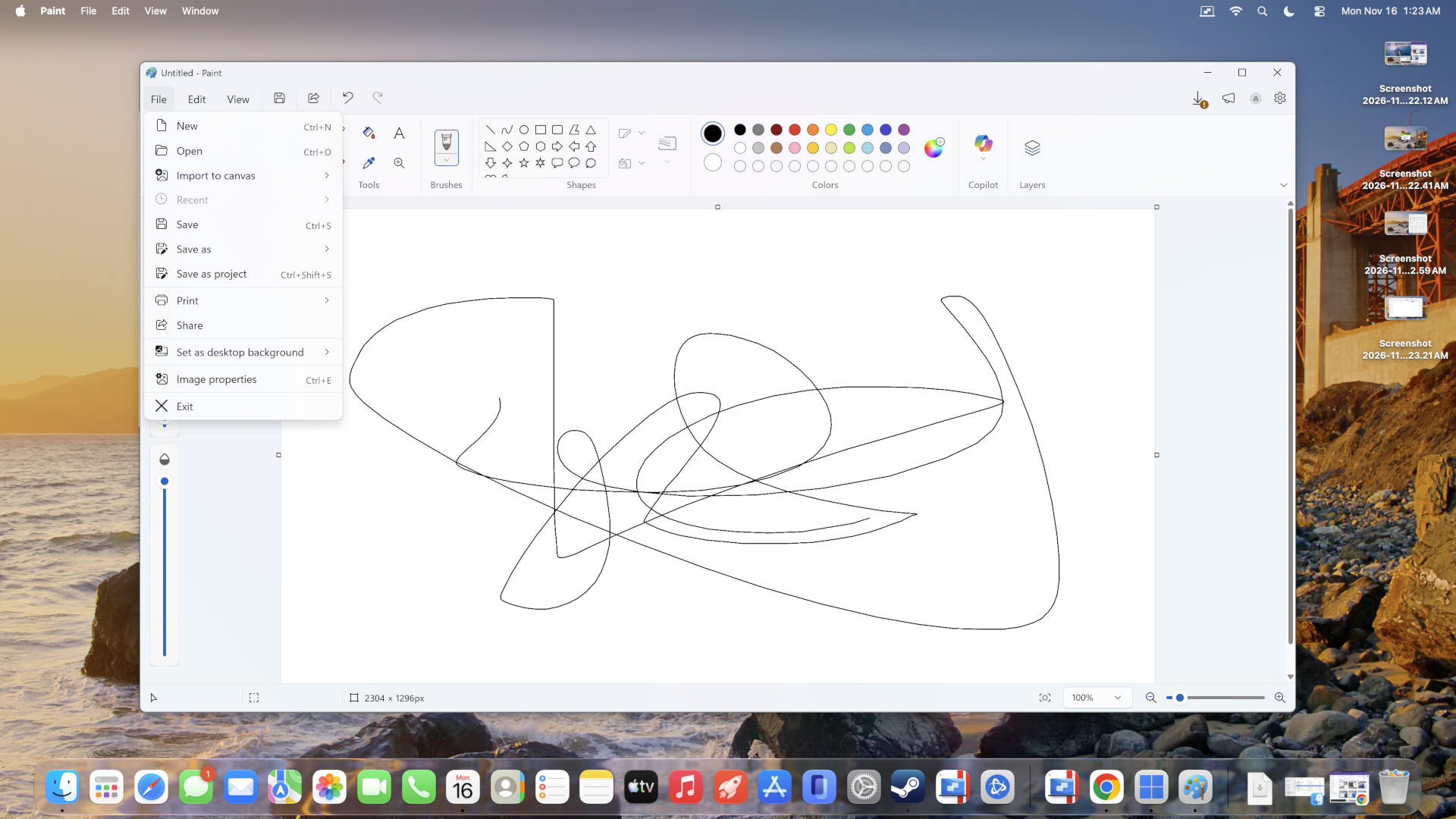
On the graphics front, the Parallels Display Adapter driver does a solid job, but its performance against native Mac apps is fairly underwhelming. Most of the graphics benchmarks I normally run, like 3DMark Steel Nomad and Solar Bay, won’t even run in Parallels, thanks to the lack of DirectX 12 support. In 3DMark Wild Life Extreme, meanwhile, a 10-vCPU/12GB configuration performed about 58% worse versus native Mac performance.
In OpenGL testing, which is one of the bigger feature updates to parallels with this version, the Windows emulated environment performed somewhat better than the DirectX test, though the 10-vCPU/12GB allocation on an Apple M6 still performed about 31% worse in Unigine’s Valley benchmark (4,127 to 2,859). The Windows VM did manage to score slightly higher than native on Unigine’s Heaven benchmark, scoring 2,160 to the native runs’ average of 2,059, or about a 5% better showing.
Parallels Desktop: Final Verdict
Parallels 27 doesn’t solve all of the compromises you need to make to run a Windows virtual machine on a Mac, but it comes pretty darn close. Its single-app performance running in Windows is nearly indistinguishable from its native counterparts (at least with most apps), and there’s no understating how easy it is to set up and use.
Where it does stumble, particularly in multi-core performance necessary for the kind of multitasking you expect from a fully functional OS, is going to be highly dependent on the host system’s hardware. That said, it’s generally going to underperform what you can get using Mac-native versions of the same apps.
But, if you were able to get those apps on a Mac, you wouldn’t be using Parallels, and so Parallels 27 offers as much of the best of both worlds as you are likely to find on the market.





 English (US) ·