
Founded and headquartered in California in 2018, PacketStream was launched specifically to address the high cost and complexity of residential proxies, which are IP addresses sourced from real devices around the world. The company runs a peer-to-peer (P2P) bandwidth-sharing network, which allows users to elegantly bypass geo-restrictions when accessing all sorts of data.
In this model, device owners share their unused internet bandwidth via a background app in exchange for compensation ($0.10/GB). On the other side, businesses and developers get to purchase cheap residential IP bandwidth for $1.00 per gigabyte.
As you can imagine, there are some risks involved. Though the setup makes proxies more affordable, it comes at the cost of reliability and speed. Then, there’s the potential issue of unreliable IP addresses within the network. Despite offering secure proxies in general, PacketStream doesn’t fully control the IPs sold through its network.
Latest Videos FromTechRadar
PacketStream: Plans and Pricing
There are loads of proxy providers with fairly complex pricing plans, and then there’s PacketStream. The vendor keeps things simple, charging per bandwidth at a flat fee of $1 per GB, with no recurring subscriptions and a purchased balance that never expires. This way, you get access to the entire network of residential proxies, which is considerably more straightforward and may even be a cheaper alternative to providers charging for individual IP addresses or monthly commitments.
Speaking of cheap, the $1 per GB price tag is one of the most affordable options in the industry. A quick look at the competitors confirms that most of them charge a lot more. For instance, entry pricing for IPRoyal begins at $7/GB for pay-as-you-go, whereas Bright Data starts at $8.40/GB, and Webshare will cost you $3.50/GB for residential bandwidth, though it scales down to $1.40/GB.
The caveat is that you’ll need to buy at least $50 worth of bandwidth to activate an account. This means you can’t buy just $1 of bandwidth to take the platform for a spin before deciding, as the $50 minimum deposit is a must. Still, PacketStream offers rotating proxies and sticky sessions (there are no true static/dedicated ISP proxies), which hold the same residential IP address for up to 60 minutes. So, in case one IP address doesn’t work, you can switch to a different one in a jiffy.
If you’re adamant about testing the service before committing, PacketStream offers trial credits, but without an automated, instant process. You need to fill out a trial request form or contact support, where a team member manually evaluates your workload before approving discretionary credits. This process can feel cumbersome for individual users who just need to test a few gigabytes' worth of proxies.
PacketStream accepts payments through PayPal and major credit cards, with bank transfers available for enterprise or reseller tier orders ($500+ minimum).
PacketStream: Features
Besides simply shelling out for proxies as a user, PacketStream also allows you to acquire the proxies and sell them on to offset costs. You can also sell your unused device bandwidth for profit, starting at $0.10 per GB. The minimum payout is $5 and is sent to your PayPal account within one week, with a 3% fee applied to cashouts.
During our testing, an interesting thing happened. Microsoft Defender blocked the download and installation of PacketStream, identifying it as a program that “displays deceptive product messages.” This is typically how ‘scareware’ is described, or software that makes deceptive or fraudulent claims about your computer’s health to trick you into buying unnecessary or potentially unwanted products, which may not be inherently malicious in the same way as other malware.
However, since PacketStream doesn’t make any scary claims about your device, the flagging as potentially malicious could be due to the application’s process of using your computer to route third-party traffic when you share your bandwidth with other users. Hence, the antivirus interprets the app’s behavior as unusual or questionable. So, if you fail to install PacketStream, this could be the reason.
Residential Proxies
PacketStream’s bread and butter is its P2P residential proxy network spanning 190+ countries. These proxies are sourced from real devices whose owners sell their bandwidth on the PacketStream network. Before you start worrying about illegally sourced IP addresses (a significant issue among many proxy providers), you’ll be glad to know that every IP address on PacketStream was consensually added by its owner to earn money.
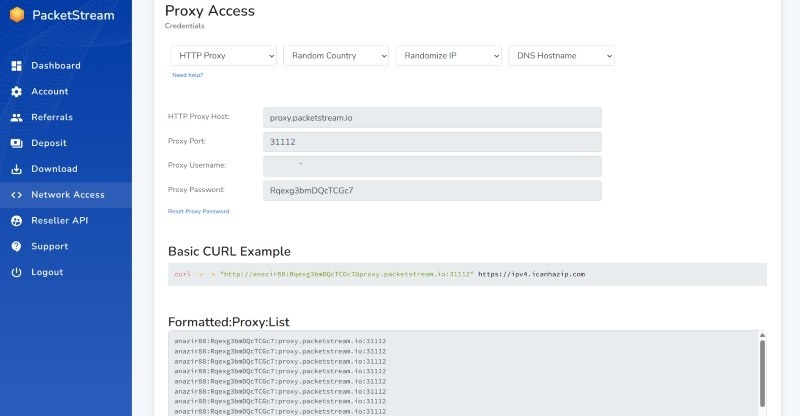
The company offers both rotating (per-request) and sticky session options. Rotating sessions switch exit IPs with every new connection for maximum anonymity, while sticky sessions hold the same residential IP connection for up to 60 minutes for workflows requiring persistent logins or multi-step requests. Notably, PacketStream doesn’t offer true permanent static ISP proxies, as sticky sessions remain dependent on active peer device availability. Selection of the session type is configured directly via your proxy authentication URL string.
PacketStream’s proxy IP addresses were reliable during our test and offered reasonable speeds. We chose IP addresses from different countries, and they provided fast connections, although the speed varies depending on the country and peer device bandwidth. PacketStream lets you pick proxies from all around the globe, but you can’t select by city or state, which we consider a disadvantage. Several rival proxy providers allow you a granular selection of proxies from specific cities or ZIP codes (not to mention ASN targeting) to boost your odds of circumventing geographical limitations.
The platform supports HTTP, HTTPS, and SOCKS5 proxy protocols, which differ in how they handle traffic and their compatibility, each with its own strengths and downsides. Having SOCKS5 in particular is important as it operates at a lower network layer than HTTP/HTTPS, which makes it ideal for general-purpose tasks and specialized scraper setups.
While we’re on the subject of setups, residential proxies can be employed for many things. A good example is data scraping, wherein people use proxies to bypass website geo-restrictions and scrape relevant information.
Let’s say you run a website that tracks the prices of commodities and delivers this data to users. Running a price monitoring site requires extracting data frequently and quickly from many websites. The websites (primary data sources) are privy to external data scraping and block it by implementing geographical and IP restrictions. They can identify specific IPs from data scraping bots and block them from further access. They can also ban IP addresses from an entire country from accessing their information.
Through PacketStream, you gain access to a sizable network of residential IP addresses you can then use to evade restrictions and scrape commodity price data. Thanks to automatic IP rotation, in case one IP address gets discovered and blocked, your next request is instantly routed through a fresh peer connection. Although specific numbers fluctuate dynamically based on active peer devices, PacketStream routes traffic through millions of active household connections across 190 countries, so you’ll have plenty of new proxies to get your hands on the data you need.
Another frequent use case for residential proxies is online retail. Many people use automated scripts to snap up fast-selling products, placing orders before they run out of stock. But, e-commerce sites aren’t particularly keen on this and tend to blocklist bot IP addresses. PacketStream’s residential proxies let users circumvent this block and get their desired product.
As far as an e-commerce site is concerned, residential proxies belong to legitimate devices. They are inherently difficult to detect and block because doing so might lead to high false-positive rates, which could result in inadvertently locking out legitimate customers who share those same IP addresses. Even when e-commerce sites block a residential proxy, a sticky session can be refreshed to visit the site in question under a new peer identity.
That leads us to what is arguably PacketStream’s biggest drawback: it only offers residential IPs. It doesn’t have datacenter IPs in its lineup, which are faster and more reliable. Datacenter IPs are sourced from dedicated servers with more speed, making them ideal for massive data scraping tasks. Large enterprises are the main users of datacenter proxies, but PacketStream doesn’t serve this cohort well. Instead, it’s best suited for individuals and small businesses seeking affordable residential proxies.
PacketStream doesn’t offer dedicated mobile-specific IPs, which is surprising since mobile device IP addresses are present organically on this P2P network. Yet, you can’t specifically filter or target mobile carrier networks. Many businesses use mobile IPs for app testing and ad verification, but performing these tasks with PacketStream is difficult.
Likewise, you won’t find ISP proxies here. Sourced directly from Internet Service Providers, these proxies (static residential) provide higher data throughput and reduced delay than P2P residential proxies, but you’ll have to get them elsewhere.
Selling Bandwidth
As a PacketStream user (or ‘Packeter’), you can sell your unused bandwidth and make money. Just add your IP address to the network and earn money when people use your device as a proxy (with no inbound ports or port forwarding required). Pricing is $0.10 per GB shared, which can help you offset the cost of buying bandwidth on PacketStream.
The bandwidth-sharing process is fairly easy, as the primary requirement is a stable internet connection. Of course, you’ll have to download the PacketStream client on your PC, available for Windows, macOS, and Linux (where it can be installed via Docker). The client is lightweight and runs on low-end PCs without noticeable hiccups.
After installing the PacketStream PC app, open it any time you feel like sharing a connection and activate the mode. Your payout is automatically calculated based on the amount of data your shared connection transmits. Closing or stopping the PacketStream app immediately terminates the shared connection and offers you complete control over the process. PacketStream can’t use your connection without your consent, which you give by running the app.
There’s no limit to the amount of bandwidth you can share. The minimum payout is $5, earned by transmitting 50 GB of bandwidth, which corresponds directly to the $50 minimum deposit threshold for buyers. Earnings are paid out in USD via PayPal and processed within one week. Keep in mind that a flat 3% fee applies to every cashout.
Reseller API
PacketStream offers white-label reselling services via a dedicated Reseller API, designed for entrepreneurs and business clients interested in launching their own proxy brand. This model allows you to sell PacketStream’s residential proxy bandwidth under your own branding with zero PacketStream mentions or attribution.
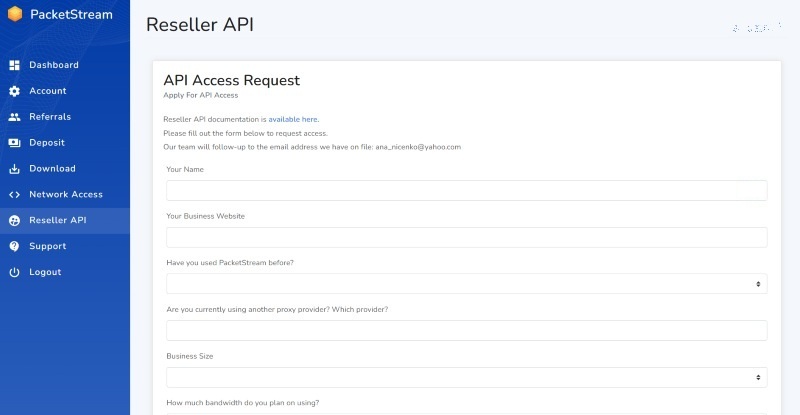
Through the Reseller API, it’s possible to programmatically create and manage subaccounts, allocate bandwidth limits, track subaccount balances, and monitor real-time usage data. Resellers purchase wholesale bandwidth at $1.00 per GB (matching the standard platform rate), which is subject to a $500 minimum purchase threshold. Resellers can set their own retail pricing to determine their profit margins and are responsible for providing direct customer support to their end-users.
Any peer device added to PacketStream’s network automatically becomes accessible to your subaccounts. This feature isn’t for individual users, but we consider it worth discussing to give a complete PacketStream review.
PacketStream: Ease of Use
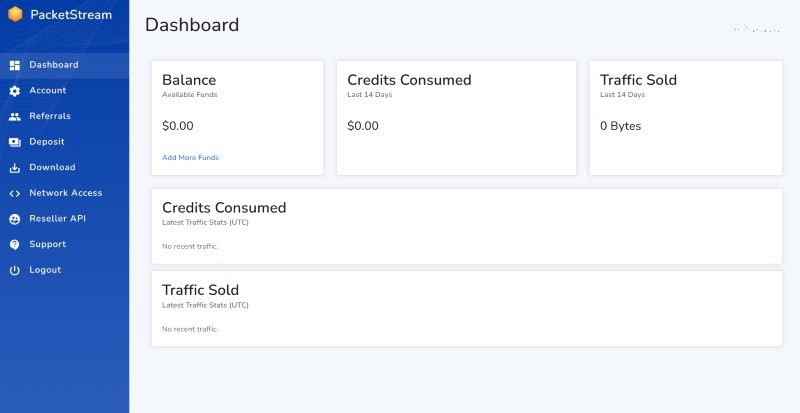
It’s safe to say that PacketStream outdoes several of its peers in user-friendliness. It offers one of the most streamlined interfaces in the proxy space, largely due to its highly focused portfolio.
All the features are neatly arranged on the left menu, and the main dashboard lies on the right side. With a white background and a few contrasting colors, PacketStream’s interface feels visually appealing and easy to navigate. The average person won’t have any issues understanding this interface, which, sadly, can’t be said for some proxy providers.
There’s a drawback, though. PacketStream doesn’t offer a browser extension to manage proxies. Instead, users must copy their proxy authentication endpoint and username parameters directly from the web-based dashboard and enter them into their scraping scripts or third-party software. An extension lets you switch proxies at the click of a single button, but PacketStream doesn’t provide this benefit.
PacketStream: Customer Support
This is an area where PacketStream lags behind its competitors. It offers direct support only via email and web contact form, with no live chat or telephone option. Though incoming tickets are monitored around the clock, PacketStream doesn’t state a guaranteed SLA response time. Replies vary and can take up to 48 hours, with no option to hold a real-time conversation with support staff.
Self-help support is organized under a dedicated Resources page on the website. It includes quickstart and proxy gateway references, guides, tutorials, insights, and runnable code examples hosted on GitHub (a big plus for devs), among other things. The overall documentation is compact and largely on par with what we’ve seen in other proxy providers.
PacketStream: The Competition
PacketStream has numerous competitors, the most notable being Bright Data, Oxylabs, and Webshare.
Bright Data offers residential, static ISP, and datacenter proxies. It also offers advanced web scraping APIs, scraping browsers, automated web unlockers, and pre-built datasets. In contrast, PacketStream offers none of these, except residential IPs. If you need PacketStream’s proxies for automated data scraping, you’ll have to get an external platform for the APIs.
But at $1 per GB (with a $50 minimum deposit), PacketStream’s residential proxy service is much more affordable than Bright Data’s, which costs around $8.40 per GB on standard pay-as-you-go plans (scaling down to $3.00/GB with monthly commitments).
Oxylabs provides residential, static ISP, mobile, and datacenter proxies, with a pool of over 100 million residential IP addresses. It also has a Web Unblocker and web scraping APIs for enterprises in its lineup. Oxylabs is undoubtedly the more sophisticated platform, with more reliable and speedy proxy IPs and complete control over its proxy network.
Still, Oxylabs’ residential IPs cost around $8.00 per GB on pay-as-you-go tiers, compared to PacketStream’s $1 flat rate.
Webshare offers residential, static ISP, and datacenter proxies, but lacks built-in web scraping APIs. Its pool of 80 million+ residential IP addresses across 195 countries is on par with Oxylabs and Bright Data, but larger than PacketStream.
With residential pricing starting at $3.50 per GB (scaling down to $1.40 per GB on volume commitments), Webshare is one of the most affordable proxy providers for enterprises. Yet, PacketStream’s $1 per GB flat rate beats it in entry-level per-gigabyte pricing.
In summary, PacketStream lags slightly behind most competitors in certain advanced features and customer support. Nonetheless, it outperforms them in ease of use and affordability, helped by the lower costs of running a P2P network and the opportunity to earn money through offering your bandwidth to other users.
PacketStream: Final words
At $1.00 per GB, PacketStream is among the most affordable residential IP providers, although the minimum purchase is $50. This makes it ideal for individual users or small businesses that require rotating and sticky (up to 60 minutes) residential proxies for everyday data collection and web browsing tasks.
Having said that, enterprises will probably find PacketStream lacking for any large-scale data scraping needs. There are no datacenter or ISP proxies; it doesn’t offer granular targeting or built-in scraping APIs, and has limited customer support.








 English (US) ·