
 3 weeks ago
41
3 weeks ago
41
James Cameron’s 1991 sci-fi blockbuster returns to theaters this weekend for its 35th anniversary.
Credit: Paramount/Studio Canal
I’m on record declaring James Cameron’s Terminator 2: Judgment Day (1991) to be The Best Damn Sequel of All Time, and I stand by that assessment. August 29, the fictional date (in 1997) of the franchise’s original nuclear holocaust, is fast approaching, and Judgment Day is celebrating its 35th anniversary this year. So StudioCanal has decided to mark both occasions with a special theatrical rerelease of the film this weekend. What better time to revisit some of our favorite scenes from this seminal sci-fi action blockbuster?
(Many, many spoilers below.)
Nobody really expected 1984’s The Terminator to be a hit, but it racked up an impressive $78 million at the box office against its modest $6.4 million budget. Star Arnold Schwarzenegger was keen to do a sequel, but Cameron was busy with other projects, including Aliens in 1986 (another killer sequel). There were also legal complications over the film rights until Schwarzenegger convinced Carolco Pictures, the studio behind Total Recall (1990), to buy everyone out and hire Cameron to make Judgment Day.
Cameron wrote the script in about six weeks, diverging significantly from the stripped-down feel of its predecessor (which some have described as a “science fiction slasher”). Instead, Cameron chose to make his original Terminator the reprogrammed hero of the sequel, serving as a mechanical father figure to a young John Connor (Edward Furlong). Cameron likened the transformation to the Tin Man getting a heart in The Wizard of Oz. Linda Hamilton agreed to reprise her role as Sarah Connor, and this “found family” triad became the emotional core of the film. Hamilton worked out like a fiend for the role, and her resulting lean-yet-ripped physique made her an action heroine on par with Sigourney Weaver’s Ripley.
Released over the July 4th holiday weekend in 1991, Terminator 2: Judgment Day was a critical and financial smash hit, despite predictions that the film would bomb and lose its estimated $70 million production budget. It ended up grossing $520 million, which sadly was not enough to protect Carolco from other film losses. (The studio went bankrupt in 1995.) It’s the perfect sci-fi action film, expertly paced with well-drawn character dynamics, amazing special effects, emotional beats, and humorous touches to keep things from getting too grim. No subsequent film in the franchise even comes close.
A “found family” triad
The father/son dynamic between Arnold Schwarzengger’s T-800 and a young John Connor (Edward Furlong) is the heart of the film. Paramount/Studio Canal
The film also has one of the best villains in cinema with the shapeshifting T-1000 (Robert Patrick). Cameron actually had the idea for a Terminator made of liquid metal when he was writing the first film, but the technology available at the time wasn’t up to the task. Then Cameron made The Abyss in 1989, which featured a flowing, water-like alien at the very end created by Industrial Light & Magic (ILM). ILM made a major investment, expanding its staff and spending over $3 million on new equipment and specially designed software just for Judgment Day.
The gamble paid off. The T-1000 and other visual effects earned critical raves and an Oscar (the film snagged four in all) and helped usher in the golden age of CGI. Audiences loved the character, which had as much to do with Cameron’s expert pacing as the effects. The T-1000’s abilities are only gradually revealed. Initially, the slender Patrick seems no match for Schwarzenegger’s heavily muscled T-800, even if he can take on anyone’s form. Then we see its liquid metal form is impervious to bullet wounds, healing them instantly—even when a gunshot blast splits its head in two. Cameron keeps upping the ante, until one becomes convinced the T-1000 is well-nigh invincible.
“T2 was made for theaters, and our lovingly prepared 3D version, coming back to the big screen, is the absolute best way to see the film,” Cameron told Deadline Hollywood in a statement. “I believe it’s safe to do spoilers after 35 years, so SPOILER ALERT: the good guys win against the AI super intelligence. And maybe that’s a message of hope we could use this summer.”
There is a staggered global rollout for the re-release. It’s now available in Germany, Latin America, the Czech Republic, the US, Italy, and Poland. The film will release in France on September 2; Australia, New Zealand, the Netherlands, Sweden, and Hungary on September 3; and the United Kingdom on September 4.
And now, we give you ten of our favorite scenes:
The T-800 in the biker bar
Credit:
Paramount/Studio Canal
Credit:
Paramount/Studio Canal
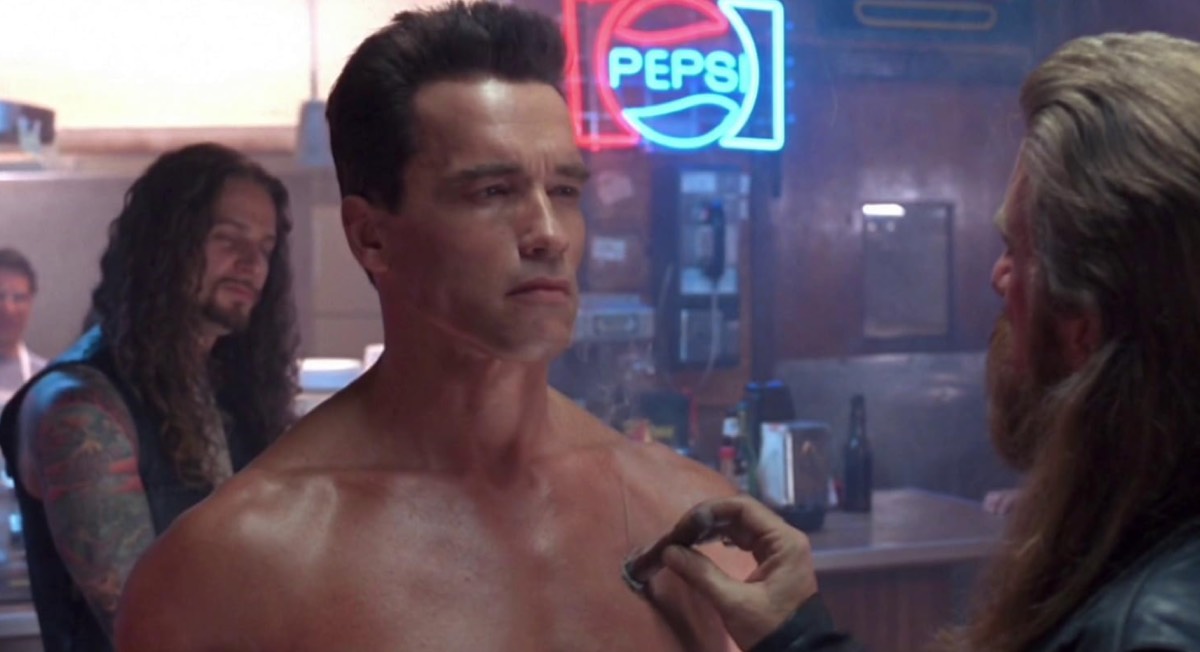
Judgment Day‘s eye-popping special effects certainly provide plenty of highlights, but Cameron didn’t skimp on the story either. This is a prime example of how the director used touches of levity to make even the film’s more workmanlike segments entertaining. The T-800 arrives from the future naked as a jaybird and must acquire clothing, transportation, and weaponry. Naturally he wanders into a biker bar—to the delight of the female patrons—finds a dude his size, and demands the biker’s clothes and motorcycle.
The biker thinks it’s a joke at first and refuses, extinguishing his cigar on the T-800’s bared pectoral muscle—with no effect. The outcome of the ensuing bar fight is a given. The T-800 walks away with cool leather clothing, a motorcycle, a shotgun, and a pair of stylish black sunglasses as George Thorogood and the Destroyer’s “Bad to the Bone” plays. The song’s been overused in films since then, but it was the perfect grace note for this scene.
Chase through the aqueduct
Credit:
Paramount/Studio Canal
Credit:
Paramount/Studio Canal
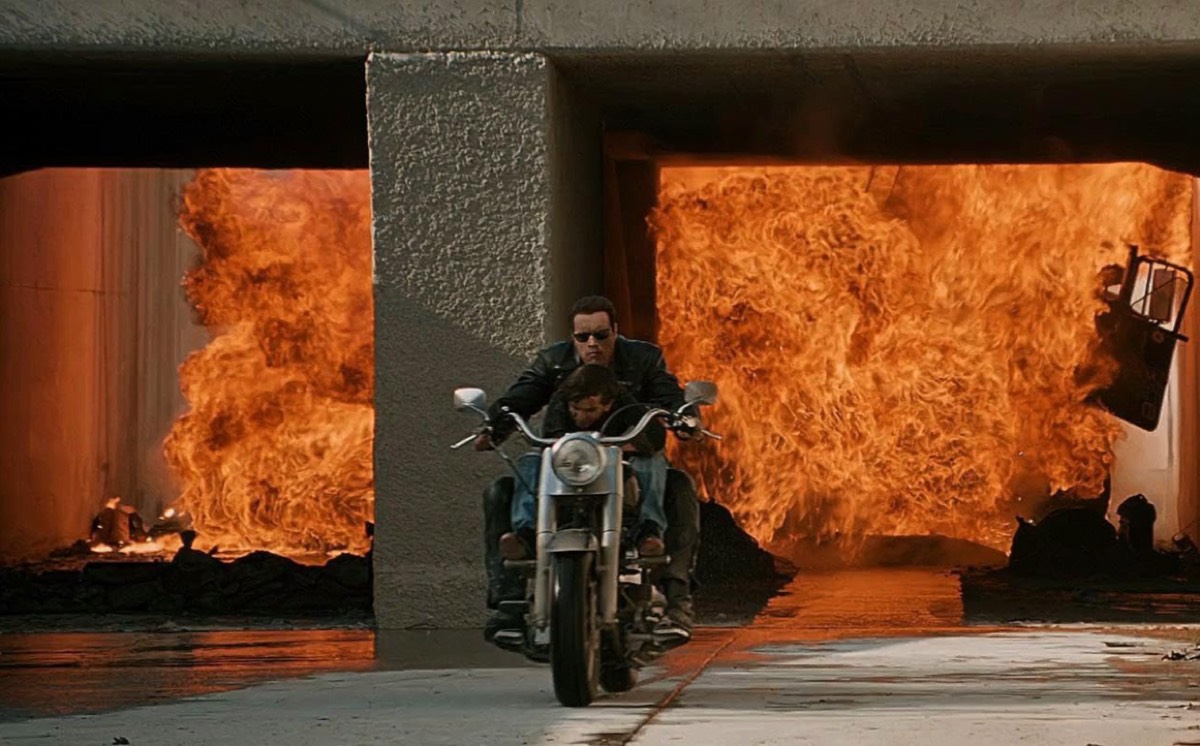
This is the first major chase sequence, with both the T-800 and the T-1000 trying to get to a fleeing John Connor first. John’s little motorbike proves no match for the large truck commandeered by the T-1000, which blasts through a cinder block wall at one point. The T-1000 never falters in its single-minded pursuit, but the arrival of the T-800 saves the boy. The truck eventually explodes, seemingly incinerating the T-1000. It’s only after the T-800 and John ride away that we see the T-1000 emerge from the flames and resume his police officer appearance.
The sequence was filmed over nine hours in LA’s San Fernando Valley. The T-800’s big stunt involved jumping a motorcycle 60 feet (at an altitude of roughly 15 feet) to the flood control channel below. Stunt coordinator Joel Kramer rigged up a support mechanism for the 750-pound motorcycle, since otherwise the jump was deemed too dangerous. The rigging and wires were erased during post-production.
The T-1000 emerges from floor tiles
Credit:
Paramount/Studio Canal
Credit:
Paramount/Studio Canal
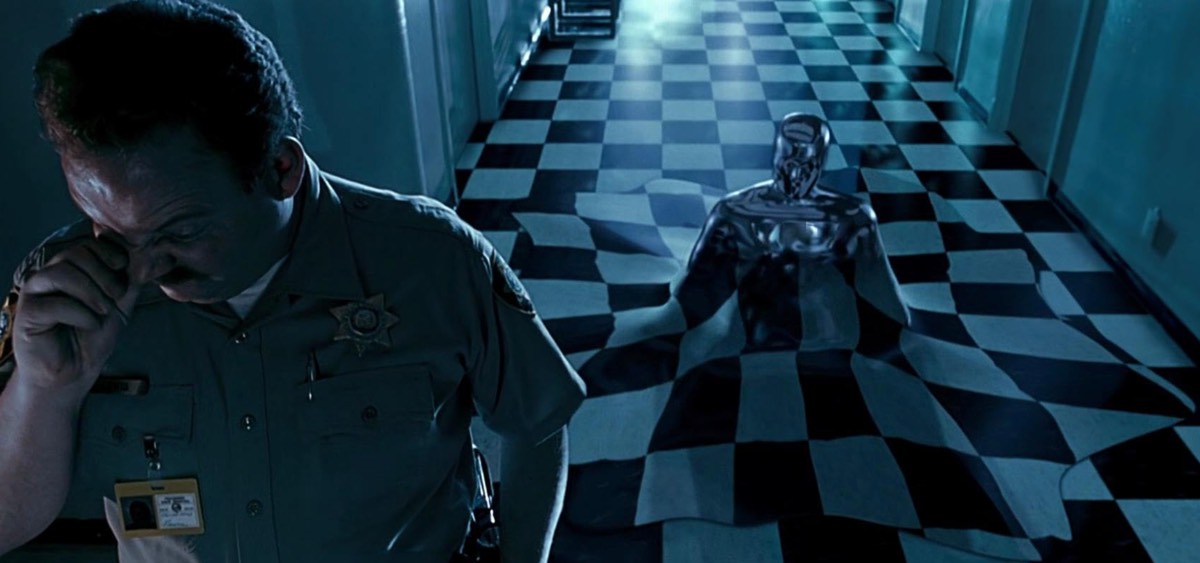
This is one of those “upping the ante” moments. We’ve seen the T-1000’s amazing shapeshifting abilities, taking on the form of a policeman and John’s foster mother in quick succession. We’ve seen his arms transform effortlessly into weapons. We’ve seen him heal bullet holes instantly. When he arrives at the mental institution to take out Sarah Connor, he must briefly hide as a team of detectives exits. A lone security guard goes into the hall to get coffee from the vending machine. The T-1000 is nowhere to be seen—until it slowly oozes up out of the checkerboard hospital floor tiles right behind the unsuspecting guard.
The shot required a special bit of software capable of reshaping specific regions of a 2D image using 3D geometry, mapping a computer-generated replica of the floor to the actual footage. This was combined with animation of the T-1000 taking shape. As for the T-1000 taking on the guard’s shape—that was achieved the old-fashioned way, since the actor Don Stanton had a twin brother (Dan).
“Come with me if you want to live”
Credit:
aramount/Studio Canal
Credit:
aramount/Studio Canal
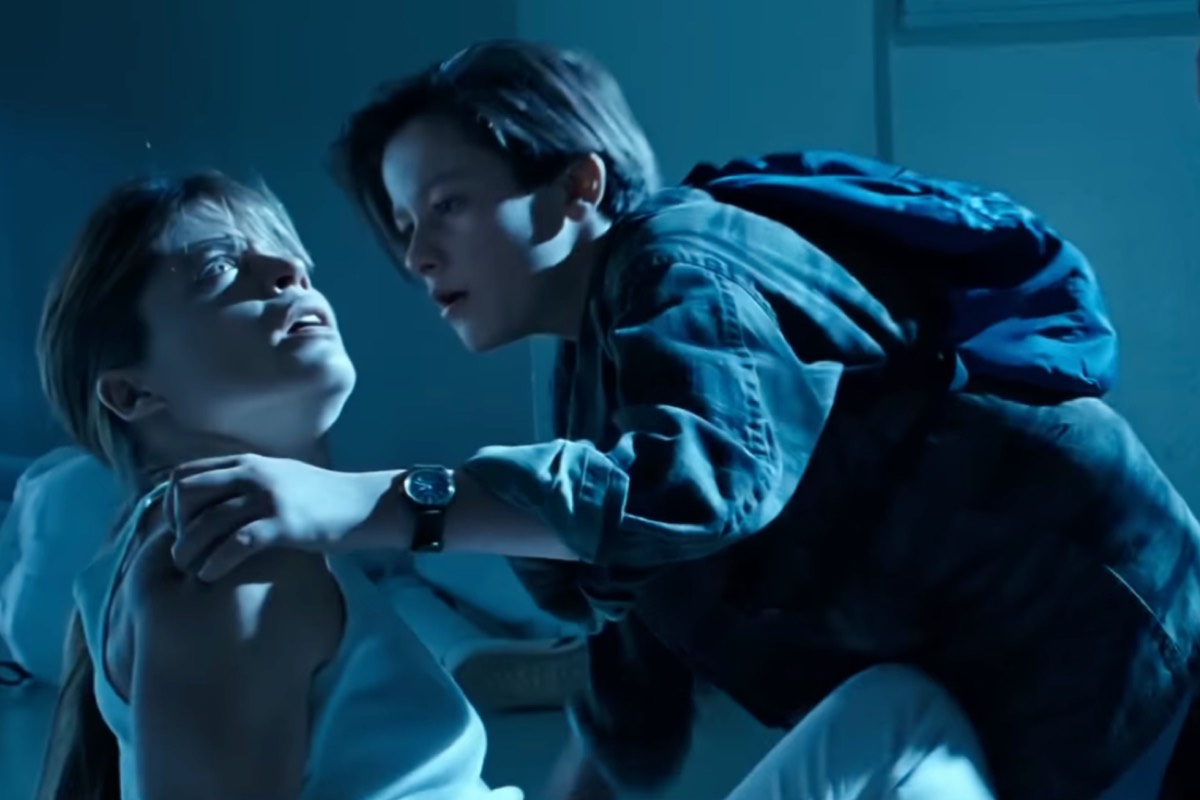
This is where flipping the script to make the T-800 John’s protector instead of the hunter really pays emotional dividends. Sarah Connor has reshaped her entire persona (not just her physique) in the wake of what happened to her in the first film. Everything centers on protecting John from the machines. Her obsession gets her locked up in a mental institution and her odds of release are not good.
She’s in the middle of breaking out on her own—quite effectively—and has made it to the elevator, which opens to reveal the T-800, her former adversary, back (in her mind) to kill her and John. Horrified, Sarah flees back the way she came and is briefly subdued by hospital staff until the T-800 tosses them aside like rag dolls. She sees John is safe, and the T-800 reaches down and repeats the line her protector uttered in the first film: “Come with me if you want to live.”
Bonus: Sarah’s psychiatrist and everyone else who thought she was crazy rattling on about killer machines from the future must confront the fact that she was right all along, especially when the T-1000 shows up.
Sarah’s nuclear holocaust dream
This powerful dream sequence shows Sarah and the rest of Los Angeles utterly annihilated by a nuclear blast. It starts with children and their mothers—including a younger, more innocent Sarah Connor—on a playground, oblivious to the danger, as a distraught Sarah soundlessly tries to warn them by banging on the chain-link fence. Then the blast hits, burning Sarah alive (actually a full-sized puppet) and reducing those children to ash.
It took a ton of special effects work to pull off the sequence, combining practical effects, miniatures, and CGI enhancements. The team built a mini-Los Angeles based on the live-action footage, including skyscrapers and an overpass. Some of the model buildings stood 5 feet tall, and many were designed to break away to mimic the effects of a blast. The nuclear fireball was actually a backlit, eight-foot plexiglass column. The most powerful visual effect is the ashy remains of the playground victims, still intact—until a shock wave scatters the ashes to the wind.
That arm scene
Credit:
aramount/Studio Canal
Credit:
aramount/Studio Canal
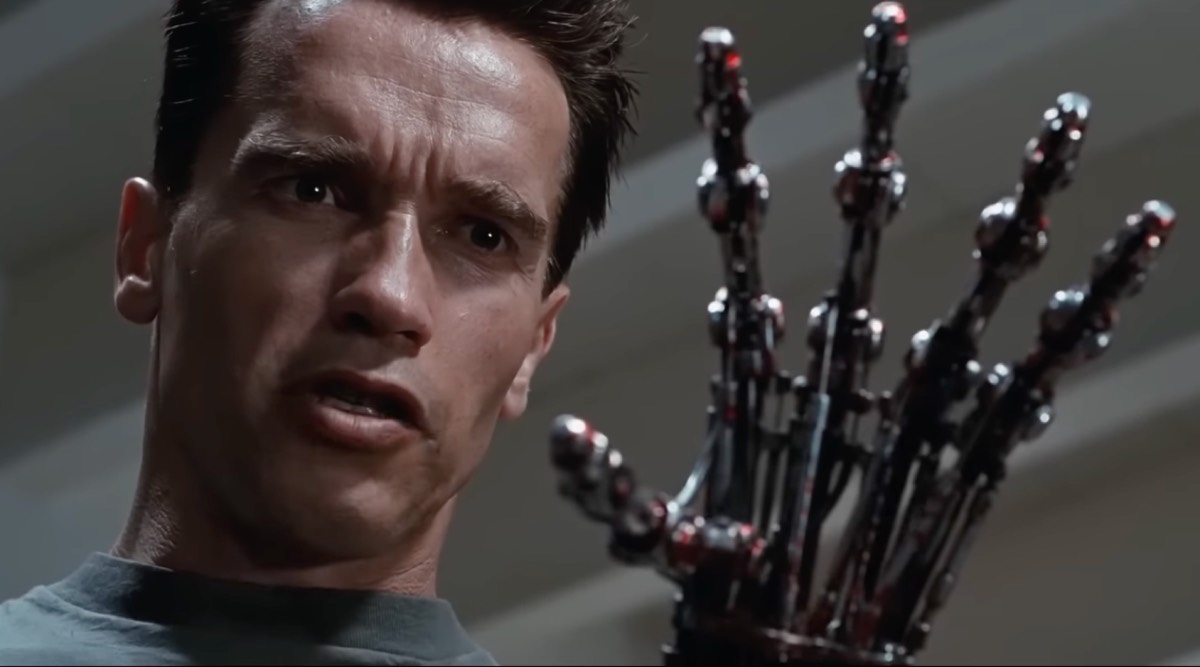
Sarah’s dream is sufficiently traumatic to compel her to leave John with the T-800 and seek out Miles Dyson (Joe Morton), Cyberdyne’s director of special projects and the scientist most responsible for developing what would become Skynet. Her plan is to kill Miles and stop Judgment Day from ever happening—hence the film’s catch phrase, “No fate but what we make.” But she can’t go through with it, even as John and the T-800 arrive to stop her.
To prove to Miles that Sarah is telling the truth—that his work will lead to humanity’s near-annihilation—the T-800 removes the skin from his hand and forearm, revealing the cyber skeleton underneath. As he flexes the mechanical fingers in front of a horrified Miles and his wife, the T-800 intones, “Now listen to me very carefully….” I’m sure Miles was hanging on his every word.
The Cyberdyne showdown
Credit:
aramount/Studio Canal
Credit:
aramount/Studio Canal
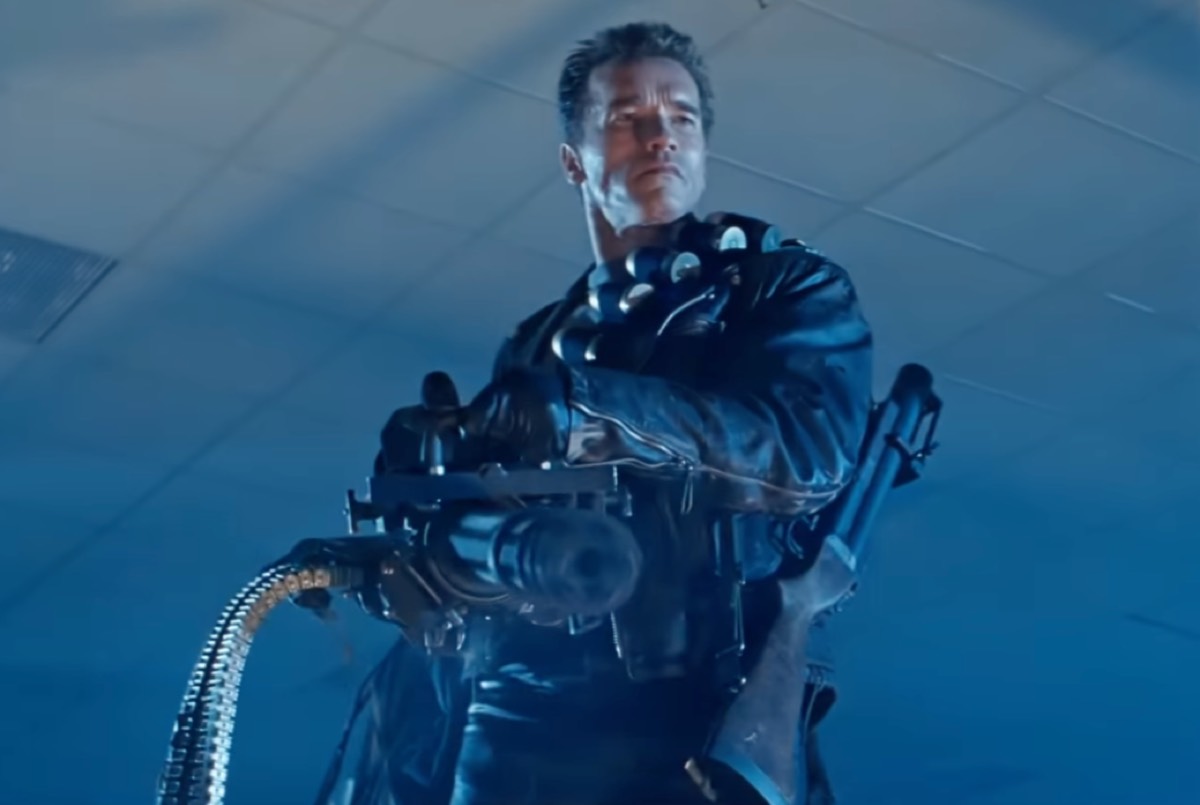
John, Sarah, and the T-800 enlist Miles’ help to break into Cyberdyne headquarters and steal the salvaged arm and computer chip left behind by the T-800 in the first film. They are working against the clock, since pretty much every law enforcement unit in the city arrives at the building to stop them. John’s hacking skills prove useful, as does the T-800’s extensive firepower—although per John’s instructions, there are zero human fatalities.
Ultimately, Miles sacrifices himself so that the others can escape, holding onto the detonator that sets off a massive explosion until his final breath. The filming site was an empty office building in Fremont, California, and the explosion was real; pyrotechnician Tom Fisher used hundreds of gallons of gas to create that giant fireball. Respect.
T-1000 vs. liquid nitrogen
The carefully orchestrated high-speed chase down a highway that immediately precedes this scene honestly deserves its own spot on the list, just for the ingenuity of the stunt design. That chase ends with a semitruck pulling a tank of liquid nitrogen overturning and skidding into an active steel mill, spilling liquid nitrogen all over the street. The T-1000 resolutely wades toward its targets anyway, only to start to freeze from the feet up, breaking its legs off at the knees and losing a hand before it solidifies, a look of shocked surprise on its face. The T-800 blasts it to smithereens with a well-time, “Hasta la vista, baby.”
That should be the end of the T-1000, right? RIGHT? But within minutes the scattered shards start to melt in the heat of the steel mill and begin to coalesce yet again. “We don’t have much time,” the T-800 observes—and indeed, the T-1000 soon reassembles. The frozen shards were actually made of serabin, a material used as ballast for model railroad cars that resembles chrome when it’s polished. Frozen mercury didn’t work because it turned white. But globs of liquid mercury worked just fine to show the melting shards coming together, even though its toxicity meant the special effects crew had to wear protective gear over the two-day shoot.
The T-1000 has a meltdown
Spoiler alert: The T-1000 is not quite unbeatable. Sure, he recovers nicely from a hole in the head, courtesy of Sarah, and being cleaved in two by the T-800 wielding a piece of rebar—the former achieved with a mechanical head and shoulders replica of Patrick (“Donut Head”), the latter with a maquette sculpture (“Cleave Man”), both augmented with CGI. Just when things are looking dire for John and Sarah, the T-800 reboots on auxiliary power and shoots the T-1000 with a grenade launcher. The torso explodes and creates “Pretzel Man” (achieved with three full-sized puppets).
A teetering T-1000 then topples into a vat of molten steel and slowly melts into oblivion, running through each of the human forms it took on over the course of the film (foster mom, security guard, etc.) before vanishing in a single molten howl. This was the most difficult sequence for the special effects team and took weeks to complete, matching carefully choreographed movements of all the actors in the live-action pit with splashing liquid filmed in a separate miniature version of the vat. The illusion of molten steel was basically water and mineral oil mixed with a little powdered sugar; creative lighting and heaters placed below the cameras—plus a few CGI sparks in the background—did the rest.
The end result didn’t quite satisfy Cameron but the rendering shots took so long that the director ran out of time, even with the production crew working 24-hour shifts. The final print wasn’t delivered to theaters until the night before the official release. But audiences were blown away. It was the perfect way to bring about the T-1000’s demise.
The T-800’s final sacrifice
Credit:
Paramount/Studio Canal
Credit:
Paramount/Studio Canal
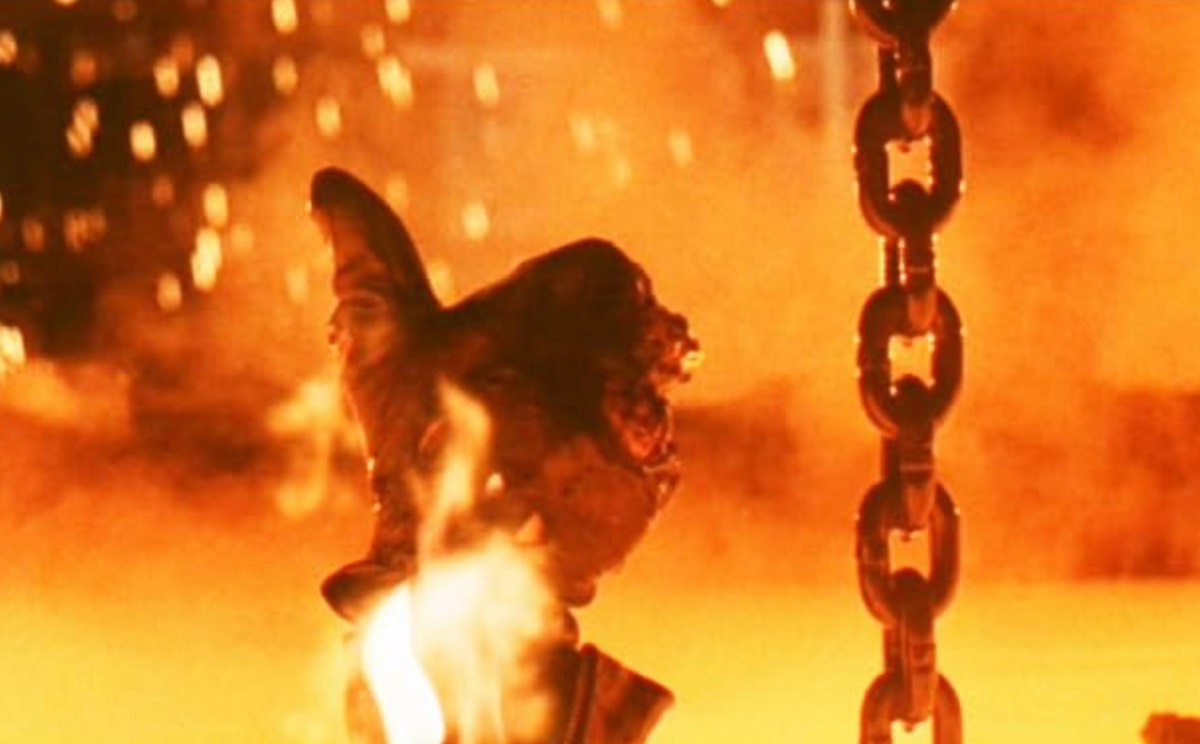
After that spectacular special-effects achievement, Cameron closed things out with an emotional, well-earned farewell. John drops the first T-800 arm and chip into the vat of molten steel to destroy them. But there is one chip left: the one in the new T-800’s head. Since it cannot self-terminate, Sarah is tasked with lowering the machine into the vat, against John’s anguished objections. It’s the final payoff to the relationship Cameron has painstakingly built between John and the machine—and the T-800 goes out in style, giving a gloved thumbs-up as its hand slowly sinks into the liquid steel.

Jennifer is a senior writer at Ars Technica with a particular focus on where science meets culture, covering everything from physics and related interdisciplinary topics to her favorite films and TV series. Jennifer lives in Baltimore with her spouse, physicist Sean M. Carroll, and their two cats, Ariel and Caliban.







 English (US) ·