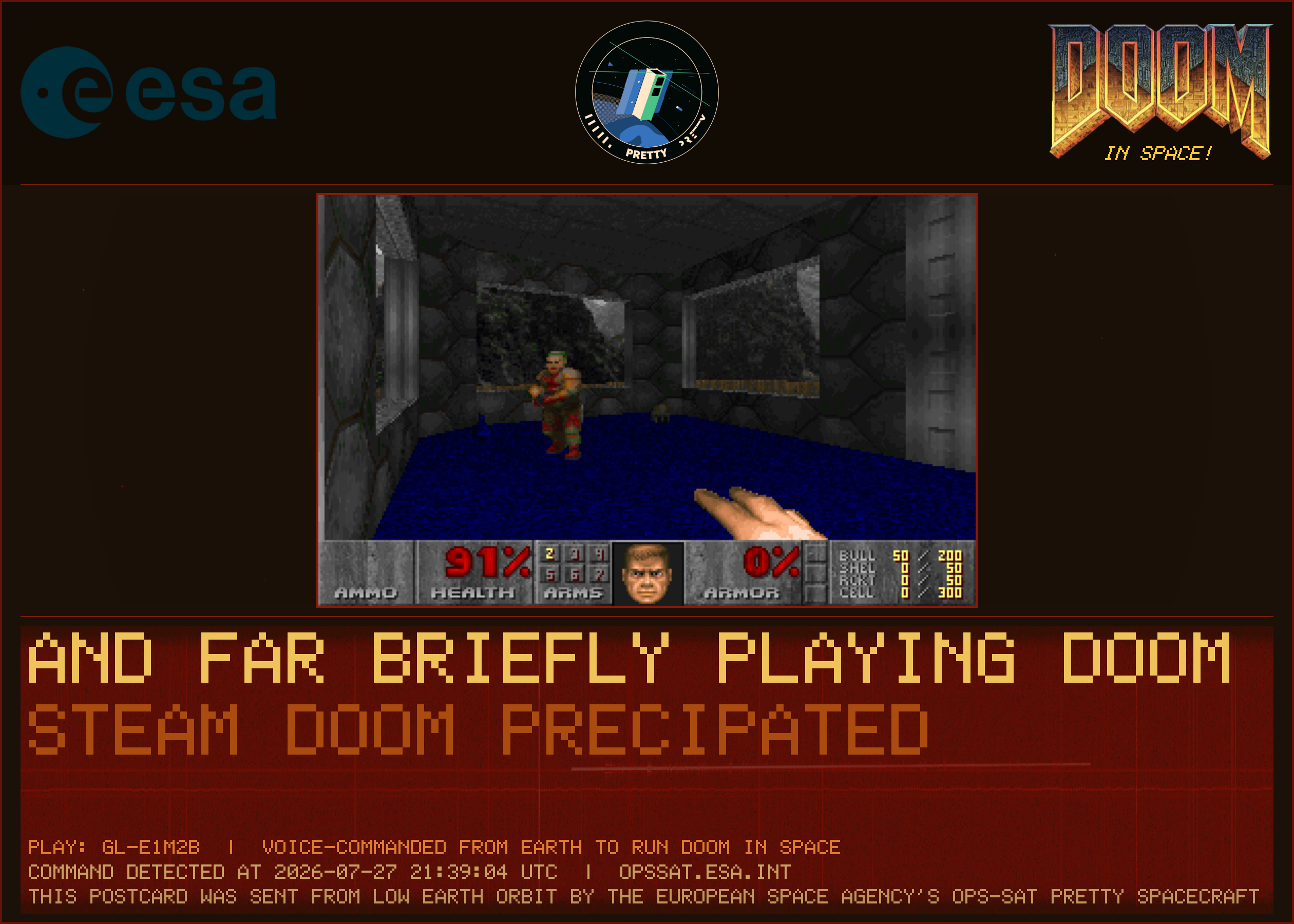
An Oslo radio amateur group, working with Tanagra Space, got a European Space Agency satellite to recognize and launch the 1993 game Doom after catching the word in a voice command sent over the 23 cm band. It took seven attempts, shared with a group in Poland, and the command finally got through on the last two, on the same day in late July. The satellite “understood its assignment,” with the help of a matcher after the 27 MB onboard speech model transcribed the audio, returning a postcard with details of the launch.
The satellite, named OPS-SAT PRETTY and flying under the ESA’s OPS-SAT Space Lab program for outside experiments, ran the game in an experiment punningly called PRETTY DOOMed. Doom ran on a different satellite, the OPS-SAT-1, in 2023, but this time is different, as the game was launched with a voice command.
(Image credit: Tanagra Space (Doom frame: id Software))
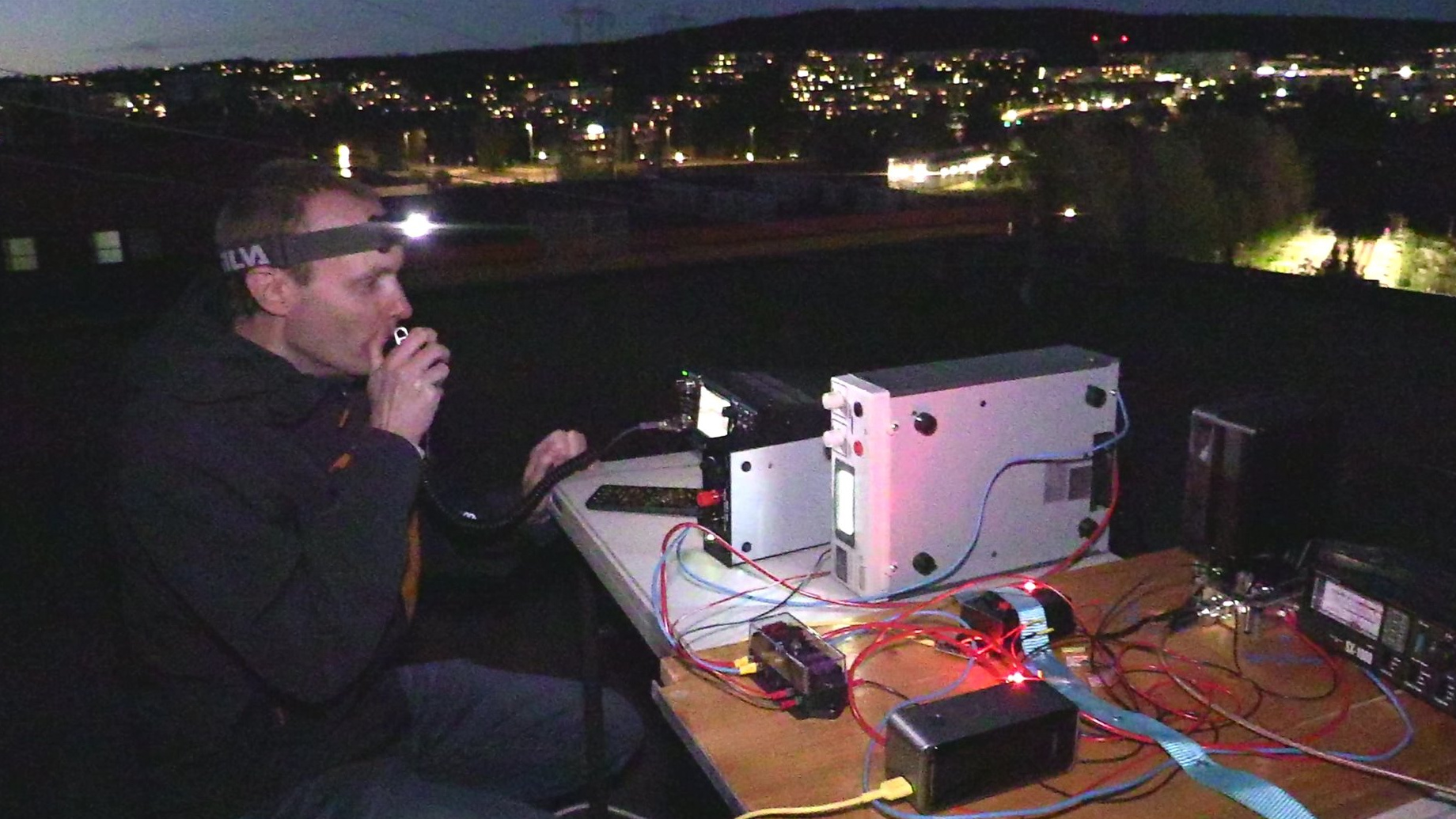
The radio club sending the command in question is LA4O, of the Norwegian Radio Relay League, hams transmitting as part of the experiment. The club’s signal went over 1296 MHz narrowband FM at about 80 W, indicated, using an Icom IC-9700 radio and a Wimo helix antenna at 15.1 dBi, directed by hand. As for the voice, Run 6, the morning pass, used a looped synthesized voice from a keyer, with three of six captures detecting the command. Run 7, the evening pass, used a live operator at a microphone, with one of five usable captures detecting it.
The live operator’s command was “LIMA ALFA FOUR OSCAR, PRETTY PLAY DOOM DOOM DOOM, PRETTY PLAY DOOM DOOM DOOM.” The call sign is for legal identification.
On board the satellite, the voice is transcribed by a 27 MB quantized English speech-recognition model, picked because it could fit the satellite’s limited computer. The voice was handled by software-defined radio (SDR), which was able to narrow in on the voice and demodulate the source for the speech model. Tuning and demodulating a signal is usually handled by fixed circuits, but using software has the advantage of being mutable with an uploaded update. The voice used this time “was only the test signal,” project lead Georges Labrèche said, and the same setup could handle other things with a new model.
The live-voice transcript caught “AND FAR BRIEFLY PLAYING DOOM STEAM DOOM PRECIPATED” with two exact DOOM matches, although one DOOM is enough. Morning detections passed only on fuzzy tolerance with transcripts such as “PLAY DOON.” The achievement is less on the understood side and more about differentiating a voice and a specific command out of the noise in orbit.
This can be an iffy business, which is one reason it took seven runs, and being able to update proved useful. The spacecraft heard LA4O, but the output was mostly static, because about 170 kHz reached the FM discriminator for a signal of about ±5 kHz. Offline analysis brought a fix: find the peak within ±100 kHz, shift to baseband, low-pass, and decimate before demodulation. It’s effectively like tuning a car radio to a specific station.
Get Tom's Hardware's best news and in-depth reviews, straight to your inbox.
Tanagra then reproduced the fix and was able to remove a redundant audio filter. Delivery of the fix took about a week, although the Oslo group’s effort took 59 days and about 7,200 NOK (about $770), pizza included.
Tanagra proposes repeat runs that keep the original data and send it back down to Earth, so the researchers can test the live-voice result properly. Better detection may be possible with larger speech models, too, which the team could test on the ground first. Labrèche says the team has demonstrated “a satellite that can listen to any type of radio signal.” Hopefully, the setup can one day detect “mayday” calls and even radio bursts from space.

 1 hour ago
6








 English (US) ·