
 1 hour ago
5
1 hour ago
5
In brief
- OpenAI unveiled GPT-Rosalind to accelerate drug discovery workflows.
- Benchmarks show strong gains, but real-world impact remains constrained .
- Access is tightly restricted amid rising biosecurity concerns.
OpenAI just named its first domain-specific AI model after Rosalind Franklin—the British chemist whose X-ray crystallography work helped reveal DNA's double helix, and who was famously denied credit for it during her lifetime.
GPT-Rosalind, unveiled Thursday, is a purpose-built reasoning model for biology, drug discovery, and translational medicine. It's the first in what OpenAI is calling a Life Sciences model series—a direct play for a market where many specialized labs from universities to Google DeepMind are all jostling for position.
Getting a drug from target discovery to regulatory approval in the U.S. takes 10 to 15 years on average according to experts.. Most of that time disappears not in eureka moments, but in the grind: parsing thousands of papers, querying databases, designing reagents, and interpreting ambiguous results. This is what GPT-Rosaling is trying to tackle.
OpenAI argues the model can compress that early-stage work. As the company put it, GPT-Rosalind is designed to help scientists "explore more possibilities, surface connections that might otherwise be missed, and arrive at better hypotheses sooner."
The benchmarks back up at least some of that ambition. On BixBench—a benchmark built around real-world bioinformatics tasks—GPT-Rosalind logged a 0.751 pass rate, the top score among models with published results. On LABBench2, it outperformed its predecessor GPT-5.4 on six out of eleven tasks.
GPT-Rosalind Beats GPT 5.4 in every single case involving life science, but it’s a highly specific model that will underperform in anything other than that.
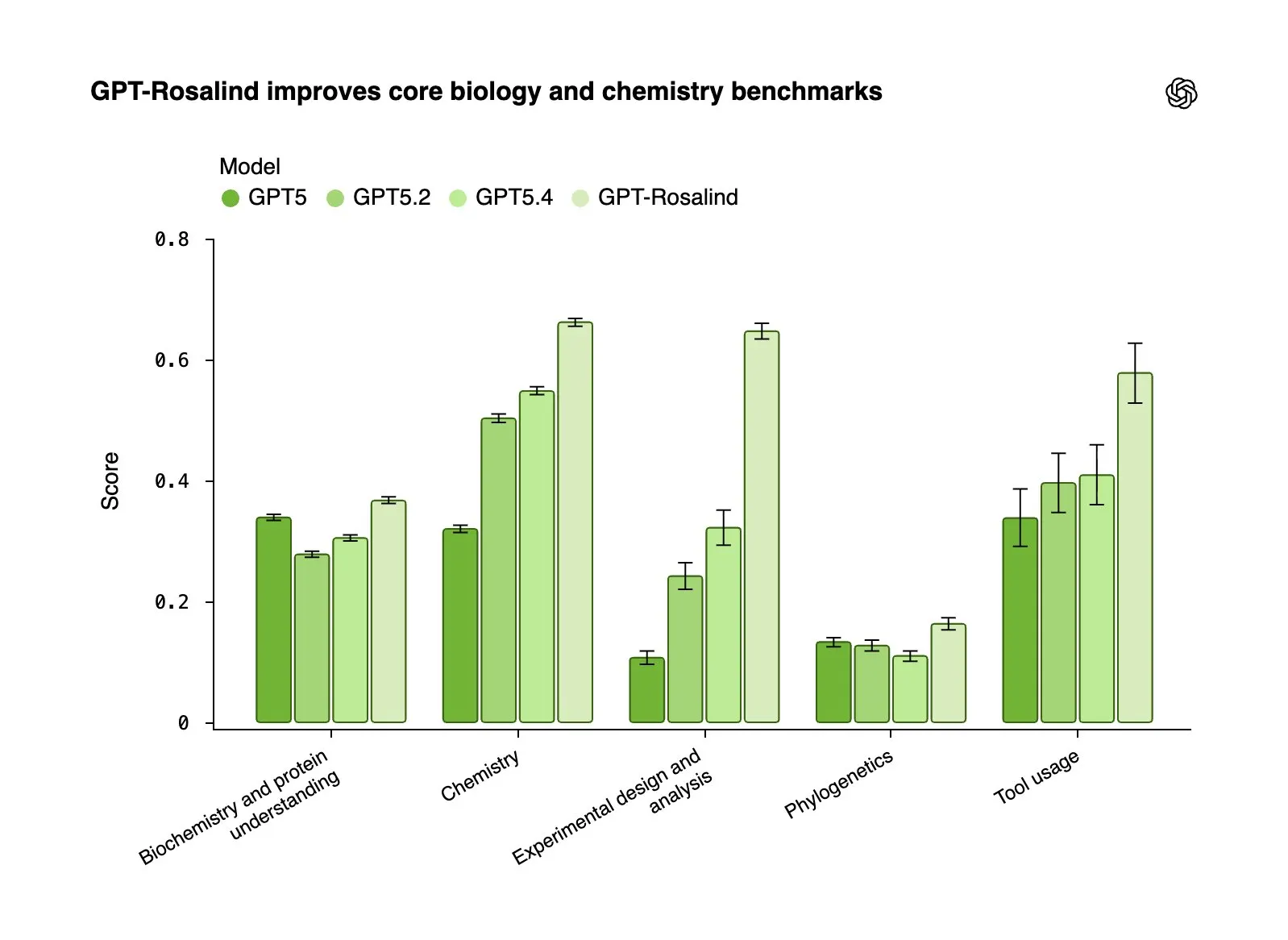
OpenAI also announced Dyno Therapeutics will help test and evaluate its model based on unpublished RNA sequences to rule out memorization. GPT-Rosalind's best-of-ten submissions ranked above the 95th percentile of human experts on sequence prediction tasks, and around the 84th percentile on generation.
That said, OpenAI's own life sciences research lead Joy Jiao was measured about what the model can actually do. She explained the company doesn’t see Rosalind as a model capable of creating new treatments autonomously, but told reporters that it could be a great help in speeding research up. "We do think there's a real opportunity to help researchers move faster through some of the most complex and time-intensive parts of the scientific process," Jiao said in a press briefing, according to the LA Times.
The ecosystem around the model may matter as much as the model itself. OpenAI is also releasing a free Life Sciences research plugin for Codex connecting to over 50 scientific databases and tools—protein structure lookups, sequence search, literature review, genomics pipelines. Enterprise users with GPT-Rosalind access get the reasoning layer on top. Everyone else gets the plugin with standard models.
OpenAI has lined up a roster of pharma and biotech customers for the launch, including Amgen, Moderna, and Thermo Fisher Scientific. Separately, it's running a research collaboration with Los Alamos National Laboratory on AI-guided protein and catalyst design.
"The life sciences field demands precision at every step. The questions are highly complex, the data are highly unique, and the stakes are incredibly high," said Sean Bruich, Amgen's Senior VP of AI and Data in the official announcement.
Access to Rosalind is deliberately restricted. The model is U.S. enterprise only, gated behind a qualification and safety review. The concern isn't abstract: an international coalition of over 100 scientists has already called for tighter controls on biological data used to train AI, citing pathogen design risks. OpenAI's restricted rollout is a direct response. During the research preview, usage won't consume existing API credits.
This also isn't OpenAI's first move into science workflows. The Prism scientific writing workspace launched in January was a first step. GPT-Rosalind is the sharper, more specialized follow-up—and a signal that domain-specific models are becoming a serious competitive front.
No fully AI-discovered drug has cleared phase 3 trials. That number is still zero. But if GPT-Rosalind helps a researcher design a better experiment six months faster across thousands of labs, then the compounding effect on what gets discovered, and when, could be the whole ballgame. That's the actual thesis here, and it's worth watching closely.
Daily Debrief Newsletter
Start every day with the top news stories right now, plus original features, a podcast, videos and more.






 English (US) ·