
Serving tech enthusiasts for over 25 years.
TechSpot means tech analysis and advice you can trust.
Bottom line: OpenAI's latest financial disclosures highlight a fundamental tension in the AI boom. The technology is scaling rapidly, but the cost of building and running it is rising even faster. The documents, obtained by independent journalist Ed Zitron, arrive as the company moves toward a possible IPO and reveal just how expensive modern AI systems have become. They portray a business generating billions of dollars in revenue while remaining burdened by even larger technology-related expenses.
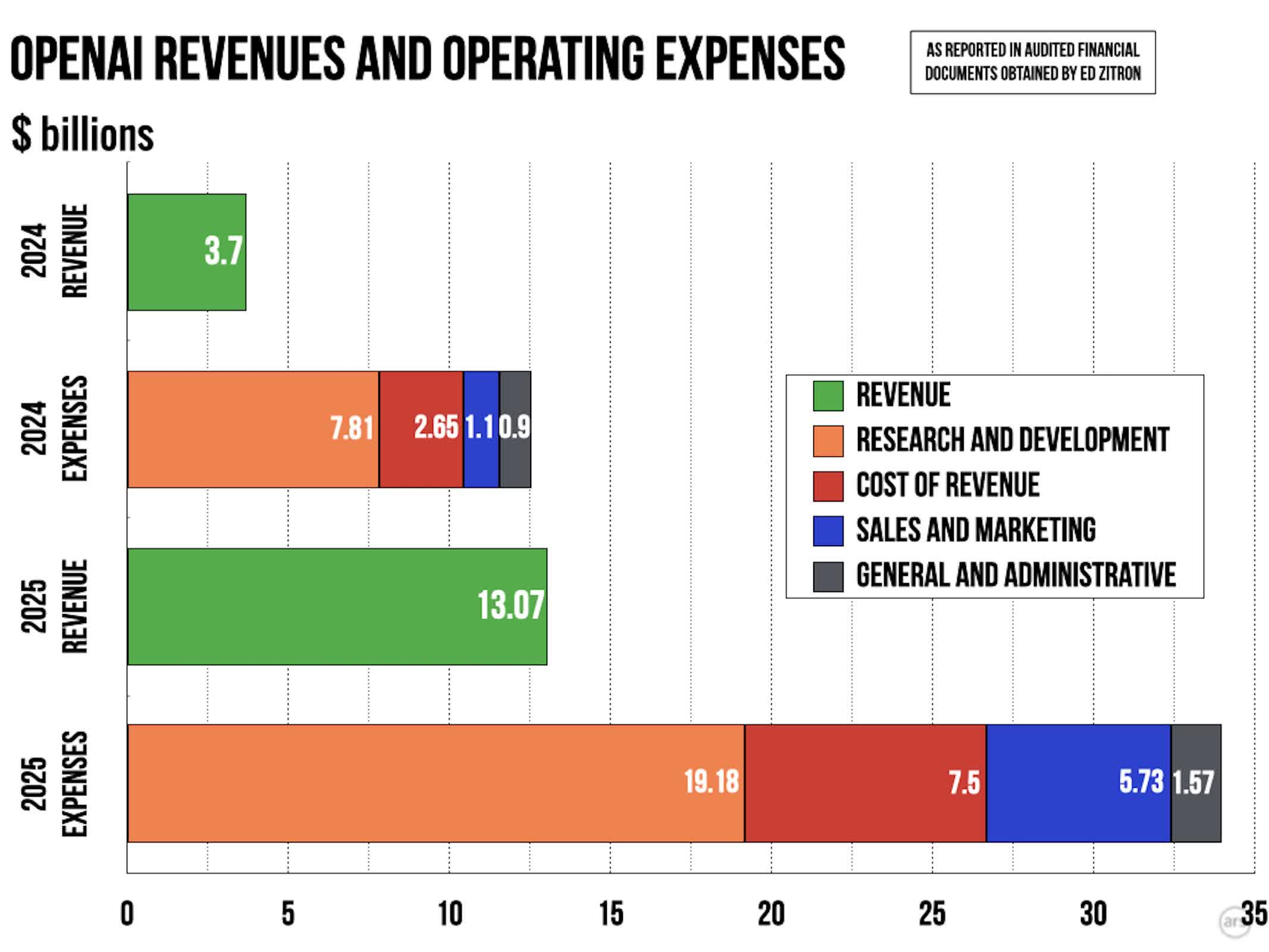
Revenue growth has been dramatic. OpenAI generated $3.7 billion in revenue in 2024 before jumping to $13.07 billion in 2025. By the end of that year, monthly revenue was approaching $2 billion, suggesting demand continued to accelerate. OpenAI says ChatGPT now has more than 900 million weekly users, though only about 50 million subscribe to paid tiers.
But the financials make it clear that scale alone does not translate into efficiency. The cost of developing AI models continues to outpace everything else. Research and development spending increased from $7.81 billion in 2024 to $19.18 billion in 2025 – a figure that, by itself, exceeded the company's total annual revenue in both years.
Those figures likely reflect the enormous cost of training new models and the payments OpenAI makes to its infrastructure partners. In 2025, $10.59 billion of the company's R&D spending went to Microsoft.
Even after the models are trained, the costs do not ease. Running them at scale – the constant stream of user prompts and responses – is proving just as expensive. OpenAI's cost of revenue climbed from $2.65 billion in 2024 to $7.5 billion in 2025, a year-over-year increase that likely reflects rising inference costs. Every interaction carries a compute cost, and at current usage levels, those expenses add up quickly.
Credit: Ars Technica
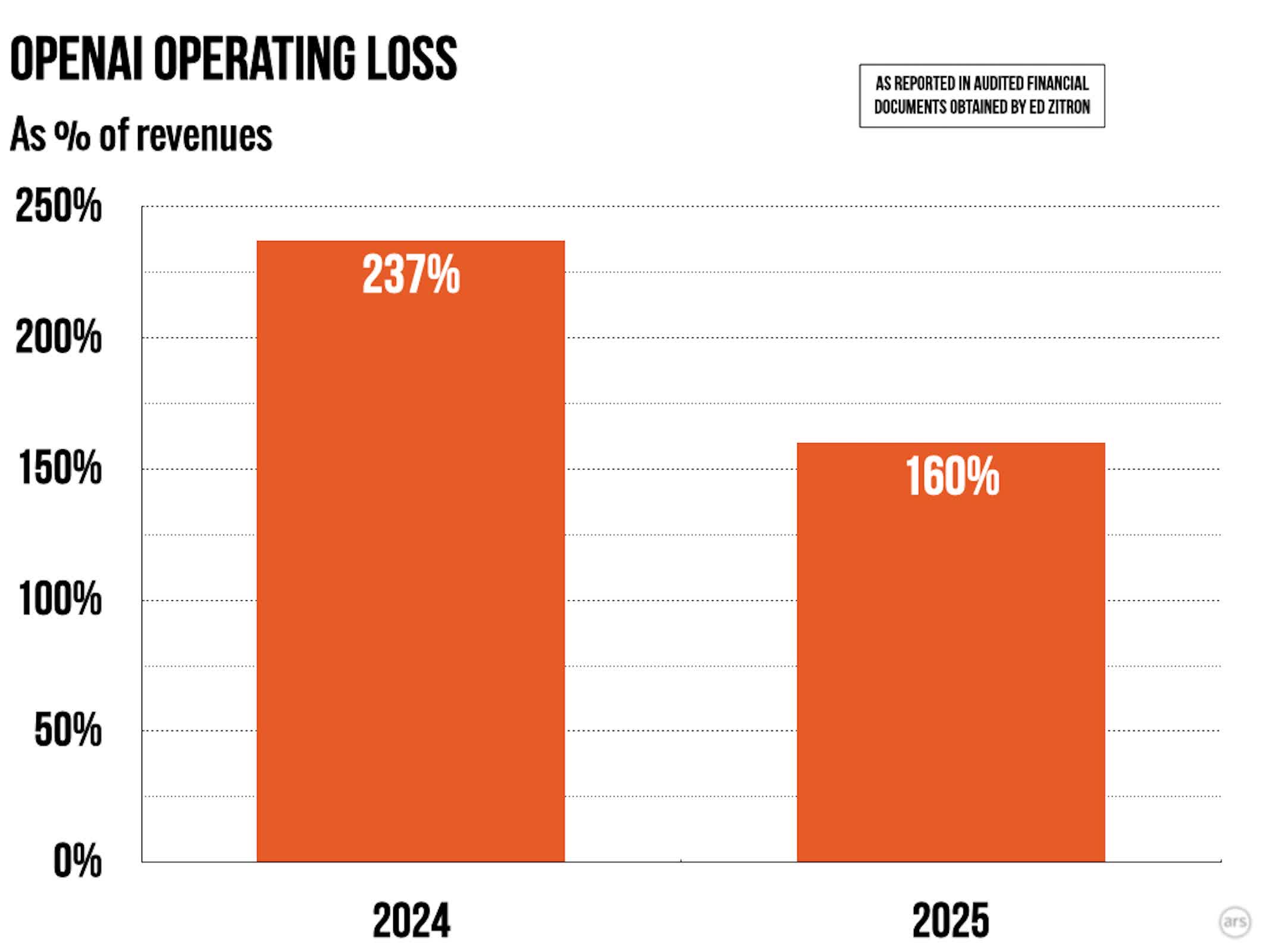
The company is also spending heavily to maintain its position in an increasingly competitive market. Sales and marketing expenses rose from $1.11 billion to $5.73 billion in a single year, underscoring how aggressively OpenAI is trying to expand its user base. Even so, the bottom line remains deeply negative. Operating losses widened from $8.78 billion in 2024 to $20.92 billion in 2025, despite the company's surging revenue.
The 2025 net loss figure – nearly $39 billion – appears especially stark, though it is somewhat misleading. A large portion of that total stems from a one-time accounting adjustment tied to changes in investor valuations following OpenAI's transition to a for-profit structure. Excluding that adjustment brings the loss closer to $8 billion, a figure that better reflects the company's underlying operations.
Taken together, the numbers highlight a fundamental challenge facing the AI industry: the technology is not only expensive to build, but also expensive to operate continuously at scale. That reality is already shaping internal decisions. OpenAI has moved away from several initiatives, including the shutdown of its Sora video model earlier this year. Around the same time, the company's leadership signaled a tighter focus on core products, particularly those aimed at developers and business users.
Credit: Ars Technica
There are also signs that revenue growth could come under pressure. Some enterprise customers are pushing back against token-based pricing and demanding clearer returns on their AI investments. At the same time, competition is intensifying. Rivals like Anthropic are putting pressure on pricing, which could squeeze margins, especially if subscription prices decline.
Even so, investor confidence has not wavered. OpenAI raised $122 billion in March at a valuation of $852 billion, marking one of the largest funding rounds in the sector. The company has told investors it hopes to become profitable by 2030, a goal that will depend in part on lowering training and inference costs.
For now, the financial picture reflects a company still in build-out mode. Demand remains strong and continues to grow rapidly. The harder question – one these documents bring into sharper focus – is how long that growth can continue to outpace the cost of the infrastructure required to support it.







 English (US) ·