 10 hours ago
3
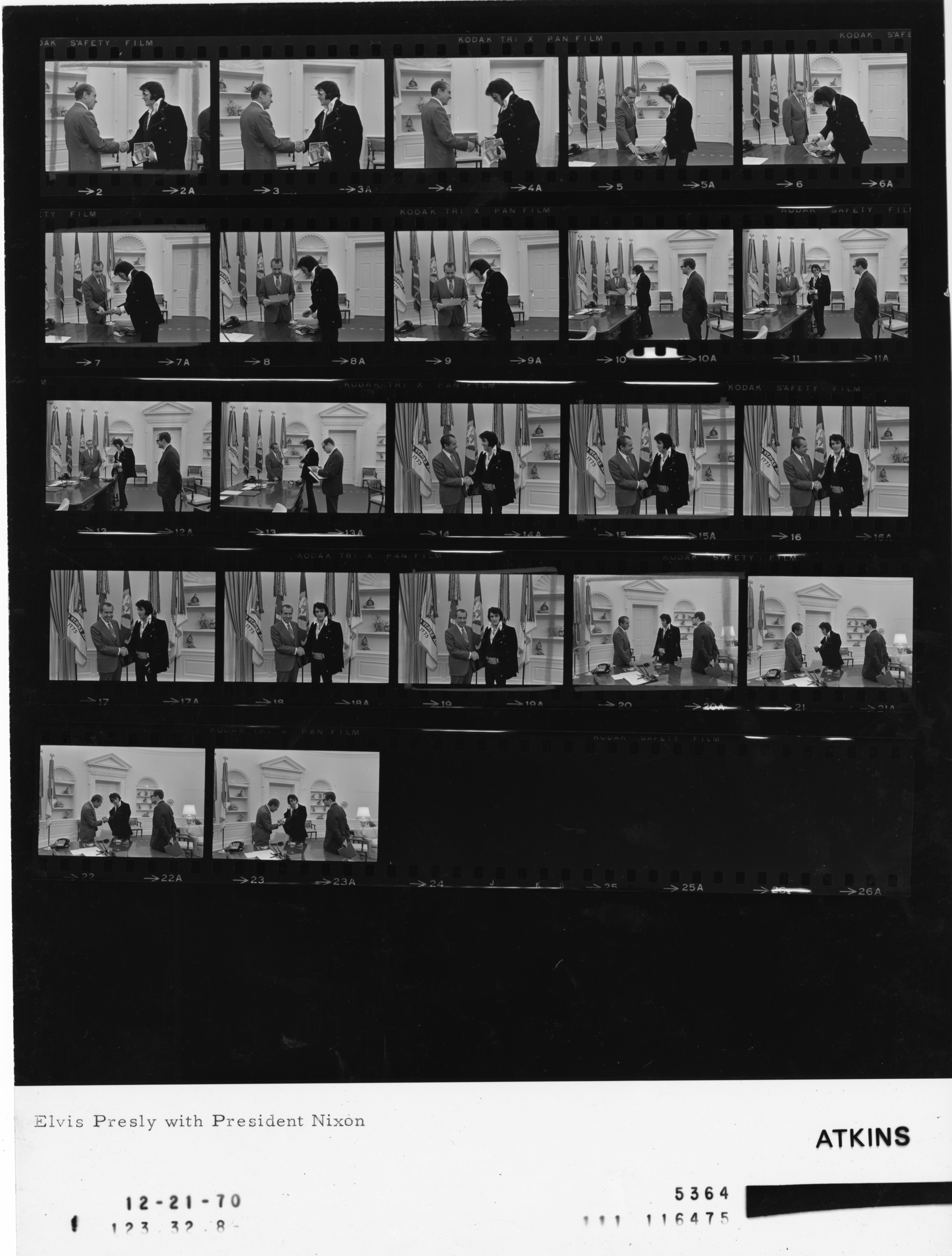
The White House Photo Office contact sheet for roll 5364 carries a typed label that misspells the singer's name, "Elvis Presly with President Nixon," along with the date 12-21-70 and one word in heavy capitals at the right edge: ATKINS. Twenty-two frames of Kodak Tri-X run across it in five rows. In frame 18, Richard Nixon and Elvis Presley clasp hands in front of the Oval Office flags and look straight into the lens.
The National Archives has described that frame both as the most requested image in its holdings and as one of its most requested. It does not show the moment the two men met. Ollie Atkins, Nixon's chief White House photographer, had photographed their first handshake 16 frames earlier, with Presley in oversized tinted glasses and holding a handful of photographs. Frame 18 is a second handshake, posed partway through a meeting Presley had asked the White House to keep "very private."
Most of the paper trail around Atkins' 28 frames survives in the Nixon Library's holdings: Presley's handwritten letter, the staff memos that got him into the Oval Office, the president's Daily Diary, two contact sheets, and the press guidance the White House drafted 13 months later, when the meeting leaked. In 2004, the Archives' own magazine said there was no practical way to track how often any of its photographs, this one included, is obtained.
A Letter at the Northwest Gate
Presley, who was 35, flew overnight from Los Angeles and reached the White House on Monday, December 21, 1970. At the northwest gate, around 6:30 a.m., he handed a guard a letter written on American Airlines in-flight stationery. It runs five handwritten pages, plus a sixth sheet listing private phone numbers for his houses in Memphis, Beverly Hills, and Palm Springs and for his manager. That sheet is marked private and confidential and addressed to the president via Senator George Murphy of California, who had been on the same flight.
"First, I would like to introduce myself. I am Elvis Presley and admire you and have great respect for your office," Presley wrote. He went on to say that hippies, the drug culture, the Students for a Democratic Society, and the Black Panthers did not see him as their enemy or as part of what they called the establishment. What he wanted in return for his help was to be made a "Federal Agent at Large."
Presley gave his room at the Washington Hotel, where he had registered as Jon Burrows, and promised, "I will be here for as long as it takes to get the credentials of a Federal Agent." He set one condition: "I am glad to help just so long as it is kept very private." The National Security Archive, a research group at George Washington University, posts scans of the letter and memos it obtained from the Nixon presidential materials.
Dwight Chapin, the president's special assistant, forwarded the letter to chief of staff H.R. Haldeman that morning. Presley "showed up here this morning," Chapin wrote. He proposed that Egil "Bud" Krogh, a deputy assistant whose portfolio included drug abuse, see Presley first and check "if there is some kind of an honorary agent at large or credential of some sort that we can provide." Krogh would then bring him in to meet Nixon briefly during the Open Hour, a block of short courtesy visits. "He wants to keep everything private and I think we should honor his request," Chapin added.
Haldeman initialed the line approving Presley's visit at the "end of Open Hour." Beside Chapin's closing pitch, that Presley might be a good place to start if the president wanted to meet bright young people outside government, the margin carries "You must be kidding," a note that both the Archives' Prologue magazine and the White House Historical Association attribute to Haldeman. The talking points prepared for the president set the meeting for 12:30 p.m., listed the participants as Presley and Krogh, and suggested that Presley record an album on the theme "Get High on Life" at the federal drug rehabilitation and research center in Lexington, Kentucky.
The president's Daily Diary for that Monday lists "Elvis Presley, entertainer" with Krogh from 12:45 to 1 p.m., at the tail end of a run of short visits that had begun at 12:05 with four White House telephone operators. It logs Presley again from 1:09 to 1:11 p.m., this time with his two companions, Jerry Schilling and Sonny West. The diary does not list Atkins, whose 28 frames are the Archives' visual record of both visits.
What Roll 5364 Recorded
Atkins had worked about two decades for the Saturday Evening Post, much of it covering Washington, before he became the photographer for Nixon's 1968 campaign. The Nixon Library's finding aid describes him as the president's personal photographer and head of the White House Photo Office, and he photographed Nixon leaving the White House after resigning on August 9, 1974. His office logged every roll by photographer, date, film format and type, and processor. Both contact sheets from December 21 carry his name, and Prologue, the Archives' magazine, credits the meeting's photographs to him.
"The meeting opened with pictures taken of the President and Elvis Presley," Krogh wrote in his memo for the president's file. Roll 5364 opens the same way. Kodak numbers each frame along the edge of its 35mm film, and the camera advances one frame per exposure, so the numbers run in the order Atkins took the pictures. Frames 02 through 04 show the greeting, a handshake beside a door, with Presley in big tinted glasses and a high white collar, a stack of photographs and a leather case in his left hand. In frames 05 through 09, the two men stand at Nixon's desk while Presley lays out photographs and small leather cases, and Nixon reads a print.
Krogh's memo says Presley started showing off his law enforcement gear right away, including police badges from California, Colorado, and Tennessee. The White House Historical Association identifies the badge collection in a small pile at the edge of the desk and the photographs as signed pictures of Presley's wife, Priscilla, and daughter, Lisa Marie. Frames 10 through 13 pull back across the room, with Krogh standing at the right.
Frames 14 through 19 are six exposures of a posed handshake in front of the flags, with Presley's glasses off. In frames 18 and 19, both men look into the lens. Frames 20 through 23 return to the desk. By frame 21, Nixon is bending over Presley's cuffs while Krogh looks on. The positions for frames 24 through 26 on the contact sheet are blank.
The edge printing on the sheet reads Kodak Tri-X Pan, a black-and-white film, and the Nixon Library's catalog scans of all 28 frames, most about 5,400 by 3,600 pixels, are grayscale. The velvet that the Archives' 2009 press release called a "black velvet jacket" and Smithsonian magazine called a "purple velvet suit" comes out the same near-black in every frame, so Atkins' film cannot settle which description is right.
The second roll, 5369, was already in use before Presley walked in. Its contact sheet starts with frames 3A through 7A of Deputy Assistant Edward Morgan and his mother, whom the Daily Diary logs with Nixon from 12:42 to 12:45 p.m. Frames 12A through 17A, labeled "Elvis Presly and his aides with RN," show the 1:09 p.m. visit by Schilling and West. Atkins had roll 5369 working both before and after the 15-minute meeting he shot on roll 5364. Frame 15A on that sheet carries a check mark.
No tape of the meeting exists, because the Secret Service did not install Nixon's taping system in the Oval Office until February 16, 1971, 57 days later. The written record is Krogh's two-page memo, which has Presley calling the Beatles "a real force for anti-American spirit," telling Nixon emotionally that he was "on your side," and closing the meeting when he "put his left arm around the President and hugged him."
The Badge in the Record and in the Retelling
Krogh's memo for the file mentions Presley's police badges but never a request for a federal one. The White House Historical Association, whose account draws on that memo, Krogh's 1994 book, and Schilling's 2006 memoir, notes the same gap: the badge request appears in Krogh's later book but not in the meeting notes. The badge does appear in White House guidance Krogh wrote on January 27, 1972, which says Krogh was told to look into the request after Presley asked Nixon for a badge, and that the narcotics bureau then made a special badge bearing Presley's name. "Presley collects badges," the guidance explains.
Nixon's best-known lines from the meeting come from later recollections that do not agree. Smithsonian magazine's 2010 account quoted Nixon asking Krogh, "Can we get him a badge?" A Los Angeles Times story written after a January 2010 panel at the Archives, where Krogh and Schilling told the story together, had Nixon saying, "Get him the badge." Neither line appears in the 1970 memo. According to the White House Historical Association, John Finlator, the bureau's deputy director, had turned Presley down that morning, then came to the Old Executive Office Building that afternoon and handed him a badge in Krogh's office.
Graceland holds the badge today, according to the association, and the Graceland Archives displayed it in a 2020 exhibit for the meeting's 50th anniversary, alongside the outfit Presley wore to the Oval Office. Nixon's December 31, 1970, thank-you letter acknowledges Presley's own gift, a "commemorative World War II Colt 45 pistol, encased in the handsome wooden chest," along with family photographs. The Archives' 2009 press release says security kept Presley from handing over the gun himself, and Nixon's aides accepted it for him. The pistol is now at the Nixon Library.
Thirteen Months of Quiet
The meeting stayed out of the papers until January 27, 1972, when Jack Anderson's column in the Washington Post ran as "Presley Gets Narcotics Bureau Badge." Krogh's memo to Neal Ball, dated the same day and headed "Guidance on Jack Anderson Column - Elvis Presley," said Presley had come to tell the president about his support for law enforcement and his efforts against drug abuse. It added that weeks before the visit, the Chamber of Commerce had announced Presley as one of the country's 10 outstanding young Americans, an honor the president's press secretary received at the same time.
The file copy is stamped as received by Central Files that day, and the handwritten filing codes at its top include Finlator's name and the Washington Post. The Los Angeles Times later reported that Anderson got the story from an advance copy of a memoir by Finlator. The guidance sent questions on specifics to the Justice Department, which oversaw the narcotics bureau. Smithsonian's account says "few people seemed to care" when the column ran.
The Requests the Archives Cannot Count
Atkins' frames passed to the National Archives with Nixon's other presidential materials under the 1974 Presidential Recordings and Materials Preservation Act. Prologue's 2004 account says the photographs came under the Archives' Nixon Presidential Materials Staff in 1975 and were opened for research in the early 1980s. One of them caught the eye of a Chicago Tribune columnist whose piece was widely syndicated, and a comedian held up a copy on David Letterman's show. "For a while there," staff member Steve Greene recalled, "we had a boiler-room operation for handling these requests. We were getting hundreds of them a month."
Smithsonian's account places a Chicago newspaper report in 1988 and says some 8,000 people requested copies within a week. The Archives put all 28 frames online in July 1997, with high-resolution downloads, in an exhibit called "When Nixon Met Elvis," timed to the 20th anniversary of Presley's death. By December 2009, the agency's NARAtions blog was calling the handshake "one of the most requested photographs at the U.S. National Archives," and a press release that month said it was "still one of the most requested photographs from the National Archives' holdings of 15 million images."
Two years later, a post on the Archives' Pieces of History blog said, "This is the most-requested image in our holdings." The DocsTeach page for frame 18, run by the National Archives Foundation, calls it "the most requested photograph in the holdings of the National Archives." The National Security Archive goes further, saying the picture has been requested more often than the Bill of Rights or the Constitution.
In its Winter 2004 issue, Prologue said the picture is "sometimes identified as the most requested photograph at the National Archives," then called identifying a single most popular photograph "virtually impossible." Photographs sit in presidential libraries, regional archives, and separate branches that each handle requests on their own, and patrons can download images or make copies in research rooms. "There is no practical way to track exactly how frequently any photograph is obtained," the article said.
Frame 18 is the 17th of 22 exposures on roll 5364, the Tri-X roll Atkins shot between 12:45 and 1 p.m. on December 21, 1970. It comes from the second of the two handshakes he photographed in those 15 minutes, and it is one of only two frames from either handshake in which Nixon and Presley both look straight at his camera.
Lead image by Ollie Atkins (White House Photo Office), public domain. Source.




 English (US) ·