
 8 hours ago
8
8 hours ago
8
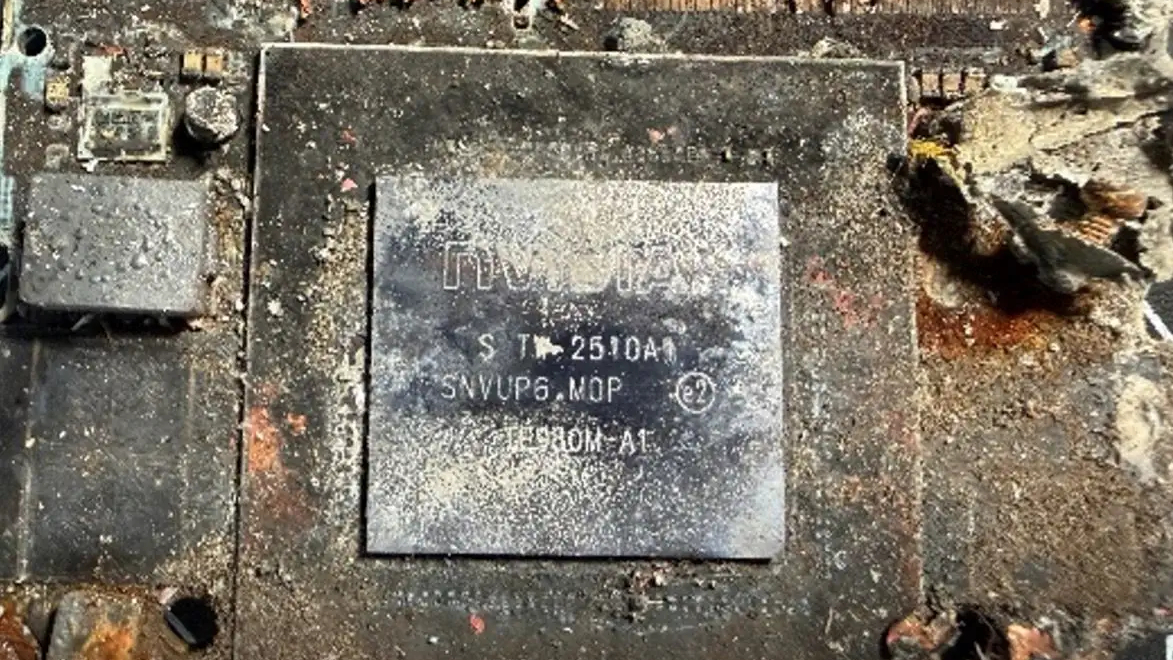
Russia's latest S-71 'Monochrome' cruise missiles use Nvidia's Jetson Orin modules with artificial intelligence capabilities, the Main Directorate of Intelligence of the Ministry of Defense of Ukraine claimed on Wednesday. The S-71 'Monochrome' is distinguished by reduced observability and autonomous targeting capability, reports Militarnyi. Nvidia says the Jetson Orin is a consumer-grade device that is not export-controlled and is not officially available in Russia.
According to the claims, the module in question carries an Nvidia chip marked as SNVUP6.MOP TE980M-A1 and resembles the Jetson Orin NX 8GB/16GB system-on-module. The Orin NX is an automotive-grade SoM based on a system-on-chip featuring up to eight Arm Cortex-A78AE cores, a GPU featuring Ampere architecture with 1024 CUDA cores and 32 Tensor cores that provide up to 157 sparse INT8 TOPS performance for AI, dedicated NVDLA engines, and a vision accelerator. The unit has been shipping since 2023, though based on the markings on the chip purportedly found in the missile, it was packaged in October, 2025.
"Our Jetson Orin modules are consumer-grade products sold to students, developers, and startups for a wide range of beneficial applications," an Nvidia spokesperson told Tom's Hardware. "They are not available in Russia and are not designed for military purposes. Pre-owned Jetsons are available through many reseller channels. Although we cannot track products after they are sold, if we determine that any customer is violating U.S. export controls, we will take appropriate action."
Nvidia positions Jetson Orin NX as a solution for space- and power-constrained applications that need vision, but cannot accommodate more powerful and power-hungry solutions, which essentially means drones and mobile robots that work on battery power. Conceptually, an Orin NX could function as a dedicated electro-optical perception computer that can recognize images locally and pass the information to a separate flight-control/guidance system.
In the S-71 'Monochrome' missile, capabilities of Nvidia's Jetson Orin NX are potentially useful as the compute engine behind an electro-optical perception system (based on a Honpho TS130C-01 module that is made in China) that recognizes images in real time and assists terminal guidance. As per Militarnyi, the S-71M 'Monochrome' can be fired from Su-57 fighters or S-70 Okhotnik drones. With a range of up to 300km, it carries a 250k high-explosive fragmentation bomb as its payload.
Previously, Ukrainian intelligence reported that Russia used Nvidia's Jetson Orin NX modules in its Shahed MS001 autonomous drones for local decision-making and terminal guidance.
Nvidia's Jetson Orin NX modules have been shipping since 2023 and are widely available, which means that Nvidia sells hundreds of thousands, if not millions, every year. Meanwhile, the majority of Jetson Orin NX-based products available in retail are not the SoMs themselves, but rather small-form-factor systems or development kits. The modules are available too, though not as widely. For example, a German store sells them for €685 with a 19% VAT.
In any case, while the American government does export control for high-end AI accelerators like Nvidia's H100 or B200, which can be used to train AI models that can later be used for military purposes, it does not export control hardware that can run these models locally. Ultimately, the models are trained anyway, and the hardware that can use them is readily available.

Follow Tom's Hardware on Google News, or add us as a preferred source, to get our latest news, analysis, & reviews in your feeds.






 English (US) ·