
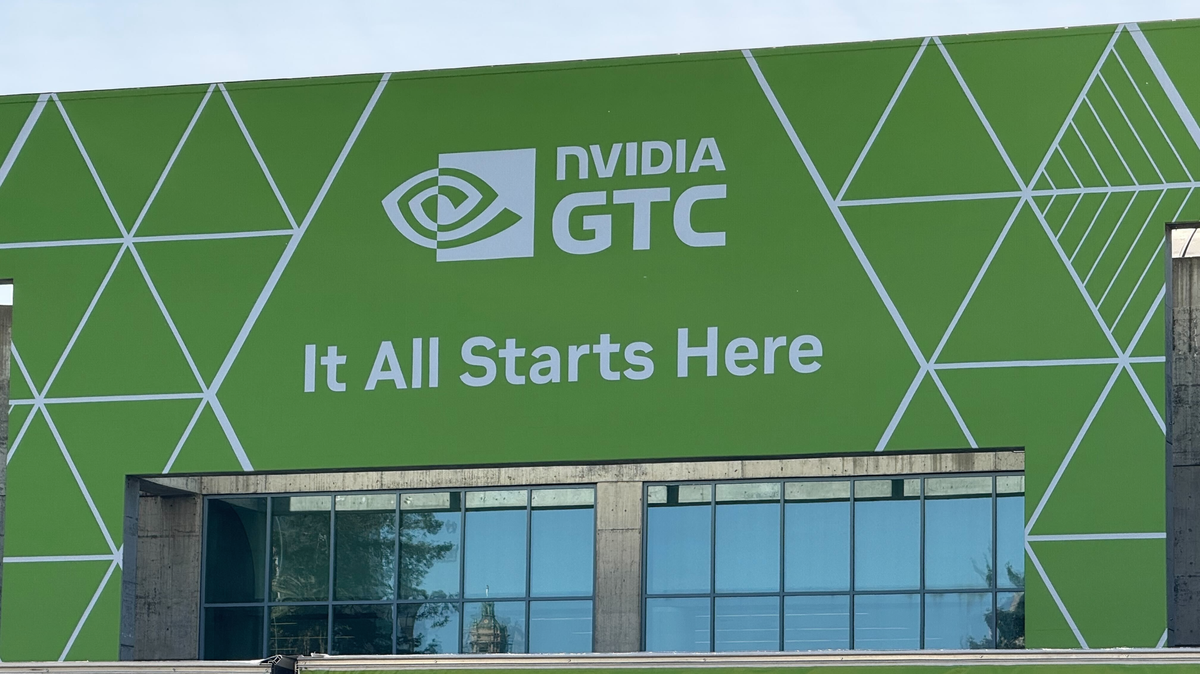
Nvidia is now expecting to generate $1 trillion in revenue through 2027 from its Blackwell and Vera Rubin platforms, CEO Jensen Huang said at the annual GPU Technology Conference in California. The revenue expectation is up 200% from the $500 billion in revenue through 2026 that the company previously projected in last year’s GTC.
“A trillion dollars is an enormous amount of infrastructure; you have to have complete confidence that the trillion dollars you’re putting down will be utilized, would be performant, would be incredibly cost-effective and have useful life for as long as you could see,” Huang said.
That “complete confidence” is coming from a belief that demand for AI will rise exponentially, thanks to the rapid developments in agentic AI, Huang argued. That belief is based on a new token-driven AI economy that he detailed previously in the company’s latest earnings report. That new revenue model is based on the rising importance of inference with the proliferation of agentic AI models.
As agentic AI hype takes over Silicon Valley and models mature, the amount of data managed by an AI system expands, and the importance of inference outgrows that of training. The inflection point for this new order came with Anthropic’s Claude Code AI agent, Huang argued.
“Claude Code has revolutionized software engineering,” Huang said. “There’s not one software engineer [at Nvidia] today who is not assisted by one or many AI agents helping them code.”
At multiple points in his more than two-and-a-half-hour-long keynote speech, Huang compared agentic AI to other foundational tech breakthroughs, at one point calling it “the new computer.”
“Every single SaaS company will become an AgaaS company, an agentic as a service company,” Huang predicted.
It’s not the first time Huang has sung the praises of agentic AI and how it’s reshaping the tech industry, and it likely won’t be the last. In January, agentic AI and the importance of inference were center stage in the launch of Nvidia’s Rubin platform. Just a few weeks before that, the company made its largest purchase ever by acquiring Groq (not Grok), a chipmaker that specializes in inference.
The fruits of Nvidia’s renewed mission were three announcements: a major push into CPUs, Nvidia’s first Groq chips that the company will ship in the second half of the year, and a collaboration with OpenClaw, the open-source AI agent software that made waves with its viral success earlier this year, after launching just a few months earlier under a different name.
“OpenClaw has open-sourced, essentially, the operating system of agentic computers,” Huang said. “It is no different than how Windows made it possible for us to create personal computers.”
He then talked about how, in the rise of the internet, every company needed to have an “HTML-strategy” and now, in the age of AI agents, every company will need to have “an OpenClaw strategy.”
But OpenClaw is a bit of a wild card. The agent requires full access to your computer and your files, creating a cybersecurity minefield. Top tech companies and even the Chinese government have reportedly advised employees against relying on OpenClaw and similar agentic AI platforms out of security fears. Giving an AI boundless control over your computer is also likely to have some big risks, like the off chance that OpenClaw’s AI agent deletes your entire inbox, which actually happened to a Meta executive last month.
In an attempt to address at least some of those concerns, Huang unveiled NemoClaw, Nvidia’s attempt at making OpenClaw allegedly more secure and private for enterprises to use.
Nvidia’s push into the OpenClaw world is also symbolic of the company’s desire to be more competitive in the open-source space, seeing its role as an emerging open-source model provider as a tool to drive further global reliance on the company’s hardware.
On top of the inference-focused announcements, Huang also announced that the company is working on a new Vera Rubin computer to be used in space-based AI data centers, and will be partnering with Hyundai, Nissan and the top Chinese automakers BYD and Geely to build 18 million robotaxis each year.
The finance world has grown weary of the multibillion-dollar AI investments and spending commitments it once loved, and the rapid growth trajectory for AI demand that it once steadfastly believed in. You can see how much that skepticism has grown within the last few months by looking at how investors have become significantly tougher to please with each announcement.
Investors have grown concerned that Nvidia’s revenue growth might be peaking, per Bloomberg, with shares falling 5.5% the day following a stellar earnings report last month. Huang’s proclamations on Monday and his confidence in agentic AI might not have changed that outlook, with shares of the company down a little less than 1% after market close despite the usually share-spiking keynote speech.






 English (US) ·