Nvidia DGX Spark update cuts idle power by 32% or more — hot-plug detection on ConnectX NIC makes for a more efficient AI workstation
2 weeks ago
36
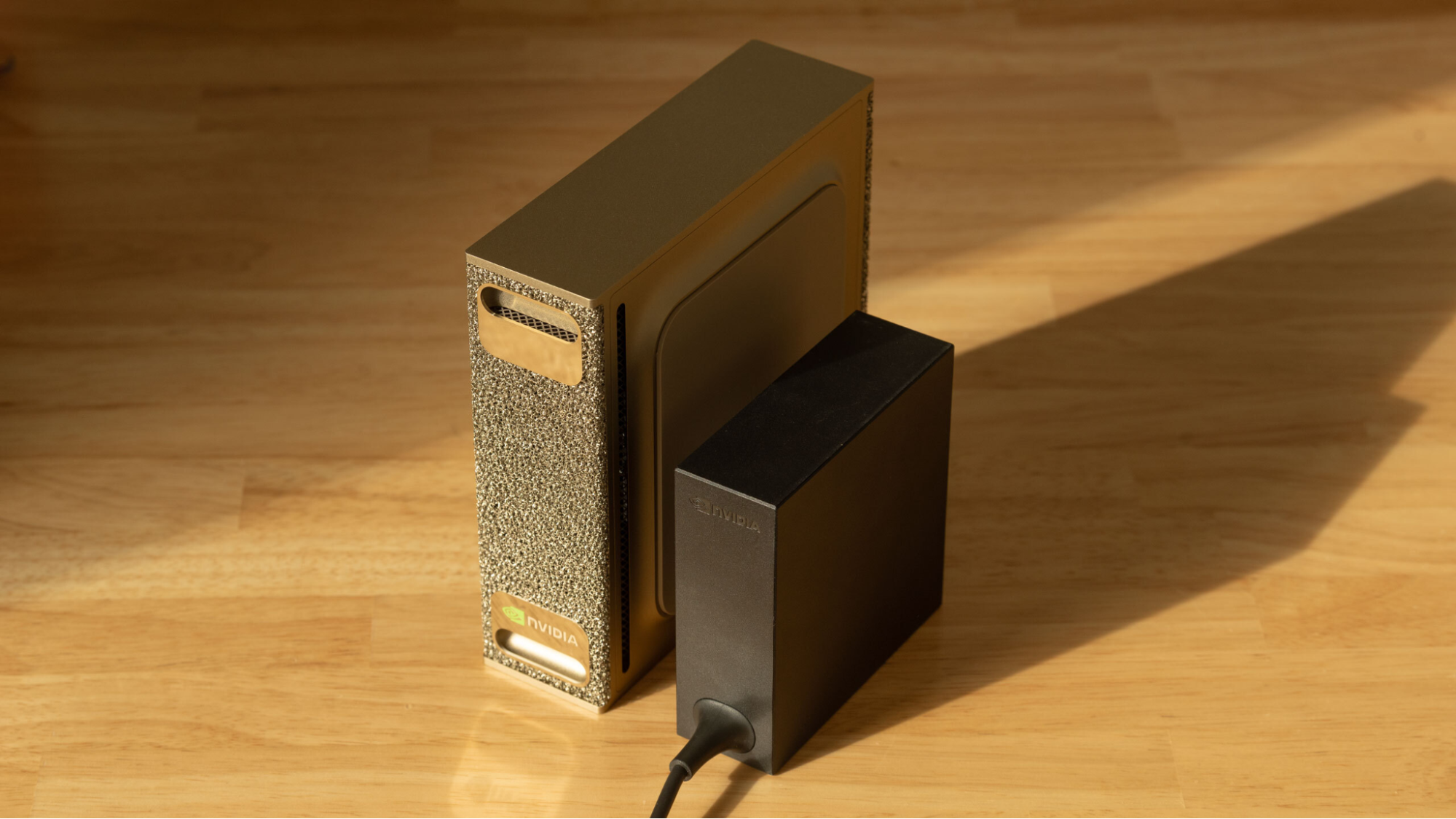
(Image credit: Tom's Hardware)
Nvidia's DGX Spark has proven itself as a compact, versatile local AI engine thanks to its 128GB of RAM, fast 20-core Arm CPU, and capable Blackwell GPU. We found it equally useful for LLM inference and generative image and video workflows in our review.
But one surprise did rear its head during our testing. Despite its 3nm-class fabrication tech, Arm CPU complex, and Nvidia's long experience with mobile power management, the DGX Spark and its GB10 SoC drew a surprising 37W or so at idle. That's hardly the end of the world for an otherwise efficient system, but now we have some insight into why that number was high to begin with—and an easy fix.
In its most recent system software update, Nvidia has enabled hot-plug detection for the Spark's 200Gbps ConnectX 7 NIC, an exotic networking interface whose controller apparently drew a lot of power at idle until now. Nvidia says that the new update can reduce system power draw by up to 18W when the ConnectX 7 interface isn't active.
We like to put hard claims like that to the test, so we got out our USB-C power meter and measured idle power on the Founders Edition Spark before and after applying the latest update.
Prior to the update, the DGX Spark Founders Edition indeed idled at the same 37W or so that we observed in our initial review. After the update, the system drew just 25W at idle with our connected display on, a 32.4% reduction. With the display disconnected, as one might do if the Spark were operating as a headless server, idle power fell further, to just 22W.
Not every GB10 box may benefit equally from this update, though. We also tried the new software version on our Dell Pro Max GB10 system, and idle power remained stubbornly unchanged, at 35-37W. We're still toying with the Pro Max and will see if we can get similar reductions in idle power on that system.
Nvidia is also taking this moment to highlight a few ways that the Spark is being used at educational institutions around the world as a local AI accelerator for a range of interesting projects.
Get Tom's Hardware's best news and in-depth reviews, straight to your inbox.
According to the company's latest blog post, DGX Sparks are now powering AI models at the IceCube Neutrino Observatory at the South Pole, chewing through radiology reports at NYU, and helping study the genetics of epilepsy at Harvard, among other applications.
Benedikt Riedel, computing director at the Wisconsin IceCube Particle Astrophysics Center, says the Spark's low power requirements are ideal for deployment in the harsh, remote conditions of the South Pole for local analysis of neutrino observation data.
Network bandwidth and available power are certainly at a premium at the South Pole, so being able to run AI models locally at relatively high performance within just 140W or so of power seems invaluable. The lab will doubtless be happy to save a few more watts of idle power from their Sparks with the most recent update.
If you're running a Spark of your own, be sure to call up the DGX Dashboard and head over to the Settings tab to install the latest software for yourself.
As the Senior Analyst, Graphics at Tom's Hardware, Jeff Kampman covers everything to do with GPUs, gaming performance, and more. From integrated graphics processors to discrete graphics cards to the hyperscale installations powering our AI future, if it's got a GPU in it, Jeff is on it.

 2 weeks ago
36
2 weeks ago
36






 English (US) ·