
 3 hours ago
6
3 hours ago
6

Published Aug 24, 2026, 12:00 PM EDT
Arcana Unleashed offers more magical options to every class, but its accompanying adventure is lackluster
 Image: Wizards of the Coast
Sign in to your Polygon.com account
After the “new era” of Dungeons & Dragons kicked off with Ravenloft: The Horrors Within, Wizards of the Coast has a very different type of product lined up to follow the latest excursion into the dreaded mists of its horror setting. Arcana Unleashed is a player-focused book presenting new (or reworked) subclasses, spells, and magical items, showcasing the importance of magic in the game. It’s also accompanied by a long adventure, Arcana Unleashed: Deadfall, a “magical espionage” story set in Thay, the treacherous land of the Red Wizards.
Polygon had the chance to read and review both products early, and together they reaffirm the current design philosophy of 2024’s 5.5 edition of the game. Arcana Unleashed goes a long way toward fixing some subclasses that were lackluster in 5e, and it gives more magic-focused options to players. In the process, it also erodes the barriers between classes, offering more flexibility for each class at the expense of what makes each distinct to begin with. Whether you like it or not, that’s D&D’s current direction.
Arcana Unleashed gives more magic options to everyone
 Image: Wizards of the Coast
I am a big fan of the Arcana Domain cleric, and I can happily report that the subclass returns in its 5e configuration, which grants spells from the wizard list as domain spells, but with some powerful upgrades. You now get Counterspell at cleric level 5, and while the jury is still out on whether the 5.5e version of the spell is better or worse than before, it’s still a great addition to the class. Moreover, the underwhelming Channel Divinity: Arcane Abjuration feature is gone, replaced by Modify Magic. You can now spend one use of Channel Divinity when casting a spell to either grant temporary hit points to the target or to subtract 1d6 from the target’s saving throw against the spell. This second use is probably overpowered: Clerics have several control spells such as Command and Hold Person/Monster, and subtracting 1-6 from a saving throw can actually make a huge difference.
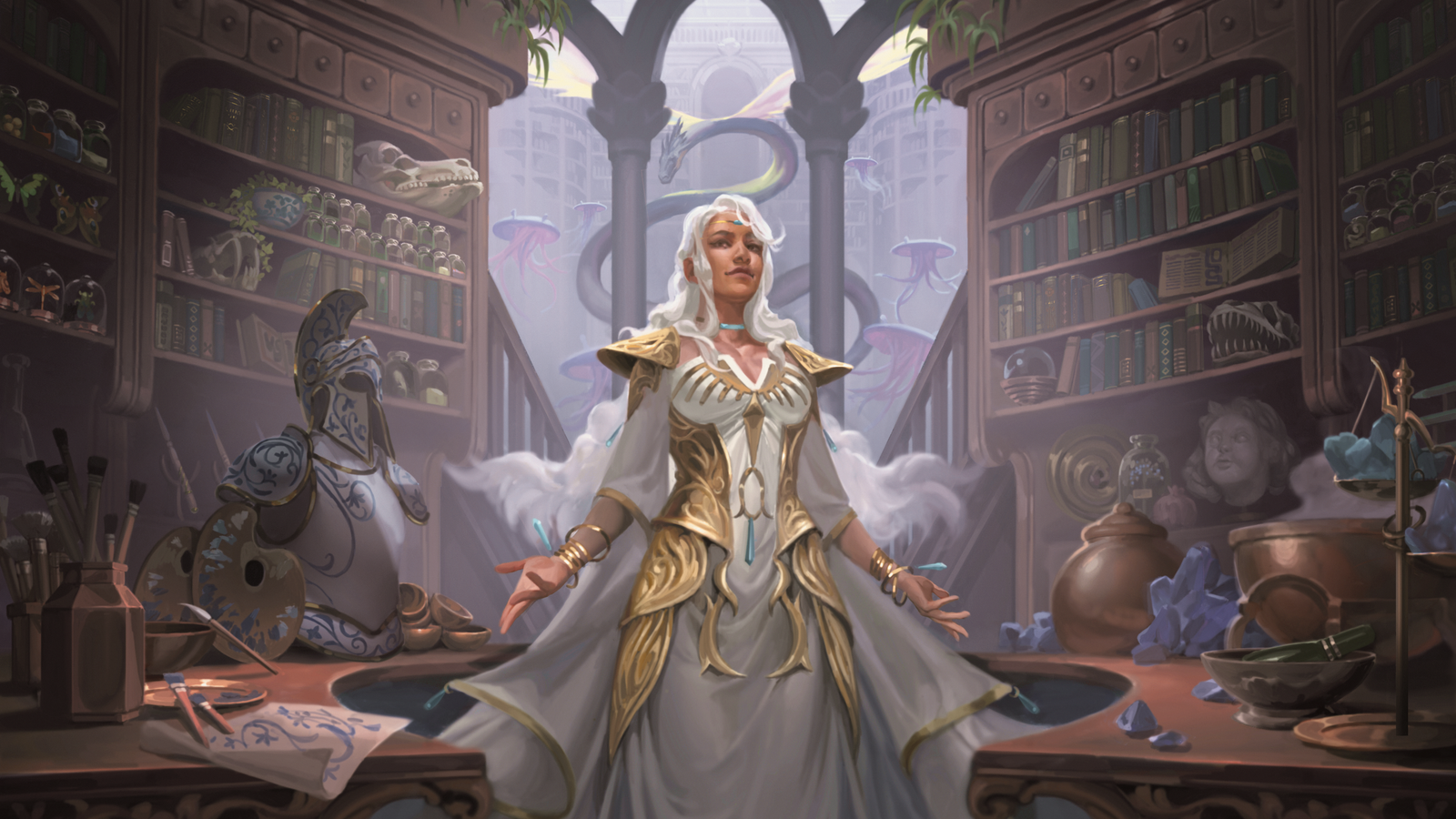
Of course, this being a book about magic, wizard subclasses are treated with extreme care. Players now get all the magic school options that were missing from the Player’s Handbook, namely Conjurer, Necromancer, Enchanter, and Transmuter. They all receive significant boosts compared to their 5e versions. The Conjurer now gets their teleportation ability at level 3 rather than 6, and for a number of times equal to their Intelligence modifier, making this wizard very hard to catch on the battlefield. At level 6, the Conjurer’s summoned creatures become stronger, with temporary hit points and resistance to most forms of damage.
The Enchanter wizard gets a pretty cool class feature at level 3 with Hypnotic Presence, letting them charm a creature that fails a Wisdom saving throw, granting the target the incapacitated condition too. As this can be used repeatedly, it can set a nasty sequence of alpha strikes by a well-coordinated party.
 Image: Wizards of the Coast
The Necromancer, on the other hand, got a complete reskin. D&D players have been waiting for a long time for a chance to play a “pure necromancer” that focuses on raising and boosting undead minions, and finally they got what they wanted. The new Necromancer wizard is all about summoning undead, making them stronger, and even letting them explode in the face of your enemies for massive damage.
Last but not least, the Transmuter, once considered the weakest wizard subclass, got a nice rework thanks to a boost to its Polymorph-related abilities.
One of the two martial subclasses present in the book, the Mystic Arts monk, got the short end of the stick, in my opinion. I can’t see the addition of limited spellcasting as having good synergy with the rest of the class’s abilities, but hopefully more dedicated players will prove me wrong.
Arcana Unleashed also introduces 10 new backgrounds, nine of which are tied to magical factions that are described in the book. The other one, Familiar Trainer, will probably be the most popular among players. Have you ever wanted to play a Fighter but can’t imagine D&D without an adorable magical pet following you around? Well, now every class has access to the Find Familiar spell thanks to this background and its origin feat, Familiar Friend.
 Image: Wizards of the Coast
It’s clear that the D&D design team has been trying to break down the barriers between classes for a while, in an effort to give players maximum freedom when building characters. This isn’t inherently bad; plenty of great RPGs are built around a flexible class system (like Sword World). However, I feel this goes against the established style of D&D too much and causes balance issues.
In my experience running 5.5e games, the single feat that caused me most frustration is Magic Initiate, which unlocks powerful builds by letting any character choose two cantrips and a level 1 spell. If you are a fellow “Magic Initiate-hater,” I regret to inform you that Arcana Unleashed introduces an upgraded version of the feat, called Magic Connoisseur, which lets players choose a further level 1 and a level 2 spell, too.
The DM section of the book includes a lengthy guide on building worlds and campaigns with a heavy magical component. Expert DMs will find this information mostly redundant, but it can be a good worldbuilding resource for those just starting to approach the game. Far more valuable is the section on magical factions. These can be plugged into any campaign as patrons, antagonists, or just a backdrop for worldbuilding. It’s exactly the type of resource I want, as a DM.
Finally, the book includes new spells, magical items, and monsters. A big highlight is Venger, the villain from the 1980s Dungeons & Dragons cartoon. If you ever wanted to terrorize a group of children in your D&D game, now you have the perfect villain for it.
Deadfall is a linear adventure that offers few options for emergent gameplay
 Image: Wizards of the Coast
I had big expectations for Arcana Unleashed: Deadfall, as the first long-form adventure published for 5.5e. It appears that now all products of this type will feature two separate sections: a “gazetteer” detailing the region where the adventure is set, and the adventure itself. However, while the Thay Gazetteer section is excellent, the adventure feels way too “railroad” for my tastes. (“Railroad” is a term used to describe linear adventures that offer limited choices to players, as opposed to the “sandbox” style.) There’s nothing inherently wrong with a railroad adventure; some players and DMs enjoy that style. However, it limits a product's scope and replayability.
In Deadfall, the characters have to undertake a series of quests for a patron NPC, Xelnene Thrul, a Zulkir who wants to stop Szass Tam’s plans to take over Thay (again), until the inevitable final confrontation with the lich. There’s little to no room for deviating from this plot or for exploring different avenues or outcomes. Again, this is a matter of adventure style, but the issue is that there’s not much point for the characters to maintain their secrecy or even succeed in the early stages of the adventure.
 Image: Wizards of the Coast
The book presents a series of “failures” that arise from the characters exposing themselves, but they all result in their Zulkir handler giving them an earful. There’s even a list of ways to “fix” the situation if the characters are exposed, one of which consists of paying 5,000 gold to “hire mages to remove evidence of the character’s recent activities.”
Moreover, the whole premise of a “magical spy thriller” kind of falls apart when you consider that the characters start this adventure at level 11, when they possess powerful spells and abilities that make espionage activities feel trivial. In fact, the book even encourages these “magical tactics,” listing all the spells that can be used, such as Greater Invisibility, Scrying, and Teleport. Sure, the antagonists can use magic too, but I think that the best espionage stories are based on risk and craftiness. With powerful magic and an unlimited reset button available to the characters, Deadfall will struggle to build stakes that feel big enough to keep players invested.
Even worse, all the espionage and diplomacy players engage in are kind of useless: Towards the end of the adventure, Szass Tam discovers the conspirators, takes down the operation, and kidnaps Thrul, forcing the characters to storm the lich’s fortress. Structurally, Deadfall feels rather similar to 2024’s Vecna: Eve of Ruin, another villain-focused adventure from the same lead designer, Amanda Hamon. Both are linear adventures built around patrons that send the players on a series of quests, and both feature an inevitable plot twist that ushers in the bombastic final act. That ultimately makes Deadfall feel a touch formulaic, but only if you prefer the sandbox style of D&D gameplay.
Adventures published during the 5e era did not separate the environment from the game, as 5.5e products do. They let players explore an area more or less spontaneously, leading to emergent, organic gameplay that made these adventures highly replayable. Gazetteers are a great resource for DMs who just want to plug a specific area into their own world and story, but there’s a reason why players keep returning to Curse of Strahd a decade after its publication.
 Image: Wizards of the Coast
Deadfall, however, is still a good product if you don’t take it as a big campaign. The book contains an abundance of locations, encounters, and small quests that can be easily used for short adventures or reskinned and plugged into another campaign. Together with the first extensive look at Thay in a couple of decades that the book provides, this makes Arcana Unleashed: Deadfall worth buying, as long as you’re not expecting an exciting out-of-the-book campaign to play.
Unlike Ravenloft: The Horrors Within, the two books in the Arcana Unleashed drop can appeal equally to new and veteran players. Whether you like the “everybody gets everything” approach to character options and the railroad adventure style or not, these books confirm that the current D&D team has a clear design vision for the game, which will unfold throughout its products going forward.






 English (US) ·