

Powered by a great lead performance from Moeka Hoshi, Never After Dark is a thoroughly entertaining horror-mystery, even if it has its limits.

Published Sep 23, 2026, 9:00 AM EDT
Alex is the Senior Editor of Reviews & Prestige Content, overseeing ScreenRant's film reviews as one of its Rotten Tomatoes-approved critics. After graduating from Brown University with a B.A. in English, he spent a locked-down year in Scotland completing a Master's in Film Studies from the University of Edinburgh, which he hears is a nice, lively city. He now lives in and works from Milan, Italy, conveniently a short train ride from the Venice Film Festival, which he first covered for SR in 2024.
Never After Dark is thoroughly enjoyable. It's a lot of other things, too – creepy, intriguing, at times gripping – but even as it was unfolding, I was aware of how good of a time I was having. It was my primary response, a constant hum underneath my reactions to the story's twists and turns. This ghost story leans heavily into mystery and laces it with character drama, some Gothic mood, and a couple other ingredients I wouldn't want to spoil here, to create something I was just glad to be watching.
The downside of that being a dominant feeling, of course, is that nothing else was quite strong enough to override it. Writer-director Dave Boyle's has plenty of good components, but aside from Moeka Hoshi's excellent lead performance, none of them truly cross the line into greatness. As much mileage as the movie gets out of the power of suggestion, I was waiting for Never After Dark to push itself further, but it simply doesn't have those ambitions. It's an entertaining, atmospheric story that is sometimes greater than the sum of its parts. Even if it doesn't reach the heights it could have, it's very worthy of your time.
The Longer Never After Dark Hides Its True Nature, The Better
Never After Dark eases us into the rules of its world. Airi (Hoshi) is a medium who travels Japan cleansing lingering spirits from the world of the living. Ghosts, she explains, can get stuck sometimes, repeating the same loop over and over, perhaps unaware that they've died. With the help of some portentous-looking items, she performs a ritual that allows her to pierce the veil between our worlds, communicate with the spirit, and help them move on. She does this largely without fear; the dead are nothing to be afraid of. It's the living that scare her.
As if to drive this home, Airi doesn't work alone. Her older sister Miku (Kurumi Inagaki), who died during their childhood, is always with her, visible in any reflective surface. Their ability to speak to each other sans-ritual is, we gather, unusual, but Miku was similarly gifted – which makes her bad feeling about Airi's latest job concerning. She's been called to a relatively isolated former hotel by its current owner, Teiko (Tae Kimura), an aspiring spirit-world obsessive, and Gunji (Kento Kaku), her skeptic son. Teiko has seen a ghost in their home. Her painting of it, with its unsettling, gaping mouth, is an early mood-setter.
Possibly the chief joy of Never After Dark is the drawn-out dance of trying to get a grip on the movie's tone.
Airi is unfazed by her sister's warnings, and approaches this like any old job. Unlike Teiko, she can see the ghost wherever it moves and notices the loop it follows, traversing the stairs and leading to one of the empty second-floor rooms. Her ritual, which lets her cross over into the spirit world, helps her understand what it's after. But "The Gaping Mouth Man" (Mutsuo Yoshioka), as he's officially credited, isn't like other ghosts she's helped in the past. The more she learns, the more she understands why Miku asked her to promise that, if she insisted on starting this job, she would see it through all the way to the end.

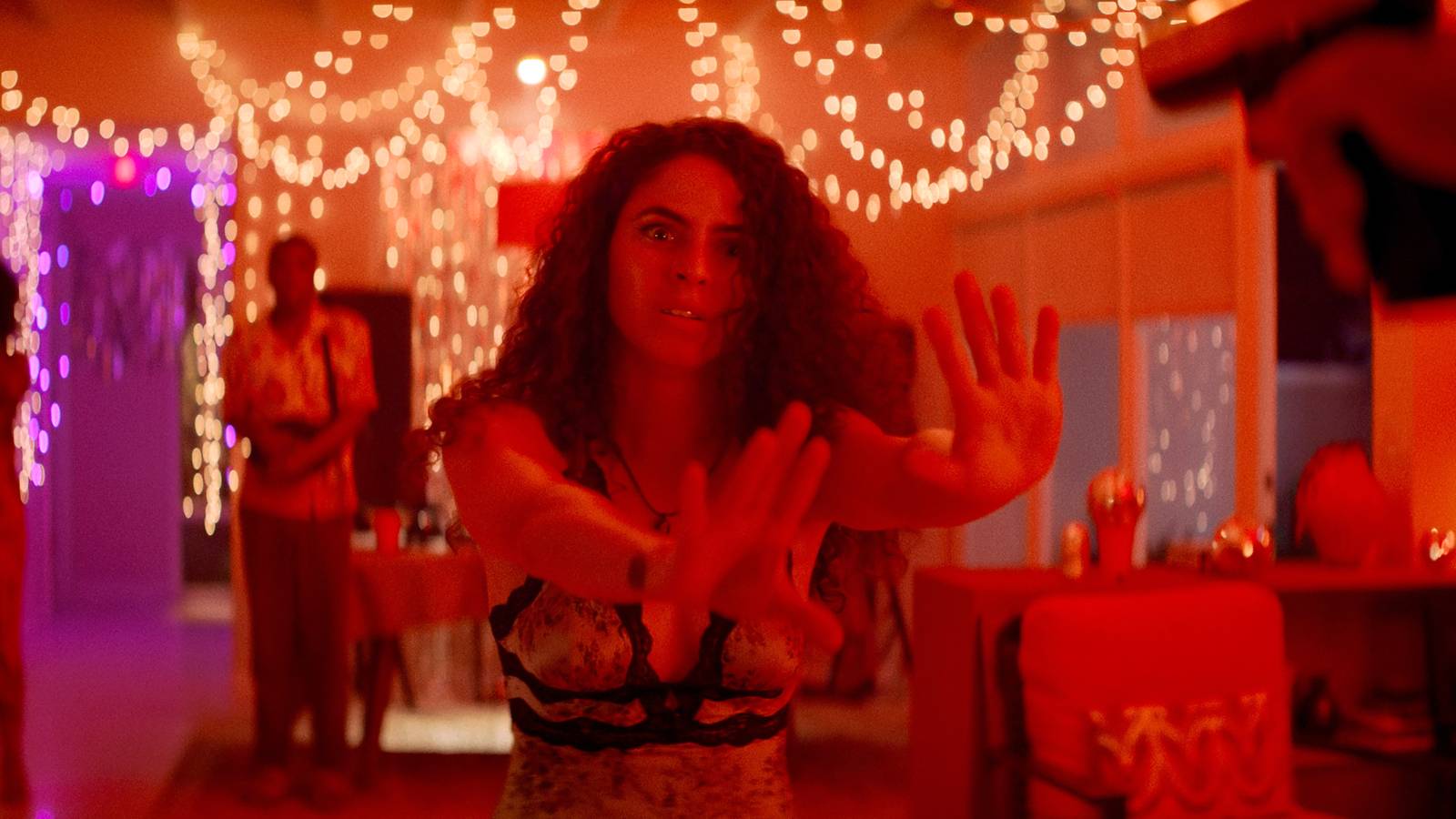
Possibly the chief joy of Never After Dark is the drawn-out dance of trying to get a grip on the movie's tone. The setup and ghost design direct us toward the building fear typical of such stories, but Moeka Hoshi's performance pulls us in the opposite direction. Her body language is all unease when speaking to her clients, and totally relaxed when wandering the haunted grounds on her own. She plays music, makes food, drinks. There is no sense of any precaution against the danger the rest of the film tells us is there – the way the ghost looks doesn't even seem to phase her.
Early on, the effect is really wonderful. There's a straightforwardness to this narrative that satisfies a particular genre-itch, but because we receive so many mixed signals about where to direct our anxiety, it doesn't really feel that way. Never After Dark then rewards that discomfort with genuinely interesting twists on the established situation, changing the stakes and opening up opportunities for a different brand of horrific imagery. As long as the story is morphing in this way, it's especially compelling. Once it finally settles in time for the third act, the tension has solidified into an entertaining shape, but some of the magic has dissipated.
It doesn't help that the two movies I thought of most often while watching, for various reasons, were Stanley Kubrick's The Shining and Park Chan-wook's The Handmaiden – both of which offer far richer versions of some of the feelings on offer here. Even so, that I invoke these classics at all is a compliment in itself. If you enjoy either of them, you'll surely have a good time with Never After Dark.
Never After Dark releases in theaters on Friday, September 25.

Release Date September 25, 2026
Runtime 104 minutes
Director Dave Boyle
Writers Dave Boyle
Producers Kento Kaku, Dave Boyle, Kosuke Tsutsumi





 English (US) ·