
 3 hours ago
6
3 hours ago
6
Francis Halzen, a physicist at the University of Wisconsin, Madison, has won the 2026 Nobel Prize in Physics “for decisive contributions to the IceCube Neutrino Observatory and the discovery of high-energy neutrinos of astrophysical origin.” Halzen spearheaded the development and construction of the IceCube Neutrino Observatory in Antarctica, enabling physicists to capture high-energy neutrinos created in the distant universe.
“It was a great surprise, and I obviously didn’t expect it,” Halzen said during a news conference in Stockholm, Sweden, speaking by phone from Italy. While the Nobel was awarded to Halzen, he emphasized that his work was the result of a “large collaboration” with other researchers.
“This reflects on the really courageous people who joined me in this project when really no respectable conservative physicist would have joined me. But many talented people did, and that’s why I’m here,” he said.
“I am shocked and absolutely delighted that Francis was awarded the Nobel this year,” said particle physicist Danielle Norcini of Johns Hopkins University in a statement. “He is the scientific visionary and driving force behind [IceCube]. It has transformed our understanding of the universe by detecting the first high-energy neutrinos from beyond our galaxy, opening an entirely new field of neutrino astronomy. The experiment is the extraordinary achievement of hundreds of scientists, engineers, and collaborators, but Francis was the person who dreamed big enough to imagine an experiment of this scale and then relentlessly pushed to make it a reality.”
Ghost particles
As previously reported, neutrinos travel near the speed of light. John Updike’s 1960 poem, “Cosmic Gall,” pays tribute to the two most defining features of neutrinos: They have no charge, and for decades, physicists believed they had no mass (they actually have a teeny bit of mass). Neutrinos are the most abundant subatomic particle in the universe, but they very rarely interact with any type of matter. We are constantly being bombarded every second by millions of these tiny particles, yet they pass right through us without our even noticing. That’s why Isaac Asimov dubbed them “ghost particles.”
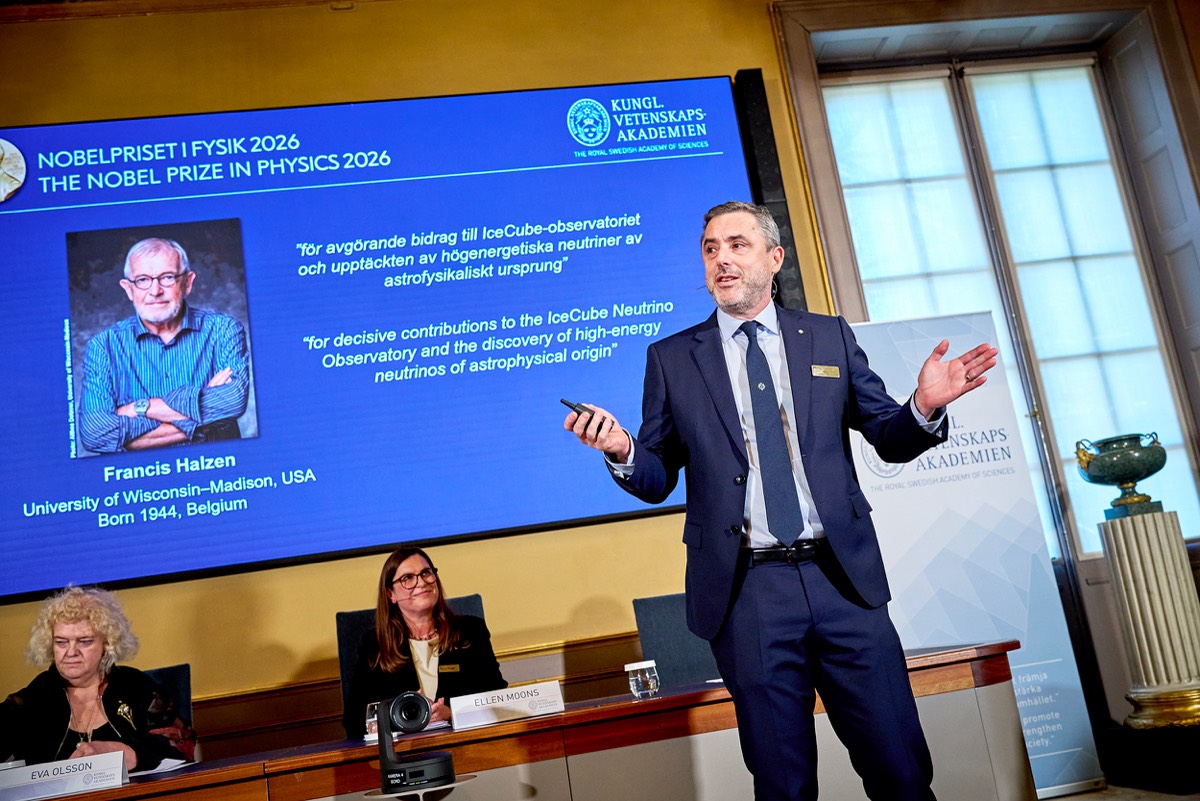
Mark Pearce, chair of the Nobel Committee for Physics, presents the 2026 Nobel Prize in Physics.
Credit: Patrick Lundin
Mark Pearce, chair of the Nobel Committee for Physics, presents the 2026 Nobel Prize in Physics. Credit: Patrick Lundin
That low rate of interaction makes neutrinos extremely difficult to detect, but because they are so light, they can escape unimpeded (and thus largely unchanged) by collisions with other particles of matter. This means they can provide valuable clues to astronomers about distant systems, further augmented by what can be learned with telescopes across the electromagnetic spectrum, as well as gravitational waves. Together, these different sources of information have been dubbed “multimessenger” astronomy.
Neutrinos were first proposed by Wolfgang Pauli in a 1930 letter to colleagues. He was trying to explain some baffling experimental results on radioactive beta decay in atomic nuclei, where energy appeared to be missing—something he deemed (correctly) to be impossible. He thought a new kind of subatomic particle with no charge and no mass may have carried away the missing energy; it was Enrico Fermi who later dubbed it a neutrino.
Clyde Cowan and Frederick Reines first observed these ghostly particles in 1956, thanks to fusion reactions in nuclear power plants that proliferated after World War II. Ten years later, physicists detected the first solar neutrinos. This snagged Ray Davis Jr. and Masatoshi Koshiba a Nobel Prize in 2002, shared with Riccardo Giacconi (who was honored “for pioneering contributions to astrophysics, which have led to the discovery of cosmic X-ray sources”).

%20ILLUSTRATION%20Isadora-Ayesa%20Lima%20SOURCE%20Amazon.jpg?mbid=social_retweet)




 English (US) ·