
 Image via Emerson Miller, Paramount Network; Everett Collection

Published Nov 22, 2026, 11:59 PM EST
Dyah (pronounced Dee-yah) is a Senior Author at Collider, responsible for both writing and transcription duties. She joined the website in 2022 as a Resource Writer before stepping into her current role in April 2023. As a Senior Author, she writes Features and Lists covering TV, music, and movies, making her a true Jill of all trades. In addition to her writing, Dyah also serves as an interview transcriber, primarily for events such as San Diego Comic-Con, the Toronto International Film Festival, and the Sundance Film Festival.
Dyah graduated from Satya Wacana Christian University in October 2019 with a Bachelor's degree in English Literature, concentrating on Creative Writing. On March 2026, Dyah graduated with Master's degree in English Literature Studies, with a thesis on intersectionality in postcolonial-feminist studies in Asian literary works.
Born and raised between Indonesia and Singapore, Dyah is no stranger to different cultures. She now resides in the small town of Kendal with her husband and four cats, where she spends her free time cooking or cycling.
Sign in to your Collider account
Yellowstone might have made Westerns cool again, but it’s not the only series that depicts the atrocities committed in the name of claiming American soil. Like Taylor Sheridan's landmark Western, Netflix’s American Primeval revolves around the fight for Native land. But instead of greedy corporations, the conflict involves Mormon militias, Indigenous communities, and white settlers all caught in the middle.
While men are often the ones framing these narratives, American Primeval shows a different side of these conflicts, particularly through the women pulled into a world that disregards their value. Yellowstone might have shocked viewers with its relentless violence, but it doesn’t come close to American Primeval. The best part is that the miniseries only needs six episodes to expose the truth of America's colonial past, giving its female characters room to tell stories that Westerns have often left on the sidelines.
What Is 'American Primeval' About?
Set during the 1857 Utah War, American Primeval reimagines the Mormon Church’s expansion under Brigham Young (Kim Coates), rooted in deep religious fanaticism and historical violence committed in the name of faith. Young’s campaign to take control of Fort Bridger puts him in conflict with the U.S. Army officer Captain Edmund Dellinger (Lucas Neff), the fort’s owner Jim Bridger (Shea Whigham), and Red Feather (Derek Hinkey), the leader of a renegade group of Crow warriors known as the Wolf Clan.
At the center of the miniseries are mother and son Sara Rowell (Betty Gilpin) and Devin Rowell (Preston Mota), who have come a long way from Missouri to Fort Bridger, Wyoming, with the intention of reaching Devin’s father in Crooks Springs, Utah. However, getting there is easier said than done. With the treacherous terrain, bounty hunters scattered across the region, and wildlife that could kill them in an instant, their chances of making it are slim to none — and that's before they have to contend with the conflict brewing around Fort Bridger. Fortunately, the reluctant mountain man Isaac Reed (Taylor Kitsch) is willing to join Sara and Devin on their journey, but even that doesn't guarantee survival.
'American Primeval' Makes 'Yellowstone' Look Tame by Comparison
There’s no doubt that Yellowstone doesn’t shy away from violence. The series already has plenty of stomach-churning moments: a charging bull let loose inside a bar, Beth Dutton (Kelly Reilly) assaulted in her own office, and the controversial Monica (Kelsey Asbille) storyline, in which she puts herself in danger while trying to lure a predator. However, American Primeval arguably takes things much further, largely because of its historical setting. Unlike the more modern world of Yellowstone, where the Duttons still have to contend with law enforcement, government officials, and legal bureaucracy, the Utah Territory depicted in American Primeval is a largely lawless frontier where formal authority has little control over the men fighting for power and land.
In American Primeval, violence is normalized, with little regard for human life or legal consequences. Public hangings, the abduction of women, and the slaughter of entire groups of settlers are all part of the brutal reality of the frontier. The series takes things even further with its bloody depictions of clashes between opposing groups, including a fictionalized portrayal of the Mountain Meadows Massacre of September 1857. In this world, there’s no telling when someone might fire the first arrow or when a seemingly ordinary verbal confrontation could end with someone getting stabbed. Whether they're battling for control, to settle scores, or simply to defend themselves, nearly everyone resorts to violence to survive.
Collider Exclusive · 8 Questions · 2 Minutes Which Western Icon Are You Most Like? No Name · Doc Holliday · Wyatt Earp · Mattie Ross
Pick your name, your gun, your horse and how you spend a night in town, and we will tell you which legend of the Old West you would have been. Four icons are waiting at the end of this: the stranger who never gives his name, the gambler who would die for a friend, the lawman who never wanted the badge, and the girl nobody has ever talked out of anything.
🚬No Name(Dollars Trilogy)
🃏Doc Holliday(Tombstone)
⭐Wyatt Earp(Tombstone)
🐎Mattie Ross(True Grit)
FIND YOUR ICON →
01
The town is about to learn your name. What do they call you? In a Western, what people call you is already half the character.
AThey never do find it out, so the stranger will have to do. BA nickname I picked up at a card table and never shook off. CMarshal, and most people say it with a bit of respect. DMy full name, and I will correct anybody who tries to shorten it.
NEXT QUESTION →
02
What are you carrying? Everything out here is character, right down to what is sitting on your hip.
AOne revolver I have had for years and have never once talked about. BA pistol, a knife and a deck of cards, and the cards do most of the damage. CA shotgun, because it tends to end arguments rather than start them. DMy father's gun, which is far too big for me, and I am carrying it anyway.
NEXT QUESTION →
03
What are you riding? A hero and their horse is one of the oldest relationships in cinema.
ASomething plain that nobody in town would look at twice. BWhatever I won last night, which may not be strictly mine yet. CA big steady horse that will not spook when things get loud. DA pony I overpaid for and named myself, and I will hear nothing against him.
NEXT QUESTION →
04
You have got one evening in town. How does it go? The saloon is where these films quietly tell you who somebody really is.
AOne drink at the far end of the bar with my back to the wall. BAt the card table, holding court, up forty dollars and climbing. CA quick drink, then a walk round town to see that everything is quiet. DUpstairs with the ledger, working out exactly what tomorrow is going to cost.
NEXT QUESTION →
05
A stranger offers you money for a job that sounds like trouble. Somebody always turns up with a full purse and a bad idea.
AI ask how much, and then I ask for a good deal more than that. BI say yes before he has finished, mostly because it sounds like a story. CI ask him who gets hurt if I turn him down. DI ask for the terms in writing before anybody shakes on anything.
NEXT QUESTION →
06
Somebody is waiting for you in the street. What does the town see? Two people, an empty road, and everybody else watching from behind the shutters.
ASomebody walking out very slowly who has not said a single word. BSomebody grinning, which everyone watching finds deeply unnerving. CSomebody making one last attempt to talk the other man down. DSomebody far too young to be out there, walking out regardless.
NEXT QUESTION →
07
What is the one thing you will not do out here? The code is about the only thing west of the river that actually holds.
AExplain myself to somebody who has not earned an explanation. BRide off and leave a friend standing out there on his own. CLet a whole town pay for a fight it had nothing to do with. DLet a grown man tell me I am too young to be standing here.
NEXT QUESTION →
08
The job is finished. Where does the story leave you? Eight questions in, this is the one that decides your icon.
AOn a ridge somewhere, riding away, without saying goodbye to anybody. BSomewhere warm and worn out, having enjoyed very nearly all of it. CHome, with the badge on the table and the whole thing behind me. DOlder, changed by it, and telling this story for the rest of my life.
REVEAL MY ICON →
The Dust Has Settled Your Western Icon Is…
Four icons and four completely different ways of walking into trouble. This is the one you would have been out there, why it fits, and what it would have cost you.
The Man With No Name
You have never explained yourself and you have never needed to, because people work out fairly quickly that you are the most capable person in the room without you ever having to mention it.
- Eastwood built the character out of everything he refused to do, stripping away the backstory, the speeches and every bit of reassurance until only the competence was left.
- You keep your own counsel, and while other people occasionally find that unnerving, you have never felt any real need to fix it for them.
- The Dollars films work because he genuinely is in it for himself right up until the moment he is not, and he never explains that part either.
- You would be gone before anybody got a chance to thank you.
Doc Holliday
You are the funniest person in most rooms and the most loyal person in all of them, and you would be genuinely insulted if somebody suggested those two things were in any tension.
- Doc has no real reason to be in this fight beyond the fact that his friend is in it, which is the only reason he has ever needed for anything.
- You lead with wit, and it does a very effective job of hiding how seriously you take the handful of people you actually care about.
- Val Kilmer's performance is the most quoted in the entire genre because the jokes keep getting sharper as the situation gets worse.
- You would spend everything you had on this and still describe it as a good week.
Wyatt Earp
You never wanted this job, and you took it anyway because the alternative was standing there watching somebody less careful do it badly, which is the most Western reason there has ever been.
- Earp is the reluctant authority figure, a man who came to town specifically to be left alone and somehow ended up answerable for all of it.
- You are protective by instinct, so when something goes wrong your first thought is who is exposed rather than who is to blame.
- These films understand that keeping order costs far more than breaking it, and that the person holding the line almost never gets thanked.
- You would do the whole thing again, and you would complain about it the entire time.
Mattie Ross
Nobody has ever successfully talked you out of something you had already decided was right, and a long line of grown adults has found that out the hard way.
- Mattie is the most relentless character in the Western canon and she manages it through argument, paperwork and flat refusal rather than a fast draw.
- You have no patience for being managed, so you negotiate, you check the details and you turn up exactly when you said you would.
- True Grit is the rare Western where the moral centre is the youngest person on screen and every adult around her has to catch up.
- You would get what you came for, and the film is honest about what that takes out of you.
↻ RETAKE THE QUIZ
'American Primeval' Does a Better Job With Its Female Characters Than 'Yellowstone'
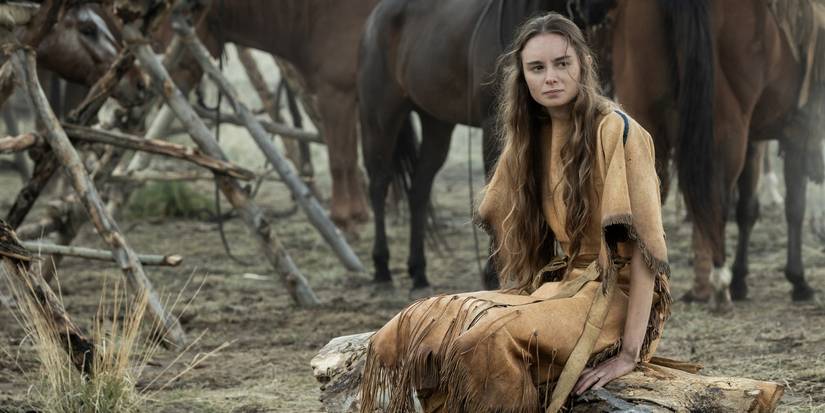 Image via Netflix
American Primeval focuses on three women whose lives are upended by violence. From different societal, cultural, and religious backgrounds, each faces the limited choices available to women on the frontier. Sara is a mother fleeing her past to protect her disabled son; Abish (Saura Lightfoot-Leon) is a Mormon wife questioning religious expectations after falling into the hands of the Shoshone; and Two Moons (Shawnee Pourier) is a mute Shoshone woman escaping her village after killing her rapist.
Yellowstone depicts its female characters in fairly rigid roles throughout its five seasons. In contrast, American Primeval gives its women more room to evolve in just six tight episodes. Initially appearing helpless, they're forced out of their comfort zones to protect themselves and others, adapting to circumstances they never imagined facing. With its complex history, religious conflicts, and women doing whatever it takes, American Primeval shows there's more to these stories than bloodbaths and conquest, offering a more complex and haunting portrait of the country's violent past than Yellowstone ever explores.
Release Date 2025 - 2025-00-00
Network Netflix







 English (US) ·