

Published Mar 13, 2026, 4:45 PM EDT
Diego Pineda has been a devout storyteller his whole life. He has self-published a fantasy novel and a book of short stories, and is actively working on publishing his second novel.
A lifelong fan of watching movies and talking about them endlessly, he writes reviews and analyses on his Instagram page dedicated to cinema, and occasionally on his blog. His favorite filmmakers are Andrei Tarkovsky and Charlie Chaplin. He loves modern Mexican cinema and thinks it's tragically underappreciated.
Other interests of Diego's include reading, gaming, roller coasters, writing reviews on his Letterboxd account (username: DPP_reviews), and going down rabbit holes of whatever topic he's interested in at any given point.
For over a century, fantasy has been one of the greatest sources of cinematic masterpieces. It's one of the Seventh Art's most popular and prolific genres, and sometimes, it's particularly good when it has a dark tone and somber elements. From Pan's Labyrinth to The Seventh Seal, the dark fantasy subgenre has produced several films that are often counted among the best of all time. Naturally, however, many dark fantasy gems from around the world and from all throughout history have ended up slipping through the cracks. It's the duty of today's cinephiles to try and bring them back into the public consciousness.
These grim, beautifully imaginative, often quite disturbing movies are proof of how great dark fantasy can be when placed in the right hands. Of course, saying that "no one" remembers them today is a bit of an exaggeration. It's only logical that there will be a few diehard cinephiles out there that are more than perfectly familiar with them, but in the grand scheme of things, it would be impossible to object to calling these movies "forgotten." Whether they're readily available to watch or must be hunted down by the genre's biggest fans, they're hidden gems that deserve a lot more recognition nowadays.
'The Meeting Point' (1989)
 Image via Art Film 80
Yugoslavian cinema has a vast history that makes it one of the most underappreciated national film industries in history. Those looking to get started needn't look further than The Meeting Point, a fantasy satire where, during the excavation of ancient Roman ruins, an old archaeology professor accidentally opens the gate to the world of the dead. Based on Dušan Kovačević's stage play of the same title, the movie was also translated in the U.S. as The Gathering Place.
Subtle, thematically powerful, and imbued with a thought-provoking atmosphere of magical realism.
Though it's definitely a satire infused with a sometimes twisted sense of humor, The Meeting Point is nevertheless so dramatic that it's probably more accurate to call it a dramedy—a dark fantasy dramedy, of course. Subtle, thematically powerful, and imbued with a thought-provoking atmosphere of magical realism, the movie today reads like a beautiful swan song to a nation that dissolved only a couple of years later.
'The Lost Letter' (1972)
 Image via Dovzhenko Film Studios
The Soviet Union is another nation that has one of the most stellar (and sometimes quite underrated by mainstream audiences) filmographies of any country in history, despite not being around anymore. One of their greatest fantasy films ever is the musical tragicomedy The Lost Letter, based on the novella of the same title by Nikolai Gogol. It tells the adventures of Ukrainian cossacks Vasyl and Andriy, as they set out on a long journey to deliver a letter from their leader to the Russian empress in St. Petersburg.
It may not be one of the most perfect musicals ever, but The Lost Letter sure is terribly underappreciated nonetheless. It's one of the greatest cinematic gems in the history of Ukraine, employing magical realism and a healthy injection of surrealism to tell a mysterious, exquisitely dark, often absurdly amusing tale that has aged like fine wine.
'To Kill a Dragon' (1988)
 Image via Mosfilm
The Soviet-West German masterpiece To Kill a Dragon follows Lancelot, a man who hopes to free the people from a ruthless dictator named Dragon. Cleverly satirizing elements of life in the U.S.S.R. and subtly critiquing Soviet leadership, this is a brilliant parable based on the play Dragon by Evgeny Schwartz. The movie is as poignant and dark as it is irresistibly comical, a balance perfectly achieved by director Mark Zakharov.
The movie's satire and sense of humor are so brutally realistic and sociopolitically razor-sharp that it's just as easy to squirm at them as it is to laugh. That's the best that a dark comedy fantasy can possibly hope to do, and as far as those go, it doesn't get much better than this. It's an undeniable masterwork by an underappreciated auteur at the height of his artistic powers, and a hidden gem that far more people outside of Europe should give themselves the chance of discovering.
'Die Nibelungen: Kriemhild's Revenge' (1924)
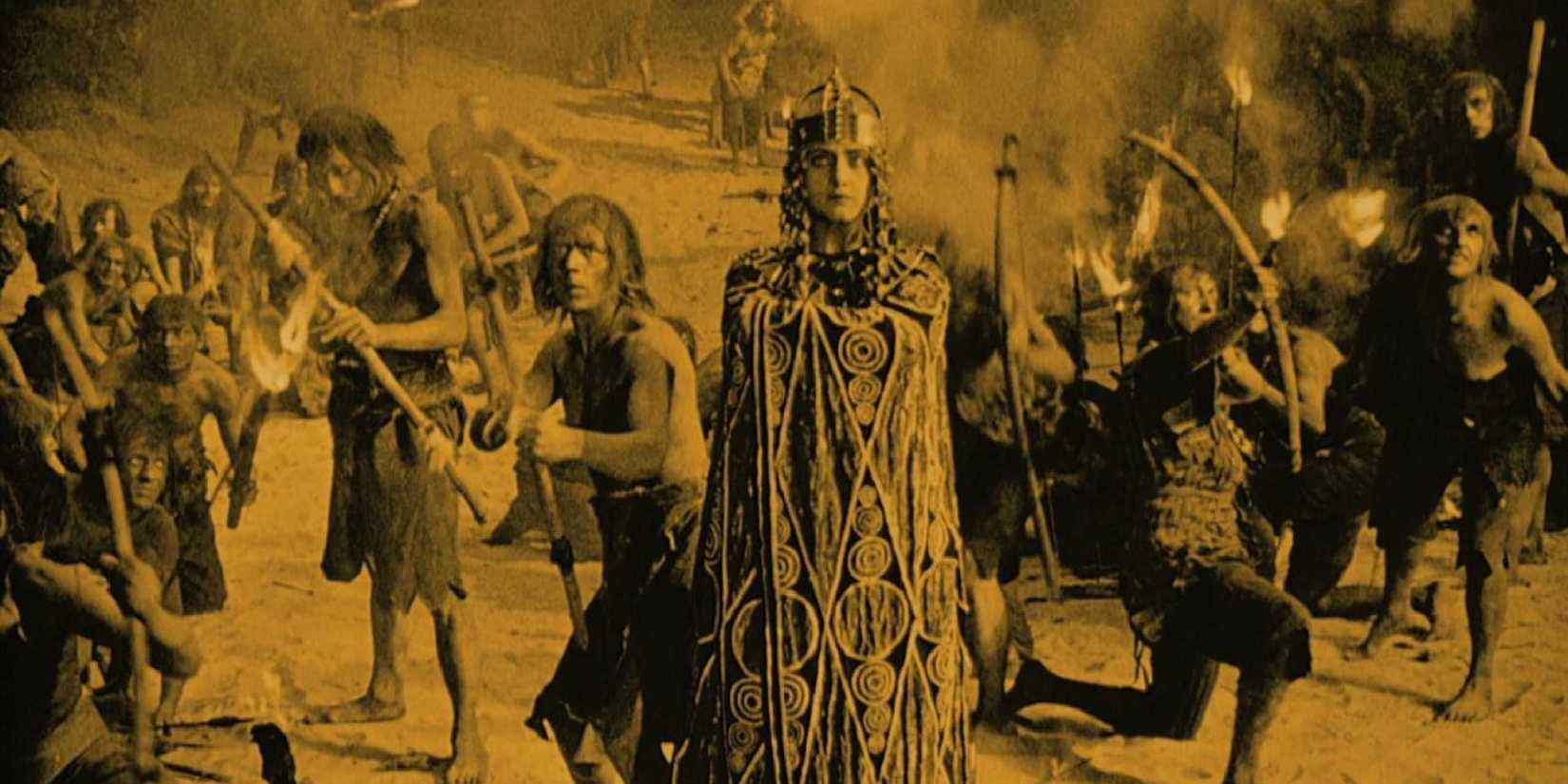 Image via UFA
Austrian filmmaker Fritz Lang was an icon of both German cinema and, later, Hollywood. One of his greatest works in Germany was Die Nibelungen, a two-part series of exceptional fantasy films consisting of the magical Siegfried, and the much darker Kriemhild's Revenge. It follows the titular princess, thirsty for revenge for her husband's murder. She marries the King of the Huns, intending to finally take the life of the man responsible for her disgrace.
It's one of the most near-perfect epics that no one remembers, a silent masterpiece with an engrossing story and some jaw-dropping production qualities. Folklore, magic, slow-mo, and spectacular life-size sets fill the screen in this classic, one of the greatest European films of the '20s. It may not be quite as exciting as Siegfried, but people who prefer dark fantasy over regular fantasy will surely find its grim tone and effective poignancy irresistible.
'The Phantom Carriage' (1921)
 Image via AB Svensk Filmindustri
It turns out that silent European cinema is the way to go when looking for criminally underappreciated dark fantasy films, as further demonstrated by masterpieces like the Swedish fantasy drama The Phantom Carriage. Directed by and starring Victor Sjöström, it's about the driver of a ghostly carriage forcing a drunken man to r'pond to Hollywood, and what a farewell it was. It's one of the greatest and most iconic examples of German Expressionism, the film movement that arguably birthed both the horror and dark fantasy genres as a whole.
Some of the most memorable imagery, artful lighting, and stunning special effects of any film of its era.
For one, Faust is visually flooring, with some of the most memorable imagery, artful lighting, and stunning special effects of any film of its era. Though it was initially a financial and critical flop, primarily due to how much it deviates from Goethe's highly-respected classic, it has since come to be recognized as one of the greatest silent movies of all time. It's a genius work of art that works equally well as a text that all cinephiles should study closely and as an engrossing hidden gem that all general audiences should check out at least once in their lives.
'Macario' (1960)
 Image via Clasa Films Mundiales
The Day of the Dead is one of Mexico's most beautiful and ancestral traditions, a two-day celebration where families welcome back the souls of deceased loved ones for a joyous reunion. There are several traditions associated with the holiday, only one of them cinematic: to rewatch Roberto Gavaldón's Macario, perhaps the greatest Mexican film ever made. It's the tale of the titular character, a poor and hungry peasant who wishes to have a whole turkey for himself for All Saint's Day. After his wife cooks it for him, he's visited by the Devil, God, and Death himself.
Anchored by Ignacio López Tarso's powerhouse performance, Macario was the first Mexican film to be nominated for an Academy Award for Best Foreign Language Film. It's an unforgettable, absolutely magical experience with a dark, deeply poignant core. It's far more than just a rags-to-riches story: It's a legendary masterpiece that mixes uniquely Mexican flavors of folk fantasy and magical realism to deliver an experience unlike anything that another dark fantasy film has ever had to offer. It's charming, but sad; sometimes funny, but overwhelmingly bleak just as often; life-affirming, but also with one of the saddest endings of any film of the '60s. It's a very well-known film in Mexico, that's for sure; but international dark fantasy fans owe it to themselves to check out this underrated hidden gem.

Macario
Release Date May 9, 1960
Runtime 91 minutes
Director Roberto Gavaldón
Writers Emilio Carballido
-

Ignacio López Tarso
Macário
-
Pina Pellicer
Esposa de Macario
-
-
Mario Alberto Rodríguez
Don Ramiro






 English (US) ·