
 3 weeks ago
40
3 weeks ago
40
“We would need over half a million 4K TVs to fully display the single Roman image from our largest survey.”
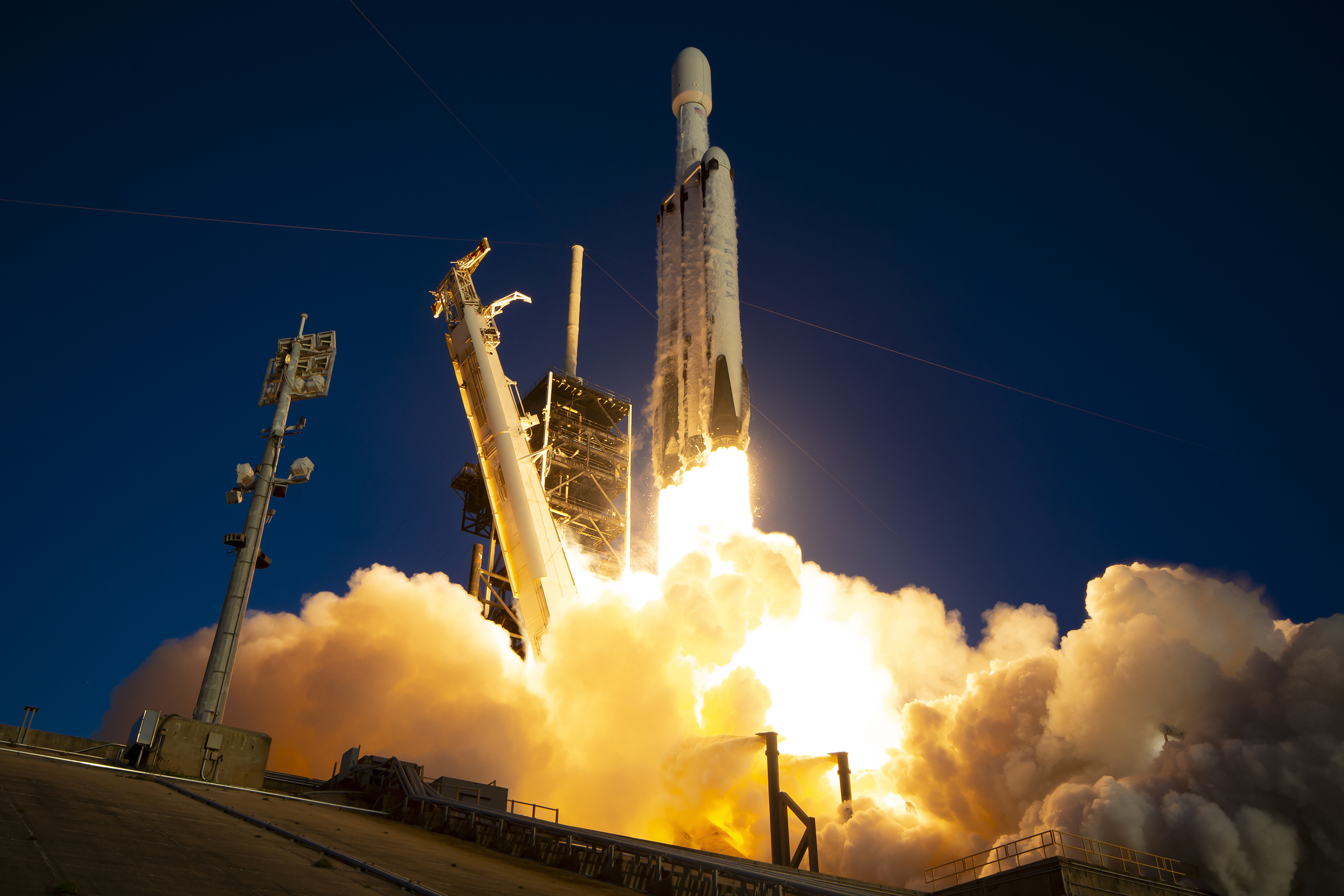
Liftoff of NASA's Nancy Grace Roman Space Telescope aboard a SpaceX Falcon Heavy rocket. Credit: SpaceX
Liftoff of NASA's Nancy Grace Roman Space Telescope aboard a SpaceX Falcon Heavy rocket. Credit: SpaceX
NASA’s $4.3 billion Nancy Grace Roman Space Telescope, equipped with a 300-megapixel camera sighted through a refurbished spy mirror, launched Sunday from Kennedy Space Center in Florida on a mission to reveal the mysterious forces driving the Universe.
The new mission will extend the vision of NASA’s other famous observatories, providing a field of view 100 times wider than the Hubble Space Telescope and complementing the groundbreaking work of the James Webb Space Telescope. Roman is just the second NASA-led astrophysics mission to launch this century, following the launch of Webb in 2021.
Unlike Webb, which suffered many years of delays before reaching space, Roman arrived at the launch pad nine months before NASA’s commitment to send it skyward by May 2027.
“Roman is exactly the kind of success story we want to see across NASA,” said NASA Administrator Jared Isaacman. “Delivered ahead of schedule and on budget, this mission reflects more than a decade of dedication from the NASA workforce and our industry partners. Now, Roman will give us a new atlas of the Universe, push the boundaries of discovery, and demonstrate what is possible when America’s space program pairs bold ambition with disciplined execution.”
A SpaceX Falcon Heavy rocket gave Roman a thundering lift to space. SpaceX’s heavy-lifter, powered by 27 kerosene-fueled main engines, took off at 7:25 am EDT (11:25 UTC) Sunday from Launch Complex 39A at NASA’s Kennedy Space Center in Florida. Darting into the sky just after dawn, the Falcon Heavy flew downrange over the Atlantic Ocean, released its two reusable side boosters to return to Cape Canaveral, then deployed Roman on a course to take it four times farther from Earth than the Moon.
Fully fueled, Roman tipped the scales at some 20,000 pounds (9 metric tons) and filled the Falcon Heavy’s payload fairing. The rocket sent the observatory toward an observation post around the Sun-Earth L2 Lagrange point, a gravitational balance point nearly a million miles (1.5 million kilometers) from Earth.
“This is a big spacecraft,” said Denton Gibson, NASA’s launch director for the Roman mission. “We needed all 5 million pounds of thrust on that Falcon Heavy, which performed flawlessly.”
It will take about three months for Roman to reach its operational orbit around the L2 point. Ground teams will activate and calibrate the observatory during the transit, and scientists aim to have the first science images ready for publication by the end of the year.
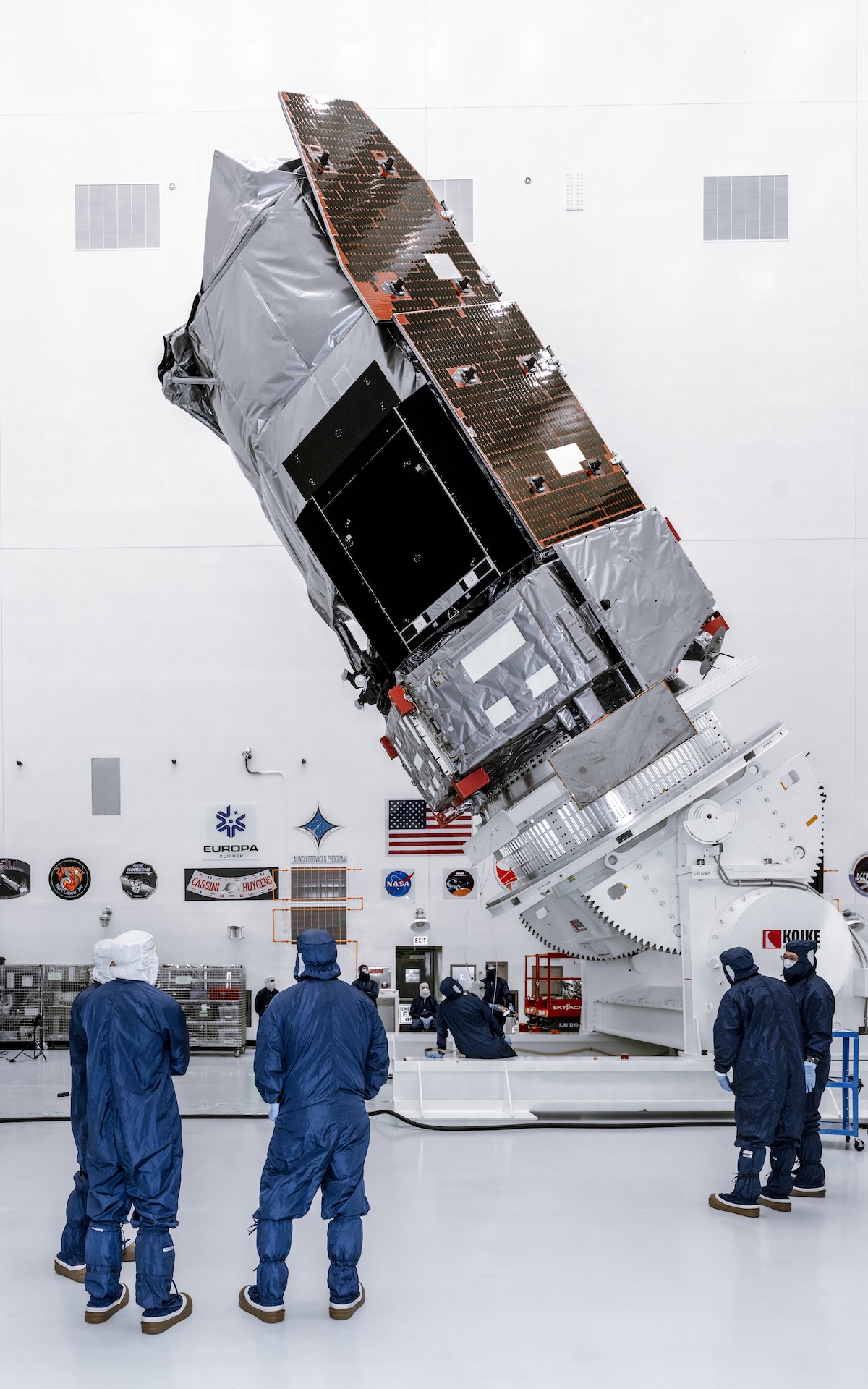
A view of the Roman Space Telescope undergoing launch preparations at NASA’s Kennedy Space Center in Florida.
Credit: NASA/Sydney Rohde (Rocz)
A view of the Roman Space Telescope undergoing launch preparations at NASA’s Kennedy Space Center in Florida. Credit: NASA/Sydney Rohde (Rocz)
Mirror, mirror on the wall
NASA named the mission after Nancy Grace Roman, the agency’s first chief astronomer and a pioneering advocate of space-based telescopes. During her tenure at NASA, Roman fostered support in the science community and funding from Congress for what became Hubble. Roman retired from her position in NASA’s leadership in 1979 and died in 2018. NASA announced in 2020 that the next great observatory, up until then known as the Wide Field Infrared Survey Telescope (WFIRST), would be named in honor of Roman.
Engineers spent the better part of a decade assembling the observatory around a 7.9-foot-diameter (2.4-meter) telescope donated to NASA by the National Reconnaissance Office, the US government’s spy satellite agency. The telescope’s primary mirror is the same size as that of Hubble.
NASA took possession of two NRO spy telescopes in 2012, and scientists soon earmarked one of them for the mission that became Roman. The agency hasn’t identified a use for the second telescope. The NRO declared the telescopes surplus after the cancellation of one of its surveillance satellite programs.
The sudden availability of an off-the-shelf telescope led to a redesign of WFIRST. The observatory—still on the drawing board at the time—essentially doubled in size to accommodate the telescope, improving its vision while adding to its cost. Ground teams also had to reconfigure the mirror to change its “optical prescription” and accommodate colder operating temperatures.
“It certainly wasn’t just plug and play,” said Julie McEnery, senior project scientist for the Roman telescope at NASA’s Goddard Space Flight Center.
Roman passed its NASA confirmation review in 2020, and since then, the mission’s development proceeded on budget and faster than expected.
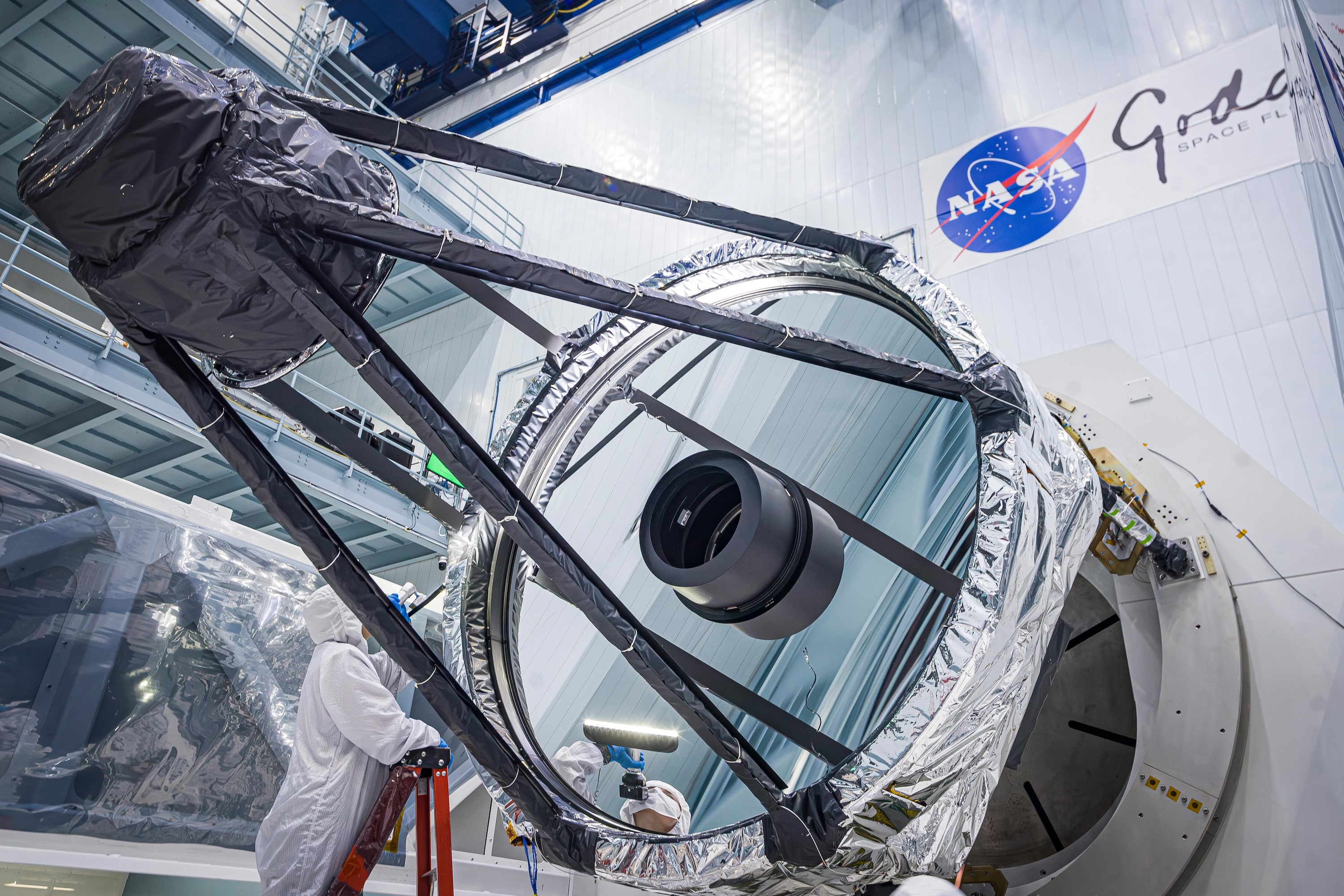
The 7.9-foot-diameter polished primary mirror for the Nancy Grace Roman Space Telescope was originally built for a US government spy satellite.
Credit: NASA/Chris Gunn
The 7.9-foot-diameter polished primary mirror for the Nancy Grace Roman Space Telescope was originally built for a US government spy satellite. Credit: NASA/Chris Gunn
Nicky Fox, head of NASA’s Science Mission Directorate, calls Roman the Swiss Army Knife of telescopes. It will survey 12 percent of the sky, and while that may not sound like a lot, it is far more than the 0.1 percent observed by Hubble over its 36 years in orbit.
“Roman’s large field of view and fast survey speeds will reveal untold cosmic objects while shining a light on dark energy and dark matter,” Fox said. “During its mission, Roman will discover tens of thousands of new planets, billions of galaxies, thousands of supernovae and tens of billions of stars. And it will do all of that at a speed about 1,000 times that of Hubble… So to put it into context, what Roman can do in a month would take Hubble a century.”
Who is the fairest one of all?
Cosmologists are eager to learn more about dark energy, an unseen force that, according to the Standard Model of the Universe, makes up about 70 percent of the cosmos and is responsible for accelerating the Universe’s expansion. Dark matter makes up a little more than a quarter of the Universe. The rest of the cosmos is made of regular atoms and molecules that we can see and touch.
But the Standard Model might be wrong. Roman’s untold discoveries “may confirm the current hints that our Standard Model of the Universe is incorrect, and set us on the path to figuring out what’s right,” McEnery said.
“One month of Roman observations could survey our own Milky Way, resulting in the detection of up to half the stars in our own galaxy,” McEnery said. “This would, itself, represent a catalog of astronomical objects much larger than any in existence today.
“Our main survey will take over a year, and it will be really huge,” she said. “We would need over half a million 4K TVs to fully display the single Roman image from our largest survey. To understand the scale, these TVs would cover 45 Manhattan city blocks, or fully cover El Capitan in Yosemite National Park.”
Roman’s Wide Field Instrument gives the observatory its broad vision. This near-infrared camera can take a picture of a pocket of the sky larger than the full Moon, allowing Roman to map megastructures like clusters of galaxies and large-scale filaments of matter and dark matter that make up the cosmic web.
“To put it into perspective, it is as if Hubble and James Webb kind of peered through a keyhole at the Universe, while Nancy Grace Roman will kick the door down,” Fox said. “But Roman isn’t just doing Hubble and Webb science faster. It’s doing fundamentally different science that could not be done by either observatory. Together, these three flagship telescopes will combine their observations to give us a more complete picture of our cosmos, and our place in it.”
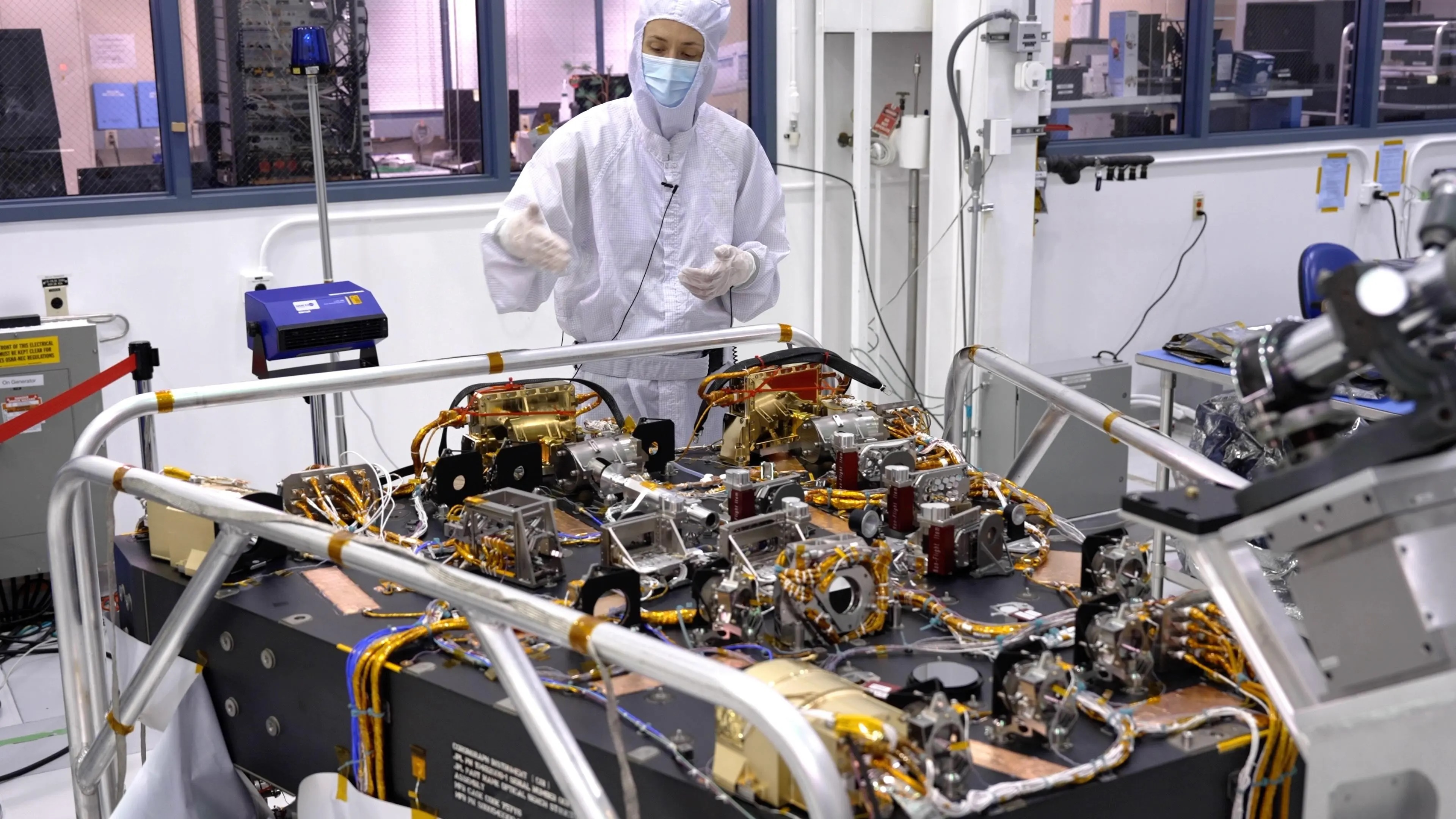
Roman’s Coronagraph Instrument, designed for direct imaging of exoplanets, is one of the most sophisticated astronomy instruments ever sent into space.
Credit: NASA/JPL-Caltech
Roman’s Coronagraph Instrument, designed for direct imaging of exoplanets, is one of the most sophisticated astronomy instruments ever sent into space. Credit: NASA/JPL-Caltech
A second instrument on Roman, called a coronagraph, will allow astronomers to directly image planets orbiting faraway stars in our own galaxy. The coronagraph works by blocking the bright light from stars, using masks and large-format self-flexing mirrors to detect planets 100 million times fainter than their hosts. NASA says the coronagraph on Roman, with internal mirrors capable of adjusting their prescription on the fly, is 100 to 1,000 times more sensitive than previous coronagraphs on Webb and Hubble.
This part of Roman’s toolkit will allow astronomers to study the sizes, atmospheres, and structures of more kinds of exoplanets than possible today. The coronagraph’s innovations will inform the design of future instruments that could expand the reach of direct imaging to include rocky planets in the habitable zones of their stars.
“Roman will photograph worlds, dusty disks, and nearby stars in visible light to help see the giant worlds that are older, colder, and in closer orbits than the hot young Jupiters that we’ve previously imaged with other telescopes,” Fox said.
Roman will also detect exoplanets using the tried-and-true transit method, but scientists expect the new telescope will find a lot more than past space missions have, thanks to its wider vision.
Heigh-ho, it’s off to work we go
All of this means data, and lots of it.
“In just one day of observing our Universe, Roman will downlink 1.4 terabytes of data,” Fox said. “That is an entire gaming system hard drive in one day. That is a staggering amount of data.”
Roman will transmit this amount of information down to Earth nearly every day for its planned five-year mission. NASA and its partners will connect with Roman through a collection of ground stations around the world separate from the agency’s oversubscribed Deep Space Network. NASA and the Space Telescope Science Institute, which oversees Roman’s operations, will release the observatory’s data to a public archive accessible to scientists around the world.
Many astronomers are accustomed to downloading data from Hubble and Webb onto personal computers. In most cases, that won’t be possible with Roman. NASA’s new observatory will generate 20 petabytes (20,000 terabytes) of data over its five-year prime mission. By comparison, Hubble has delivered a little more than 400 terabytes of data since its launch in 1990.
Scientists developed a cloud-based platform for astronomers to explore, access, and analyze Roman’s data, with options for astronomers to use preconfigured built-in software or bring their own software for data reduction.
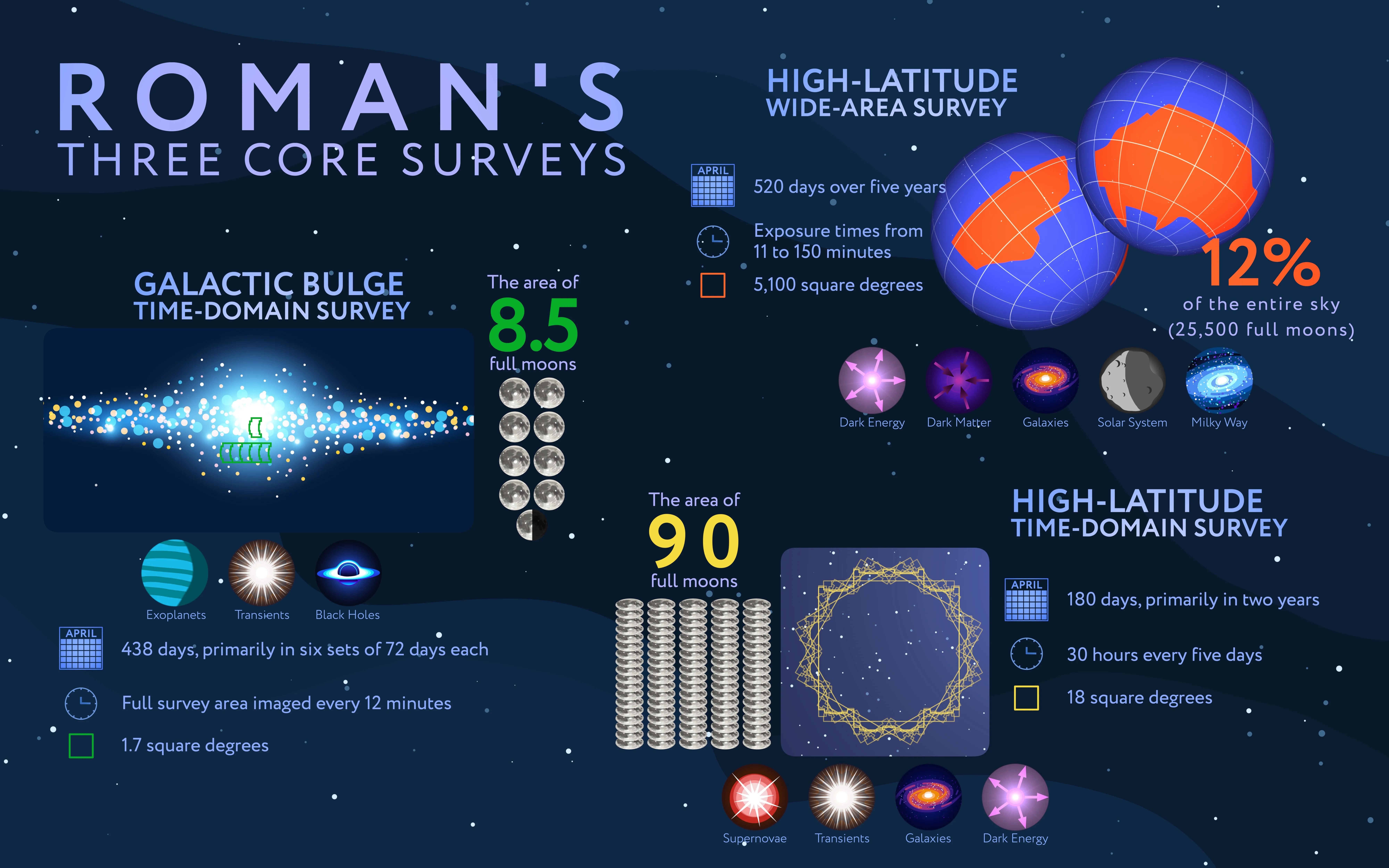
NASA’s Nancy Grace Roman Space Telescope’s three main observing programs, highlighted in this infographic, can enable astronomers to view the Universe as never before, revealing billions of cosmic objects strewn across enormous swaths of space-time.
Credit: NASA/Goddard Space Flight Center
NASA’s Nancy Grace Roman Space Telescope’s three main observing programs, highlighted in this infographic, can enable astronomers to view the Universe as never before, revealing billions of cosmic objects strewn across enormous swaths of space-time. Credit: NASA/Goddard Space Flight Center
“No single person is going to be able to look at all of the stars and all the galaxies and all the unusual things that we’re going to see with Roman,” said Jeremy Perkins, integration and test scientist for the Roman telescope at NASA Goddard. “One way I like to think about this is that our data set at the end of Roman’s life is going to be bigger than your favorite music streaming platforms. And I can’t go online and listen to every single song to find new songs and new music. I have to use algorithms and other ways to introduce new music to myself, and we’re going to do the same with Roman.”
“So much of what physics is trying to understand about the nature of the Universe today needs large number statistics in order to understand,” said Jackie Townsend, NASA’s project manager for the Roman mission.
In one survey, Roman will cover an area equivalent to 3,455 full moons in about three weeks, then go back and observe a smaller portion of that area repeatedly over five-and-a-half days—jobs that Hubble and Webb can’t do.
“We will do fundamentally different science,” Townsend said. “In some subset of our observations, we’re going to be making 3D movies of what is going on in the Milky Way galaxy and in distant galaxies. That is just something that’s never happened before.”
Roman will animate and reveal the sky with the same sharpness as Hubble’s most memorable observations, such as its famous Ultra Deep Field image.
“Now, we’re taking that depth of field and that power and applying it globally to a decent fraction of the night sky,” Townsend told Ars in an interview. “Just like we pointed Hubble at what looked to be a dark patch, and we discovered billions and billions of galaxies out there, I think Roman is going to have the same gee-whiz moments, [showing] we just didn’t understand how the Universe worked until we had this dataset that was so big and so huge.”

Stephen Clark is a space reporter at Ars Technica, covering private space companies and the world’s space agencies. Stephen writes about the nexus of technology, science, policy, and business on and off the planet.





 English (US) ·