Nanoscale device generates continuous electricity from evaporating water and some sunlight — paves the path for battery-free sensors, wearable electronics, and more
9 hours ago
8
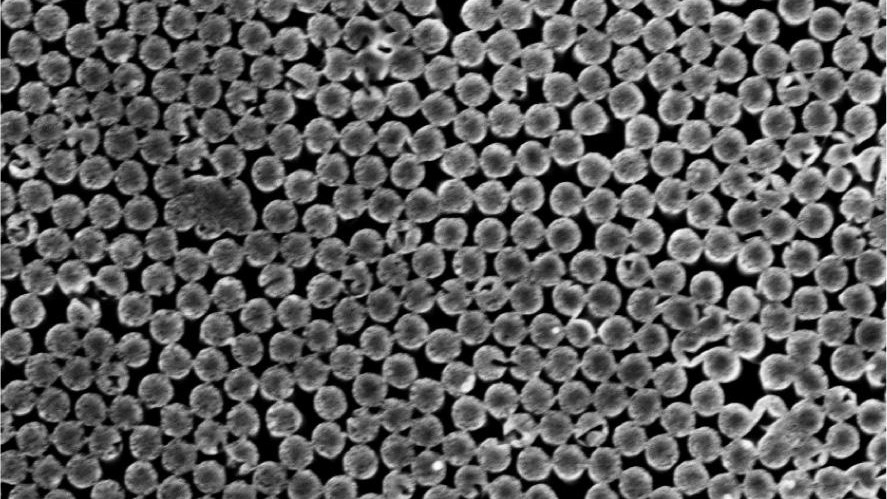
Scanning electron microscope image of the silicon nanopillars(Image credit: 2026 LNET EPFL)
In a press release Researchers at the Laboratory of Nanoscience for Energy Technology (LNET) at the Ecole Polytechnique Fédérale de Lausanne (EPFL) in Switzerland announced they had developed a device that continuously generates electricity from evaporating water, aided by modest heat and sunlight. The system requires ordinary ion-containing water, such as tap water or seawater, and does not work with highly purified water.
The technology is a nanoscale hydrovoltaic device — a class of technology that harvests electricity from the evaporation-driven motion of water molecules and dissolved ions across engineered surfaces.
The system builds on earlier work by the same group, published in 2024, in which the researchers created an experimental platform to study the hydrovoltaic effect in detail. The initial setup comprised a hexagonal network of silicon nanopillars separated by tiny channels through which water could evaporate.
Article continues below
It demonstrated that when water moves and evaporates across charged nanostructures, dissolved ions can reorganize, creating measurable electrical effects at the surface. At the time, the platform was primarily a research tool rather than a practical power source.
In the new 2026 study published in Nature Communications, the team transformed that concept into a functional three-layer electricity generator that harnesses evaporation, heat, and sunlight. According to the team, the result is a device capable of producing stable, continuous output while matching or exceeding the performance of comparable hydrovoltaic systems.
The device is built around three functional regions, each responsible for a different stage of the energy-conversion process: a top evaporating interface, a middle ion-transport region, and a bottom silicon-based nanostructured electrode.
At the top interface, water gradually evaporates into the air, creating a continuous upward flow of liquid toward the surface. As water molecules leave as vapor, dissolved ions, such as sodium (Na⁺) and chloride (Cl⁻), are redistributed within the remaining liquid, creating uneven ion concentrations and chemical potential differences across the system. This evaporation-driven ion movement contributes to charge separation and voltage generation within the device.
Get Tom's Hardware's best news and in-depth reviews, straight to your inbox.
At the bottom of the system is a nanostructured silicon electrode composed of oxide-coated silicon nanopillars. When the liquid contacts these charged surfaces, ions reorganize near the interface, forming an electrical double layer — a nanoscale region of charge separation between the solid surface and the surrounding liquid.
Surface chemical reactions, ion distribution within this interfacial region, and the resulting electrochemical potential differences play a central role in the device’s electrical output.
Without sunlight, the device can still generate hydrovoltaic output from evaporation alone, but at significantly lower levels. However, with the added heat and light from sunlight, researchers say performance increased by a factor of five. The bottom layer is made of silicon, a semiconductor that generates mobile charge carriers when exposed to light. When photons from the sun strike the silicon surface, electrons inside the material become energized and are able to move more freely.
The electric field created by the ion imbalance helps drive the excited electrons through an external circuit, generating usable electrical current.
Heat further boosts performance in two ways. First, it accelerates evaporation, increasing ion transport through the liquid layer. Second, it modifies charge behavior at the silicon interface, strengthening the surface electric effects involved in power generation.
These combined effects across the device lead to measurable electrical output. In tests, the device achieves an open-circuit voltage of approximately 1 volt and a power density of 0.25 watts per square meter (10.76 square feet) under optimal conditions.
The output is tiny compared with commercial solar panels, which can generate hundreds of watts per square meter. However, the technology is not being developed as a conventional renewable electricity source. Its real promise lies in battery-free sensors, remote monitoring systems, smart agriculture nodes, wearable electronics, and Internet of Things devices deployed in environments where water, warmth, and sunlight are naturally available. For such low-power autonomous electronics, the test outputs are significant.
Another notable feature is the team’s “decoupled” design. By separating evaporation, ion transport, and electron collection into distinct layers, each stage can be studied and optimized independently. That gives engineers more control over performance and makes it easier to scale future versions.
For now, however, the entire system still exists at the nanoscale. The electricity is real, continuous, and scientifically meaningful, but the technology remains an early-stage microscopic energy harvester rather than a grid-scale power source.
Still, if the researcher can scale future versions cheaply and reliably, the idea of sensors and electronics quietly powering themselves from nothing more than impure water, ambient heat, and sunlight may no longer sound so far-fetched.
Etiido Uko is an engineer and technical writer with over nine years of experience in documentation and reporting. He is deeply passionate about all things gadgets, technology, and engineering.
Nanoscale device generates continuous electricity from evaporating water and some sunlight — paves the path for battery-free sensors, wearable electronics, and more

 9 hours ago
8
9 hours ago
8









 English (US) ·