
 3 weeks ago
18
3 weeks ago
18
A year after its launch, the GeForce RTX 5090 remains the ne plus ultra of gaming graphics performance. I’m still astounded every time I get to game on one thanks to its jaw-dropping performance at 4K and beyond.
Nvidia’s thermal engineers achieved an amazing feat with the RTX 5090 Founders Edition card, dissipating 575W in a dual-slot, air-cooled form factor that’s still reasonably quiet. But that eye-popping TGP has taken the current capacity of a single 12V-2x6 power connector to its limit, making heavy overclocking dicey in the face of frequent cable and connector meltdowns. And with only a couple of exceptions, even the biggest, baddest partner 5090s are limited to the same single-connector design.
MSI even goes so far as to emblazon “Built to be Perfect” on the RTX 5090 Lightning Z’s packaging. That sets an incredibly (one might even say impossibly) high bar for this card to clear, especially given the $5090.99 price tag through MSI's online store. When you’re asking more than 2.5x the MSRP of a standard RTX 5090, you’re walking on an extremely high wire.
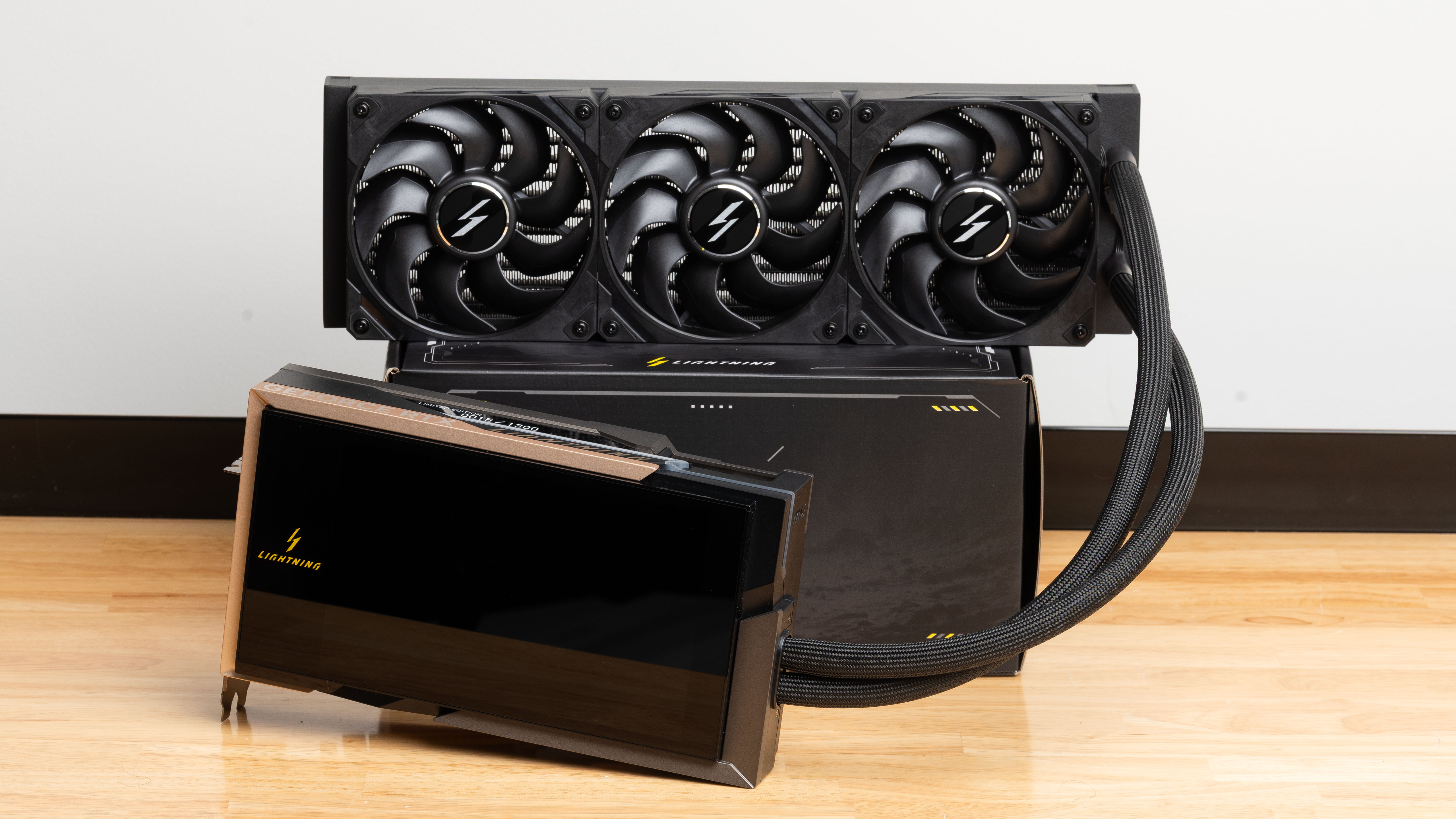
On the outside, MSI has covered most of the face of this card with an 8” screen under a glass cover, plenty of real carbon fiber, subtle RGB LED lighting, and milled metal accents to hold it all together.
It’s a six-pound brick of solid precision, a true statement piece that will unmistakably mark your build as the best of the best. And only a select few PC builders and extreme overclockers will be able to enjoy that distinction, as only 1300 of these cards will be produced.
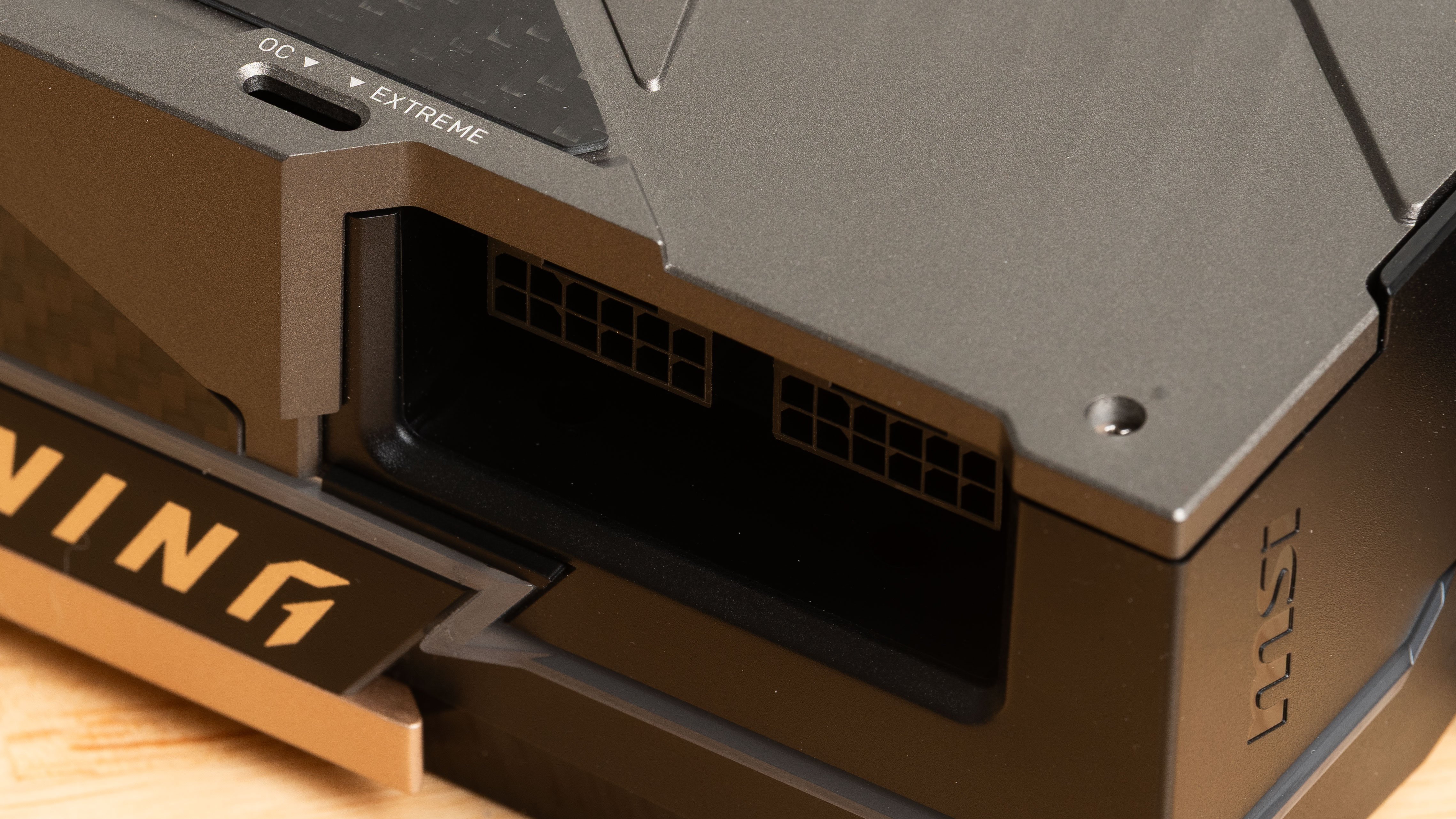
To make use of the extra current capacity of the dual 12V-2x6 connectors, MSI’s default “OC” vBIOS has a power limit of 800W. The second “Extreme” vBIOS ups that to 1000W. We’ll explore how each of these vBIOS modes affects gaming performance in our benchmarks.
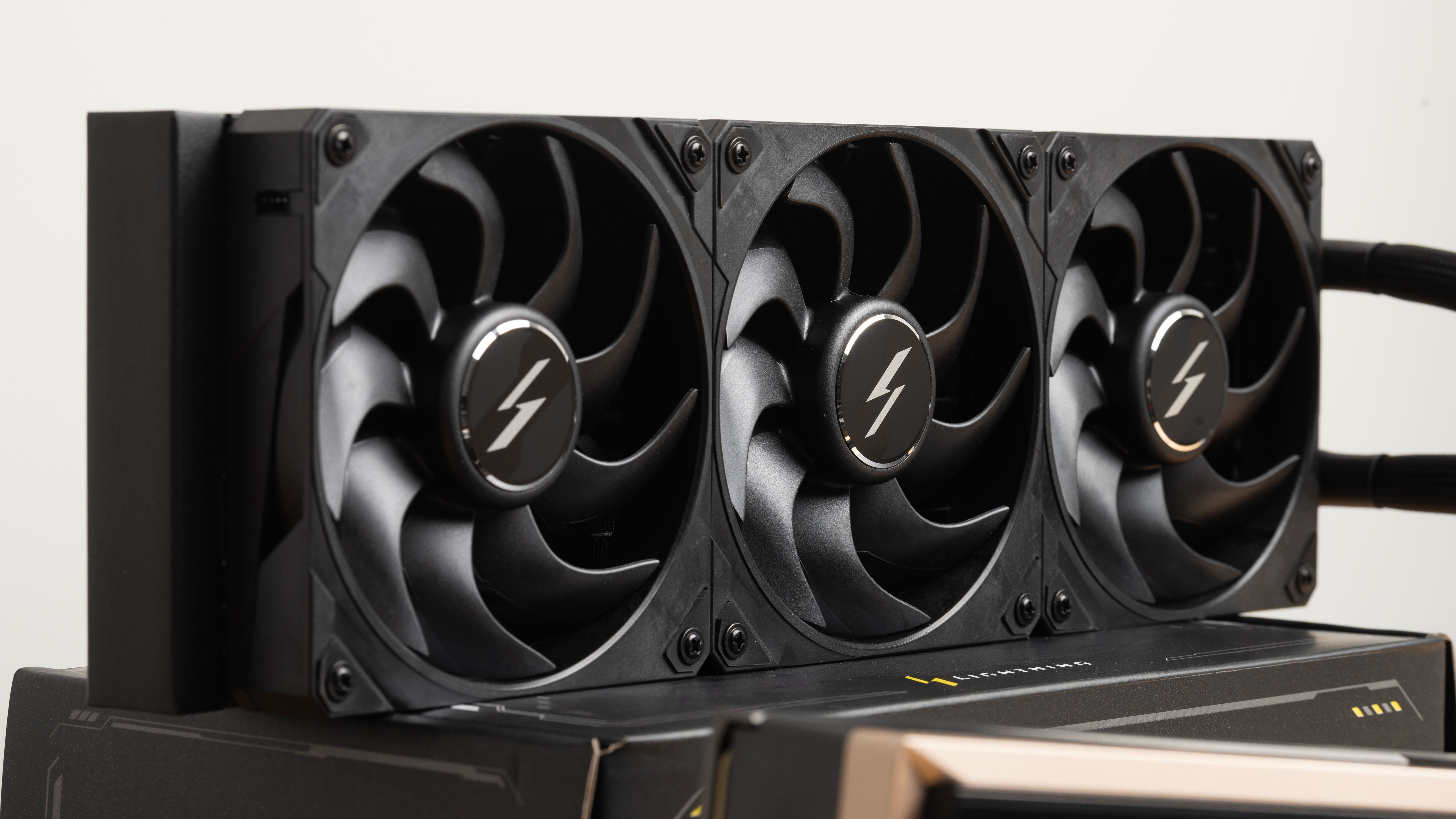
To help dissipate all of those watts, MSI has milled out a full-coverage copper water block that directly cools the GB202 GPU, GDDR7 memory, and the 40-phase VRM on the Lightning Z’s PCB. Coolant travels between the card and a standard-thickness 360mm radiator.
This cooling design obviously requires a case with an appropriate radiator mount, but I’m a fan of it for such high-wattage graphics cards as this. The RTX 5090 Founders Edition cooler blows all its exhaust right onto your CPU socket and RAM, while this remote radiator lets you direct its exhaust directly out of the case with the right enclosure.
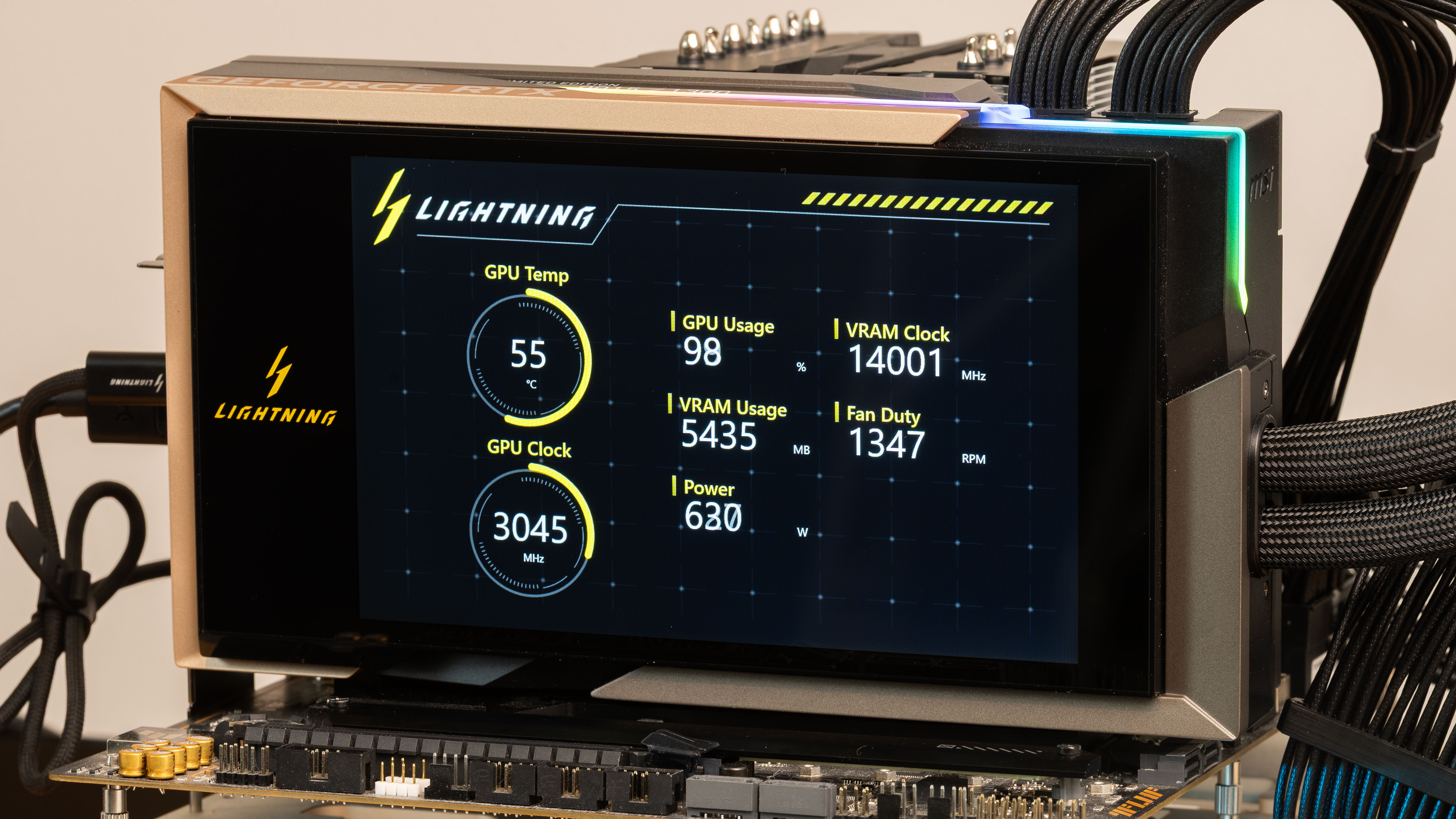
The 8” screen on the face of the card makes a statement, but it’s a little fiddly. To even power it on, you need to plug in an included USB Type-A-to-C cable and install a USB display driver. Without the cable plugged in, the screen remains black.
Once it’s up and running, you can do anything with the display that you would with a second monitor in Windows. MSI lets you put GPU stats on the screen through the MSI Center utility, or you could put your favorite looping video on there to set the mood. Yes, we even played Doom on it.
But as you launch games, you might see the second screen flicker or drop back to a tiny Windows desktop if the overlay has a hiccup, which isn’t a huge deal but also isn’t the most refined experience.
To help show off the screen in a system, MSI has also included a nicely made vertical mounting bracket with the Lightning Z that mounts on the existing expansion brackets of ATX mid-towers. It can be adjusted on both the X and Z axes to put the card right where you want it in your case.
It’s always tricky to call something the first or the best of its class, and the Lightning Z isn’t the first extreme RTX 5090 design out there.
Asus’s ROG Matrix Platinum RTX 5090 – also only made in an extremely limited edition of 1000 – also offers an 800W TGP, but you have to pair it with one of the company’s proprietary BTF motherboards to fully unlock its capabilities. And its air-cooled design might explain why it doesn’t offer an even higher power envelope as an option, as the Lightning Z does.
The RTX 5090 Lightning Z can be used with any motherboard and power supply that has the requisite dual 12V-2x6 connectors, and that more open approach appeals to my PC-building heart. Let’s see what it can do.
Our testing methods
We conducted our tests using our trusty GPU test platform, which includes the following components:
Swipe to scroll horizontally
Tom’s Hardware 2026 GPU Test Platform | |
CPU | AMD Ryzen 7 9800X3D |
CPU Cooler | Thermalright Phantom Spirit 120 SE |
Motherboard | Asus TUF Gaming X670E-Plus Wifi |
Memory | G.Skill Trident Z5 DDR5-6000 |
SSD | Inland Performance Plus 4TB |
Power supply | MSI MPG Ai1600TS |
Monitor | Asus ROG Strix XG27UCS, 4K 160Hz |
Until just recently, our test rig relied on a 1000W PSU, but that’s obviously not enough to handle both our host CPU and motherboard along with the RTX 5090 Lightning Z.
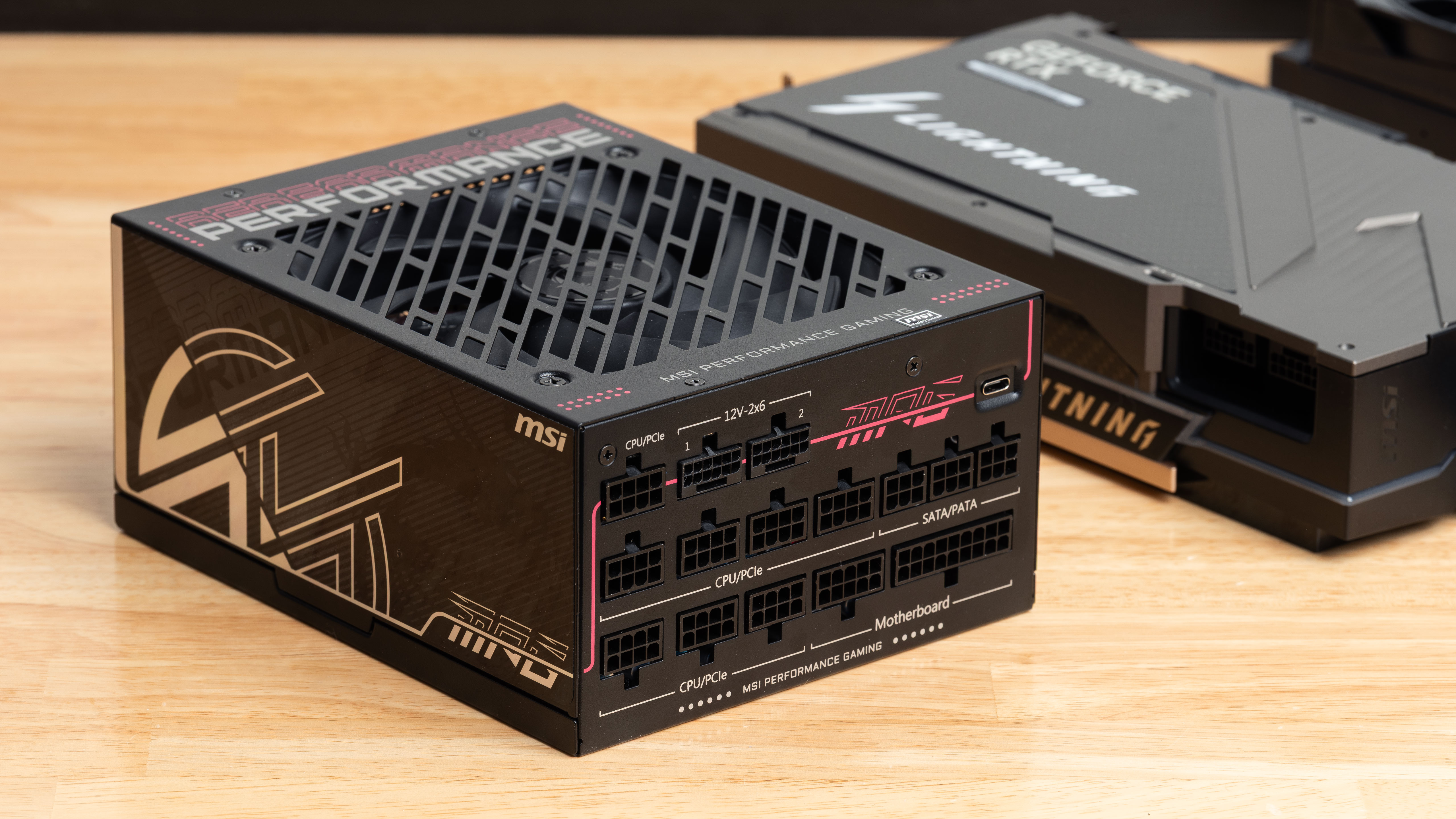
To give us sufficient power to energize the RTX 5090 Lightning Z, MSI also sent over its brand-new MPG Ai1600TS PSU. This 1600W unit features a rare fully digital topology, 80 Plus Titanium efficiency, and dual 12V-2x6 connectors. Our thanks to MSI for providing us with this top-tier PSU for our testing.








 English (US) ·