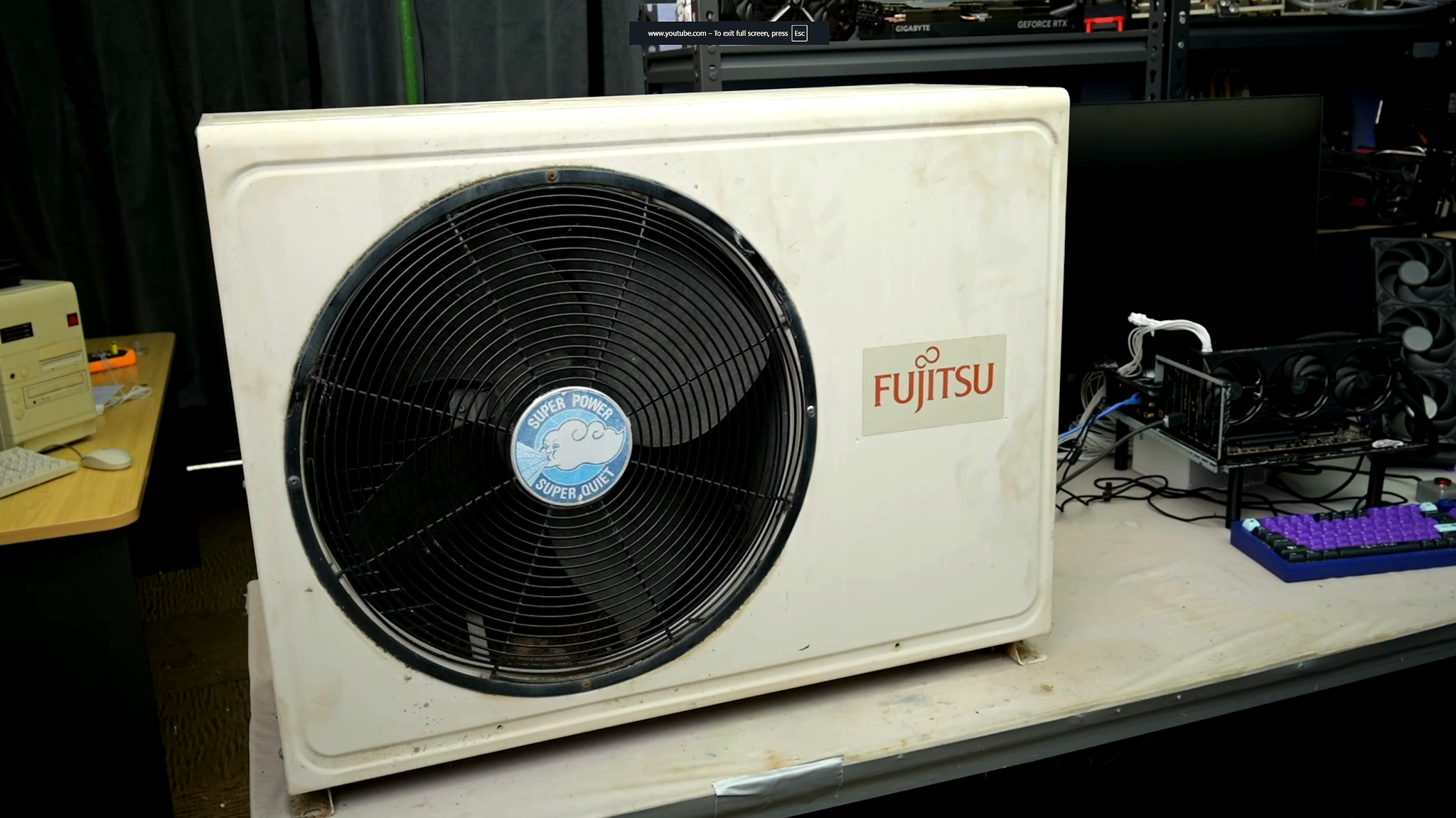
Just like we suspected, our fellow Australian hardware examiner TrashBench is up to shenanigans again. Not too long ago, after putting a graphics card in the "wrong" place for much better cooling results, he's ... thinking bigger, let's put it that way. He took an old 4-kW outdoor radiator-fan unit from a split air-conditioning setup (sans gas) and hooked it up to a water-cooling loop to assess its performance.
He kicked off the video with his best impression of Crocodile Dundee, and set out to rearrange the unit for the task at hand, as he only needed the actual radiator, fan, and pump. Most of the fiddly guts were taken out, and casters were added for convenience. TrashBench then added a bog-standard reservoir to the main enclosure.
I Made a Radiator From an Old AC. GPU Temps Dropped 39°C - YouTube
Moving on to the PC side, he converted a T-joint into a Y-joint with judicious application of heat and force, and, being the ever-clever craftsman, designed 3D-printed mounting brackets for the various cold plates. It was around this time that it was made certain he'd be successful, as at 02:49 you can see that his knuckles paid the requisite blood toll to the machine god.
After firing up the entire system, he set to benchmarking, enlisting both a modern RTX 5060 and a hotter, earlier RTX 3080 for the process. The 5060 is a very power-efficient GPU, and its temperature with the standard cooler was a tame 52ºC. However, the mighty power of four kilowatts' worth of cooling brought that down to just 33ºC, around the temperature of lukewarm water, and a 16ºC drop altogether.
With such a wide thermal range to work with, he set out to overclock the living daylights out of the GPU, moving the boost clock needle from 2902 MHz up to 3300 MHz. Despite the 14% clock-speed improvement, average FPS saw a mere 3% uplift, clearly highlighting how perfectly Nvidia has the power/performance curve dialed in since the RTX 2000 series.
He then moved on to the RTX 3080, a beastly, much more power-hungry card that could provide a worthy challenger for the Fujitsu radiator. It was promptly defeated, and its temperature went from 65ºC down to just 28ºC, or in other words, not much above ambient. Overclocking this card, however, also yielded a mere 3% fps, barely worth the man's time.
The final challenge was seeing how well the teeny weeny Fujitsu could handle a combined GPU and CPU load. The processor on hand was probably the worst possible consumer chip to try and keep cool, the lightning-fast and flame-hot Intel Core i9 14900K.
Get Tom's Hardware's best news and in-depth reviews, straight to your inbox.
TrashBench hooked it up and saw CPU temperatures drop 18ºC down to 76ºC, a strong achievement for this silicon outside of rooms with liquid nitrogen buckets. As for the graphics card, its heat sensor simply didn't move at all, suggesting that the radiator had far greater headroom than TrashBench had hardware.
Bruno Ferreira is a contributing writer for Tom's Hardware. He has decades of experience with PC hardware and assorted sundries, alongside a career as a developer. He's obsessed with detail and has a tendency to ramble on the topics he loves. When not doing that, he's usually playing games, or at live music shows and festivals.

 4 hours ago
14










 English (US) ·